

Relevance: GS III
Why in News
A settlement plan for stockbrokers under regulatory scrutiny for working with unregulated algorithmic (algo) trading platforms was recently revealed by the Securities and Exchange Board of India (SEBI).
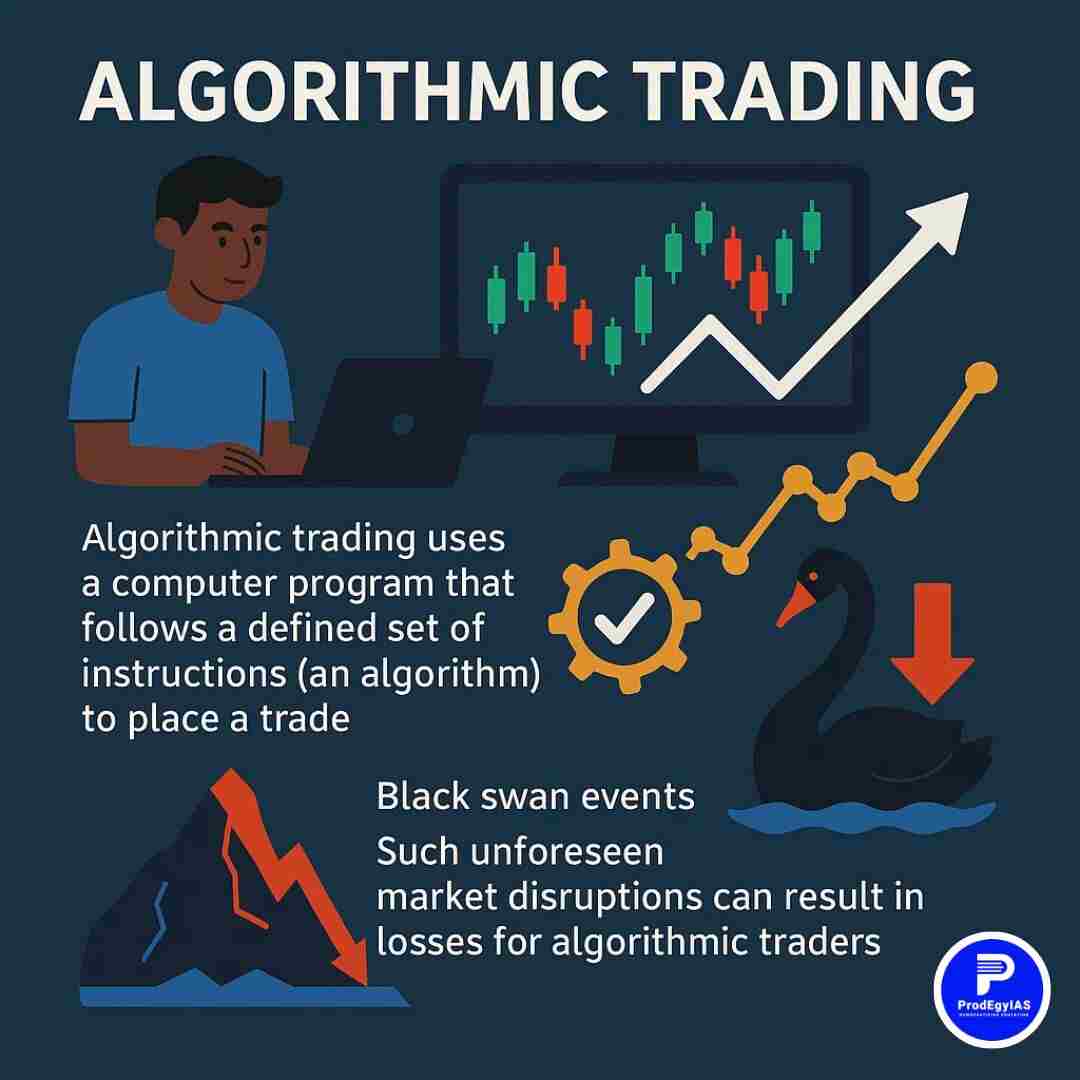
Algorithmic Trading:
A computer program that executes a predetermined set of instructions (an algorithm) is used in algorithmic trading, also known as automated trading, black-box trading, or algo-trading, to execute trades.
- It executes trades at exact times by fusing financial markets with computer programming.
- Theoretically, the deal can produce profits more quickly and frequently than a human trader could.
- The specified sets of instructions can be based on any mathematical model, timing, cost, or quantity.
- In India, both institutional and individual investors use algorithm trading. In addition to providing traders with opportunities for profit, algo-trading makes markets more liquid and trading more methodical by removing the influence of human emotions on trading behavior.
Black Swan Events: In order to forecast future market movements, algorithmic trading uses mathematical models and past data. Black swan occurrences, or unanticipated market shocks, can happen, though, and cause algorithmic traders to lose money.
MCQ. Consider the following statements regarding Algorithmic Trading:
Which of the statements given above is/are correct? A. 1 and 2 only B. 1 and 3 only C. 2 and 3 only D. 1, 2, and 3 Correct Answer: B |
Practice Question: “Algorithmic trading has increased efficiency in financial markets but also introduced systemic vulnerabilities.” Examine the statement with reference to the concept of Black Swan events and the Indian regulatory framework.
Source: Sebi offers settlement window to stock brokers in algo trading case
UPSC General Studies Paper Preparation
| Topic | |
| UPSC Syllabus | GS Genius-50 Program |
| Public administration crash course | UPSC GS Mains 2025 Study Material |
| About the Author: Nitin Kumar Singh |