UPSC Mains · General Studies Paper IV
UPSC Civil Services · General Studies Paper IV

Ethics Foundation Course for UPSC Mains

You may understand Ethics, Integrity & Aptitude in theory, but the real challenge is using those concepts when UPSC asks you to analyse an ethical issue, justify a decision or solve a case study. This GS Paper IV course helps you make that shift through conceptual clarity, ethical reasoning, structured answer writing, and case-study application with Ashutosh Pandey Sir.

  • GS Paper IV
  • Ethics Answer Writing
  • Case Studies
Ashutosh Pandey Sir Lead Faculty · 14+ Years of UPSC Mentoring Experience

New to Ethics? You can start here. No previous academic background in Ethics or Philosophy is required.

Admission Enquiry

Get Ethics Course Details

Get the current fee, course format, and access details.

Your details are used only for course counselling and admission assistance.

GS Paper IV Preparation Ethics Answer Writing Case-Study Practice Faculty Guidance
Course Overview

A Complete Ethics Course for UPSC GS Paper IV — Learn the Concept, Then Learn How to Use It

If you are preparing GS Paper IV — Ethics, Integrity & Aptitude, you will realise quite quickly that knowing the syllabus is the easier part. You may know what integrity, empathy, objectivity or accountability means, but UPSC can still ask you to explain why that value matters, apply it to an administrative situation, or take a position where two valid considerations are pulling in different directions.

That is where this Ethics Foundation Course for UPSC is focused. You first build clarity around the core GS 4 concepts, but you do not stop at definitions. The discussion moves into public service, governance, administrative situations and real-life examples so that you can understand where an ethical idea actually becomes useful in a Mains answer.

Case studies are handled in the same way. You are not expected to memorise a ready-made “ideal answer”. You learn to read the situation, identify the people affected, find the real ethical dilemma, recognise the values that may be competing with each other, and then examine the choices available. The final step is to explain why one course of action is more reasonable, ethical and workable than the others.

The GS Paper IV Learning Cycle

From understanding an Ethics concept to using it in an actual UPSC Mains answer.

  1. 01 Understand What the Concept Really MeansStart with Ethics, human values, attitude, aptitude, integrity, empathy and objectivity. Understand the meaning before memorising examples around it.
  2. 02 See Where It AppliesTake the concept out of the notes — see how it appears in public service, governance, institutional behaviour or an everyday administrative situation.
  3. 03 Find the Real Ethical IssueWhen a question or case study is given, ask who is affected, what is going wrong, and which values or duties are coming into conflict.
  4. 04 Think Through the Available ChoicesDo not jump to the most morally attractive option. Examine realistic alternatives, what each may lead to, and the practical constraints.
  5. 05 Build the Answer Around the QuestionUse the definition, thinker, example or governance reference only if it helps answer what UPSC has actually asked.
  6. 06 Take a Position and Justify ItMake the reasoning visible — explain why the decision is fair, workable and defensible on legality, empathy, accountability, feasibility and public interest.

Understand → Connect → Analyse → Decide → Write

ProdEgyIAS Results

Results from ProdEgyIAS students

See the UPSC ranks and marks secured by students mentored at ProdEgyIAS. These results reflect different preparation journeys, supported by concept teaching, answer-writing guidance and mentorship for UPSC Mains.

Suman Saurav Mohanty, AIR 9

AIR 9

299 in Pub Ad

Suman Saurav Mohanty

Karishma Nair, AIR 14

AIR 14

265 in Pub Ad

Karishma Nair

Rishita Gupta, AIR 18

AIR 18

312 in Pub Ad

Rishita Gupta

Ashwini Pandey, AIR 34

AIR 34

309 in Pub Ad

Ashwini Pandey

Mrunalee Joshi, AIR 36

AIR 36

265 in Pub Ad

Mrunalee Joshi

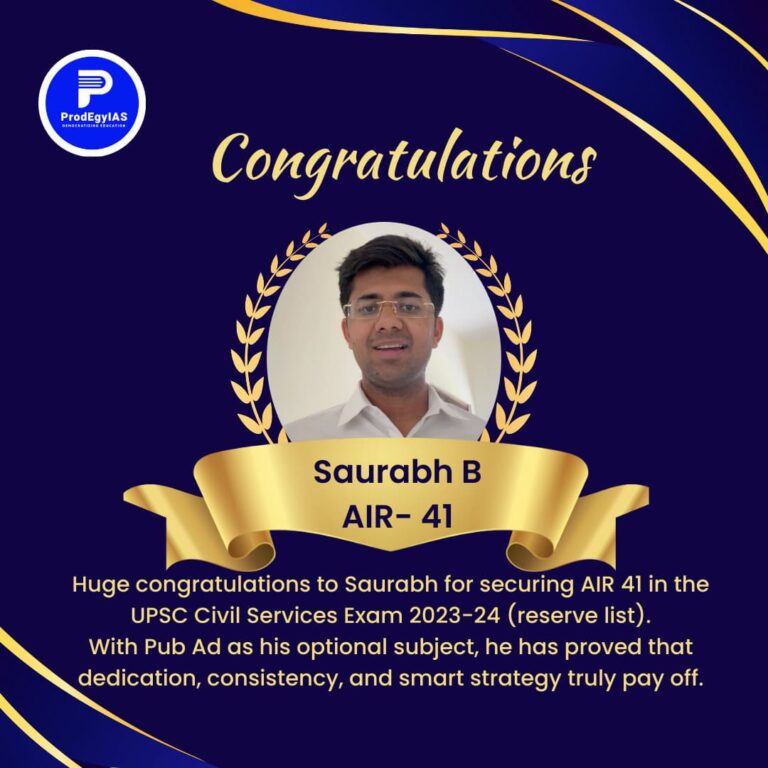
Saurabh B, AIR 41

AIR 41

265 in Pub Ad

Saurabh B

Deepankar Chowdhary, AIR 42

AIR 42

302 in Pub Ad

Deepankar Chowdhary

Rizwan Basha Shaik, AIR 48

AIR 48

309 in Pub Ad

Rizwan Basha Shaik

Khushali Solanki, Rank 61

Rank 61

274 in Pub Ad

Khushali Solanki

Deepesh Gaur, Rank 122

Rank 122

290 in Pub Ad

Deepesh Gaur

Achyuth Ashok, AIR 180

AIR 180

286 in Pub Ad

Achyuth Ashok

1,500+

UPSC selections

Including IAS, IPS and IFS

What these results represent. These are ProdEgyIAS institutional results achieved by students across the institute’s programmes, with the marks shown for Public Administration Optional — they are not results generated exclusively by this Ethics Foundation Course. They are shown here because the same teaching, mentorship and answer-writing guidance sit behind this programme. No rank or mark is guaranteed.

Your Preparation Stage

Where Are You Starting with GS Paper IV?

Whether you are beginning Ethics from the basics, know the syllabus but struggle to write answers, or find case studies difficult to structure, the programme brings theory, ethical reasoning and application into one GS 4 preparation framework.

  • Starting Ethics from the Basics Begin with the language and core concepts of Ethics, Integrity & Aptitude before moving towards application.
  • Know the Syllabus, Need Clarity Understand abstract ideas such as integrity, objectivity, empathy and accountability through situations and examples.
  • Theory Answers Feel Generic Move beyond dictionary-style definitions by learning how concepts, thinkers and examples support an actual argument.
  • Case Studies Feel Unstructured Learn how to identify stakeholders, ethical dilemmas, values at stake and realistic courses of action.
  • Need Better Ethical Reasoning Understand why different values may conflict and how to evaluate a decision instead of jumping to an instant moral conclusion.
  • Working on GS 4 Answer Writing Learn to organise definitions, arguments, examples and balanced judgement around the demand of the question.
  • Need Administrative Perspective Connect Ethics with public service, governance, accountability, probity, transparency and decision-making.
  • Preparing Alongside Other GS Papers Use a dedicated GS Paper 4 course to organise Ethics preparation instead of leaving it as an occasional self-study subject.
No previous Ethics background? You can start here.

GS Paper IV does not require a degree in Philosophy or Ethics. The programme begins with concepts and progressively moves towards answer writing, ethical judgement and case-study application.

Course Features

Everything You Need to Build Strong GS Paper IV Preparation

This UPSC Ethics course brings together concept building, Ethics answer writing, case-study analysis, administrative examples and faculty guidance. Each part addresses a different demand of GS Paper IV — from explaining an ethical value to deciding what should be done when values or interests conflict.

01 — Build Concepts

Understand Ethics Before Memorising It

  • Ethics & Human Interface
  • Human values
  • Attitude & aptitude
  • Integrity & objectivity
  • Emotional intelligence

02 — Build Reasoning

Learn to Think Through Ethical Questions

  • Identify the ethical issue
  • Recognise competing values
  • Examine different viewpoints
  • Evaluate consequences
  • Build balanced judgement

03 — Write Theory Answers

Turn Concepts into GS 4 Answers

  • Understand question demand
  • Use relevant definitions
  • Bring thinkers where useful
  • Add administrative examples
  • Write reasoned conclusions

04 — Solve Case Studies

Approach Ethical Dilemmas Step by Step

  • Identify stakeholders
  • Identify values at stake
  • Develop realistic options
  • Compare merits and demerits
  • Justify the final course of action

05 — Connect with Governance

Apply Ethics to Public Administration

  • Public-service values
  • Accountability & transparency
  • Conflict of interest
  • Probity in governance
  • Ethical governance

06 — Add Value to Answers

Use Examples Without Forcing Them

  • Administrative examples
  • Real-life examples
  • Thinkers and quotations
  • Governance references
  • Practical judgement
Signature Feature

The Ethics Application Method: From Dilemma to Decision

In a GS Paper IV case study, you cannot begin with the answer. First you need to understand the situation properly: who is affected, what the real ethical issue is, which values are in conflict, and what practical choices are actually available. Once that is clear, the case becomes much easier to examine logically instead of writing a generic moral response.

That is the approach followed in this programme. You learn to work through stakeholders, competing values, consequences and possible courses of action before arriving at a decision. The same thinking also helps in theory answers, where definitions, thinkers and examples are useful only when they support the argument you are making.

TheoryGS Paper IV concepts
ReasoningEthical judgement
Case StudiesDilemma to decision
AnswersMains application
  1. 1 Read the Situation Understand the actual administrative or ethical problem before deciding what should happen.
  2. 2 Identify stakeholders List the individuals, institutions and groups affected by the decision.
  3. 3 Find the Dilemma Recognise the ethical issue and the values that are competing with each other.
  4. 4 Examine the Options Consider realistic courses of action instead of jumping directly to one ideal solution.
  5. 5 Weigh the Consequences Look at legality, fairness, feasibility, empathy, accountability and public interest.
  6. 6 Decide & Justify Choose a practical course of action and explain why it is preferable.

Understand the situation. Evaluate the choices. Justify the decision.

Course Structure

Complete GS Paper IV — Ethics, Integrity & Aptitude Coverage

The GS Paper 4 Ethics Course follows the major areas of the UPSC syllabus while connecting theory with administrative application, Ethics answer writing and case studies. Concepts are first understood on their own, then examined through public-service situations and question-based application.

GS Paper IVEthics, Integrity & Aptitude
250 MarksGeneral Studies Paper IV in UPSC Mains
Theory + Case StudiesBoth forms are part of the official paper
Mains-OrientedConcept, reasoning and application

Theory & Concepts

Unit 01

Ethics & Human Interface

  • Essence of Ethics
  • Determinants of ethical behaviour
  • Dimensions of Ethics
  • Ethics in public and private relationships
Unit 02

Human Values

  • Human values
  • Sources of values
  • Family, society and institutions
  • Values in public life
Unit 03

Attitude & Aptitude

  • Attitude
  • Moral and political attitudes
  • Social influence
  • Aptitude
  • Foundational Civil Service values
Unit 04

Integrity & Public-Service Values

  • Integrity
  • Impartiality
  • Non-partisanship
  • Objectivity
  • Dedication to public service
  • Empathy, tolerance & compassion
Unit 05

Emotional Intelligence & Thinkers

  • Emotional intelligence
  • Application in administration
  • Moral thinkers
  • Ethical thinkers
  • Philosophers from India and the world
Unit 06

Ethics in Public Administration

  • Ethical concerns in administration
  • Accountability
  • Conflict of interest
  • Ethical governance
  • Laws, rules and conscience
Unit 07

Probity in Governance

  • Probity
  • Transparency
  • Right to Information
  • Code of Ethics
  • Code of Conduct
  • Work culture
  • Corruption
  • Quality of public-service delivery

Answer Writing & Case Studies

Unit 01

Understanding the Question

  • Directive words
  • Question demand
  • Ethical issue being tested
  • Relevant concept selection
Unit 02

Building Theory Answers

  • Definitions
  • Key ethical terms
  • Thinkers
  • Examples
  • Balanced conclusions
Unit 03

Administrative Examples

  • Governance situations
  • Public-service dilemmas
  • Accountability examples
  • Transparency and probity
  • Public-interest considerations
Unit 04

Stakeholder Analysis

  • Primary stakeholders
  • Secondary stakeholders
  • Institutional interests
  • Vulnerable groups
  • Public interest
Unit 05

Ethical Dilemmas & Competing Values

  • Values at stake
  • Competing duties
  • Conflict of interest
  • Legality vs empathy
  • Individual vs institutional responsibility
Unit 06

Courses of Action

  • Generate alternatives
  • Merits and demerits
  • Immediate implications
  • Long-term implications
  • Feasibility
Unit 07

Decision & Justification

  • Select the practical option
  • Explain the ethical basis
  • Protect public interest
  • Maintain accountability
  • Suggest longer-term measures where required
How Ethics is taught

This Ethics Foundation Course uses a concept-first approach, but the concept is not left as a definition. Relevant topics are connected with public administration, governance, examples and UPSC-style questions. In case studies, the emphasis is on identifying the actual ethical problem, evaluating realistic options and explaining the reasoning behind the final decision.

Ready to Work on GS Paper IV More Systematically?

GS Paper IV theory · Ethical reasoning · Answer writing · Case-study preparation

Enrol in the Ethics Course
Fee Structure

Ethics Foundation Course Fee & What the Programme Covers

Speak with the admission team to confirm the current UPSC Ethics Course fee, programme format and access details before you enrol.

Ethics Foundation Programme

GS Paper IV — Ethics, Integrity & Aptitude

Fee on requestcurrent fee to be confirmed

  • GS Paper IV theory
  • Ethics, Integrity & Aptitude
  • Ethical reasoning
  • Answer-writing guidance
  • Case-study preparation
  • Administrative application
Talk to Admission Team

The current fee has not been reconfirmed in the latest course information — please confirm it with the admission team before enrolling.

Admission Guidance

Mrs. Reena Pandey — Co-Founder and Admission Counsellor, ProdEgyIAS Mrs. Reena Pandey Co-Founder · Admission Counsellor, ProdEgyIAS

For the latest fee, programme format, access and enrolment details, speak with the admission team before completing registration. Call or WhatsApp +91-9990757586.

What the programme covers

GS Paper IV theory, ethical reasoning, answer-writing guidance, case-study preparation and administrative application — taught so that concepts, examples and judgement come together inside an actual Mains answer.

Before you enrol

You can also discuss whether you need complete GS Paper IV preparation or more focused help with answer writing and case studies. Email info@prodegyias.com.

Admission Enquiry

Have a Question Before Joining the Ethics Course?

Get the latest programme details, fee, learning format and admission information. You can also discuss whether you need complete GS Paper IV preparation or more focused help with answer writing and case studies.

  • Confirm current Ethics course details
  • Ask about programme format
  • Understand current fee and access
  • Get admission and enrolment guidance

Your details are used only for course counselling and admission assistance.

Demo Classes

Watch GS Paper IV Ethics Classes Before You Decide

Explore selected Ethics classes for UPSC, concept discussions and academic videos by Ashutosh Pandey Sir. See how ethical concepts, administrative examples, answer writing and case-study reasoning are explained before you choose the programme.

Our Faculty

Learn GS Paper IV with Ashutosh Pandey Sir

Students searching for the best Ethics teacher for UPSC usually need to look beyond a faculty name. What matters is whether the teacher can explain abstract ethical concepts, connect them with public administration, and show how that reasoning changes the way a theory answer or case study is written.

Ashutosh Pandey Sir — Founder and Lead Faculty, ProdEgyIAS

Ashutosh Pandey Sir

Founder & Lead Faculty · Ethics / GS Paper IV

With 14+ years of UPSC mentoring experience, Ashutosh Pandey Sir’s academic work includes Ethics, governance, Public Administration, answer writing and preparation guidance. His Ethics teaching focuses on moving from concept to application, particularly where a candidate has to evaluate a dilemma, balance competing values or justify an administrative decision.

  • 14+ Years of UPSC MentoringExperience teaching and guiding Civil Services aspirants.
  • Ethics & GS Paper IVCovers concepts, public-service values, probity and ethical reasoning.
  • Case-Study GuidanceFocus on stakeholders, dilemmas, alternatives and justified decisions.
  • Answer-Writing ApproachDefinitions, examples, reasoning and balanced judgement for GS Paper IV.
Additional

Why GS Paper IV Deserves Serious Attention in UPSC Mains

GS Paper IV carries 250 marks in the written Mains examination. UPSC uses the paper to test attitude, integrity, probity, public-service values and the way candidates approach practical conflicts and problems, including through case studies.

250 MarksOne full General Studies paper
Ethics + AptitudeConcepts and public-service values
Theory QuestionsExplanation, analysis and application
Case StudiesDecision-making under ethical conflict
What this means in practice

A strong GS Paper IV score can make a meaningful difference within the written Mains total, but no course can promise a particular score. The practical objective is to reduce generic answers and improve the quality of reasoning, examples and decision-making visible in the paper.

Student Feedback

What Students Say About Learning with ProdEgyIAS

Student feedback can help you understand the broader teaching and mentoring environment at ProdEgyIAS, including concept explanation, faculty accessibility, answer-writing guidance and preparation support.

Suman Saurav Mohanty Suman Saurav MohantyAIR 9 · Public Administration 299

What I valued most was Ashutosh Sir’s way of making me think about Public Administration rather than simply memorise material. His discussions on concepts, PYQs and answer structure gave me much more clarity. Even outside regular teaching, I could approach him whenever I needed direction in my preparation.

Karishma Nair Karishma NairAIR 14 · Public Administration 265

Ashutosh Sir was always more than just a faculty member for me. There were stages in my preparation when I needed clarity not only about the subject, but also about how to manage the pressure and stay focused. His practical guidance during those phases helped me approach preparation with a calmer mind.

Rishita Gupta Rishita GuptaAIR 18 · Public Administration 312

Scoring 312 in Public Administration was very special for me. What I remember most from my preparation is the depth with which Ashutosh Sir discussed the subject. He constantly pushed me to connect concepts, understand the demand of questions and think about how an argument would actually work in an answer.

Ashwini Pandey Ashwini PandeyAIR 34 · Public Administration 309

Answer writing was one area where I needed much more clarity. The discussions with Ashutosh Sir helped me understand that knowing a topic and writing a good UPSC answer are two different things. His emphasis on question demand, structure, interlinking and relevant content gradually changed the way I approached answers.

Mrunalee Joshi Mrunalee JoshiAIR 36 · Public Administration 265

One thing I really appreciated about Ashutosh Sir was that I could speak to him when I felt stuck in my preparation. He would listen to the actual problem before suggesting what to do next. That personal accessibility mattered a lot, especially during phases when preparation started feeling overwhelming.

Saurabh B Saurabh BAIR 41 · Public Administration 265

Ashutosh Sir helped me look at Public Administration as a connected subject rather than a collection of separate topics. His way of linking theory, Indian Administration, PYQs and current issues made revision more meaningful. It also helped me understand how the same concept could be applied differently depending on the question.

Deepankar Chowdhary Deepankar ChowdharyAIR 42 · Public Administration 302

For me, one of the most useful parts of the preparation was discussing answers after understanding what the question actually demanded. Ashutosh Sir would focus on approach, structure and application rather than just adding more content. That helped me become much more conscious about what I was putting into an answer and why.

Rizwan Basha Shaik Rizwan Basha ShaikAIR 48 · Public Administration 309

What stood out for me was the seriousness with which Ashutosh Sir taught Public Administration. Thinkers, administrative concepts and answer structure were not treated as isolated areas. The discussions helped me connect them while writing. Whenever I needed clarity about preparation or revision, I also had the opportunity to reach out and discuss it.
Study Material

Ethics Study Resources Built Around GS Paper IV Preparation

The programme’s academic resources support concept learning, Ethics answer writing and case-study application. The emphasis stays on organising and applying what you study rather than collecting large volumes of disconnected Ethics notes.

Concept & Answer-Writing Resources

Use the material to revise important GS Paper IV concepts and understand how they can be used in theory answers.

  • Ethics concepts & definitions
  • Human values
  • Attitude & aptitude
  • Emotional intelligence
  • Civil-service values
  • Thinkers & examples
  • Governance references
  • Answer-writing inputs

Case-Study Practice Resources

Resources for working through ethical situations and practising reasoned decision-making.

  • Stakeholder analysis
  • Ethical dilemmas
  • Values at stake
  • Competing values
  • Courses of action
  • Merits and demerits
  • Decision justification
  • Administrative application
More from ProdEgyIAS

Explore Other UPSC Courses & Mentorship Programmes

Already preparing for Public Administration Optional, looking for Mains revision, or need a dedicated answer-writing programme? Explore the other ProdEgyIAS courses according to your current preparation requirement.

Public Administration

Public Administration Foundation Course

Build Paper I and Paper II from the fundamentals through classes, PYQs, answer writing and faculty guidance.

  • Complete Optional preparation
  • Paper I + Paper II
  • DRAW answer writing
View Foundation Course

Mains Revision

Public Administration Crash Course

Already completed the syllabus once? Revise Public Administration for Mains through module-wise revision, PYQs, interlinking and answer enrichment.

  • Mains-focused revision
  • Paper I + Paper II
  • PYQ-oriented preparation
View Crash Course

Answer Writing & Mentorship

Answer Writing & Mentorship Programme

Revisit the Optional through PYQ frameworks, weekly writing, submission, written feedback and mentorship.

  • 16 weekend cycles
  • Weekly answer writing
  • Written feedback
View Mentorship Programme

Ready to Work on GS Paper IV More Systematically?

Have a question about the Ethics Foundation Course, current fee, programme format or case-study preparation? Speak with the ProdEgyIAS admission team before you decide.

Confirm the Current Programme Format and Fee Before You Join

Contact Mrs. Reena Pandey: +91-9990757586 | info@prodegyias.com | www.prodegyias.com

Frequently Asked Questions

Questions Students Ask Before Choosing an Ethics Course for UPSC

From GS Paper IV syllabus coverage and Ethics answer writing to case studies, faculty and course format, these are some of the questions students commonly consider while comparing an Ethics course for UPSC Mains.

What does an Ethics Foundation Course for UPSC actually cover?

A proper Ethics Foundation Course for UPSC should cover the major areas of GS Paper IV — Ethics, Integrity & Aptitude, including human values, attitude, aptitude, emotional intelligence, public-service values, Ethics in Public Administration and probity in governance. At ProdEgyIAS, the academic approach also connects these concepts with answer writing, ethical reasoning and case-study application.

Is Ethics an optional subject in UPSC or part of General Studies?

Ethics is not an optional subject. It is General Studies Paper IV — Ethics, Integrity and Aptitude in UPSC Mains. This distinction matters because Ethics preparation should be planned as part of the GS Mains strategy, with theory questions and case studies approached according to the demands of GS Paper IV.

Can a beginner join an Ethics course without studying Philosophy?

Yes. You do not need a Philosophy or Ethics academic background to begin GS Paper IV preparation. The course can start with fundamental concepts such as values, attitude, integrity, objectivity and emotional intelligence before moving towards administrative application, answer writing and ethical case studies.

How should I choose the best Ethics course for UPSC?

Do not judge only by the course title or the number of lectures. Check whether the programme covers GS Paper IV theory, Ethics answer writing and case studies together. Also see how examples are used, whether administrative situations are discussed, how ethical reasoning is taught and whether the faculty helps students move beyond memorised definitions.

Who is the best Ethics teacher for UPSC, and what should I check before choosing faculty?

Instead of relying on a “best teacher” claim, look at the faculty’s actual role. Can the teacher explain abstract Ethics concepts clearly, connect them with governance and public administration, work through case studies, and show how reasoning should appear in a GS 4 answer? Ashutosh Pandey Sir has 14+ years of UPSC mentoring experience and teaches Ethics alongside governance and answer-writing guidance.

Does Ashutosh Pandey Sir teach Ethics and GS Paper IV at ProdEgyIAS?

Yes. Ashutosh Pandey Sir is the Founder and Lead Faculty at ProdEgyIAS. He mentors GS Paper II, III and IV, teaches Ethics and guides answer writing. His academic background also includes Public Administration and governance, which is relevant when Ethics concepts need administrative application.

How is Ethics answer writing different from simply knowing the theory?

Knowing that integrity, empathy or accountability is important does not automatically produce a good GS Paper IV answer. The question may ask you to examine, justify or apply an ethical idea. You therefore need to identify the demand, choose the relevant concept, develop the reasoning and use examples or thinkers only where they strengthen the argument.

Does the Ethics course include GS Paper 4 answer-writing guidance?

Yes. The Ethics academic approach includes structured, concept-based answers with administrative and real-life examples, governance references and balanced judgement. The focus is not on writing dictionary-style definitions, but on explaining why a concept matters and how it applies to the question being asked.

How should I approach UPSC Ethics case studies?

Start with the situation, not the final answer. Identify the stakeholders, the ethical issue, the values involved and any competing values. Then examine realistic courses of action, their merits, limitations and consequences. Your final decision should be practical and justified through relevant considerations such as legality, fairness, empathy, accountability and public interest.

Is there one correct answer to an Ethics case study?

Usually, there may be more than one defensible course of action. What matters is whether you have understood the ethical problem, considered the stakeholders and alternatives, and justified your decision logically. Reasoning and justification matter more than memorising a single model answer.

How do I identify stakeholders in a GS 4 case study?

List everyone who is directly or indirectly affected by the decision: individuals, vulnerable groups, government departments, institutions, colleagues, the public or any other relevant party. Stakeholder analysis helps you see whose rights, duties and interests may be affected before you decide what action is ethically and administratively reasonable.

What does “values at stake” mean in an Ethics case study?

These are the ethical principles or public-service values that the situation puts under pressure. A case may involve integrity, empathy, transparency, confidentiality, accountability or fairness. Sometimes two valid values compete. Recognising that conflict is important because it explains why the problem is genuinely difficult rather than a simple right-versus-wrong situation.

How can I make my GS Paper IV answers less generic?

Avoid relying only on broad moral statements such as “an officer should be honest.” Identify the exact concept being tested, explain it in the context of the question, and support the reasoning with a relevant administrative or real-life example. Where useful, thinkers, governance references or public-service values can add depth without making the answer look forced.

Should I memorise many quotations and thinkers for Ethics?

They can help, but they should not become the centre of your preparation. A thinker or quotation is useful when it clarifies your argument. If it is inserted simply because it was memorised, it can make the answer look artificial. Your own reasoning, relevance to the question and clarity of judgement remain more important.

Are PYQs useful for GS Paper IV Ethics preparation?

Yes. PYQs help you see how UPSC frames theory questions, repeats broad ethical themes and structures case-study situations. Ethics preparation is commonly organised around topic-wise PYQs, answer-writing sessions and case studies, which reflects how useful previous questions are for understanding the actual exam demand.

Should I prepare Ethics theory and case studies separately?

You can practise them separately, but they should not remain disconnected. Theory gives you the concepts and vocabulary; case studies test whether you can apply them. For example, integrity, empathy, accountability or conflict of interest become more meaningful when you can identify where they appear inside an administrative situation.

Is an online Ethics course for UPSC enough for GS Paper IV preparation?

An online Ethics course for UPSC can work if the format gives you organised concept coverage and enough application through answers and case studies. The learning mode alone is not the main issue. Check whether the course explains the syllabus properly, supports GS 4 answer writing, and teaches how to reason through ethical situations rather than only providing recorded notes.

Is there an Ethics course in Delhi at ProdEgyIAS?

ProdEgyIAS has its centre in Karol Bagh, New Delhi. The current Ethics delivery mode — classroom, online or recorded — should be confirmed with the admission team before enrolling.

What is the current fee for the ProdEgyIAS Ethics Foundation Course?

The current fee should be confirmed directly with the admission team. Older documents contain different prices for previous Ethics programme versions, so quoting one of those figures as the present Ethics course fee would be misleading.

How can I enquire about the ProdEgyIAS Ethics Foundation Programme?

You can submit the course enquiry form or contact the ProdEgyIAS admission team on 9990757586 by phone or WhatsApp. You can ask about the current Ethics Foundation Programme format, fee, access, learning mode and admission process before deciding whether the course matches your GS Paper IV preparation needs.

ProdEgyIAS Courses Prospectus — information brochure cover

Download ProdEgyIAS Information Brochure

Complete course details, batch schedule, study material list and fee structure — in one PDF.

DOWNLOAD
Visit / Contact

Visit ProdEgyIAS in Karol Bagh, New Delhi

If you are in Delhi and want to discuss the Ethics Foundation Programme in person, you can visit the ProdEgyIAS centre in Karol Bagh and speak with the team about GS Paper IV preparation, the current programme format, fee and admission details.

ProdEgyIAS
First Floor, Synergy IAS Library
16-A/2, Ajmal Khan Road, Block 16A, WEA
Karol Bagh, New Delhi – 110005
Get Directions

Contact ProdEgyIAS

Have a question about the UPSC Ethics Course? Speak with the admission team about GS Paper IV preparation, current programme format, fee or admission process.

Have a Question? Send Us an Enquiry

Share your details and our admission team will get back to you with the current Ethics Foundation Programme information you need.

Your details are used only for course counselling and admission assistance.

Scroll to Top

Public Administration

Foundation Course for UPSC 2027