

Answer:
Approach to the answer:
Recognizing the query: The question discusses how the British government changed after the 1857 uprising. Here, we must examine every facet of administration and, if relevant, contrast the modifications with those made prior to 1857.
Introduction: We might begin the response by briefly discussing the 1857 uprising.
- For Example: The “First War of Independence,” or Revolt of 1857, was the first major Indian attempt to overthrow British dominion. Under the de jure direction of the final Mughal Emperor, Bahadur Shah Zafar, it began on May 10, 1857, initially as the Sepoy Mutiny and then as a coordinated effort by Indian rulers.
Body: Since the question’s instruction is to provide a comparative study, we must first discuss the British modifications before outlining how they varied from the administration that existed prior to the 1857 uprising.
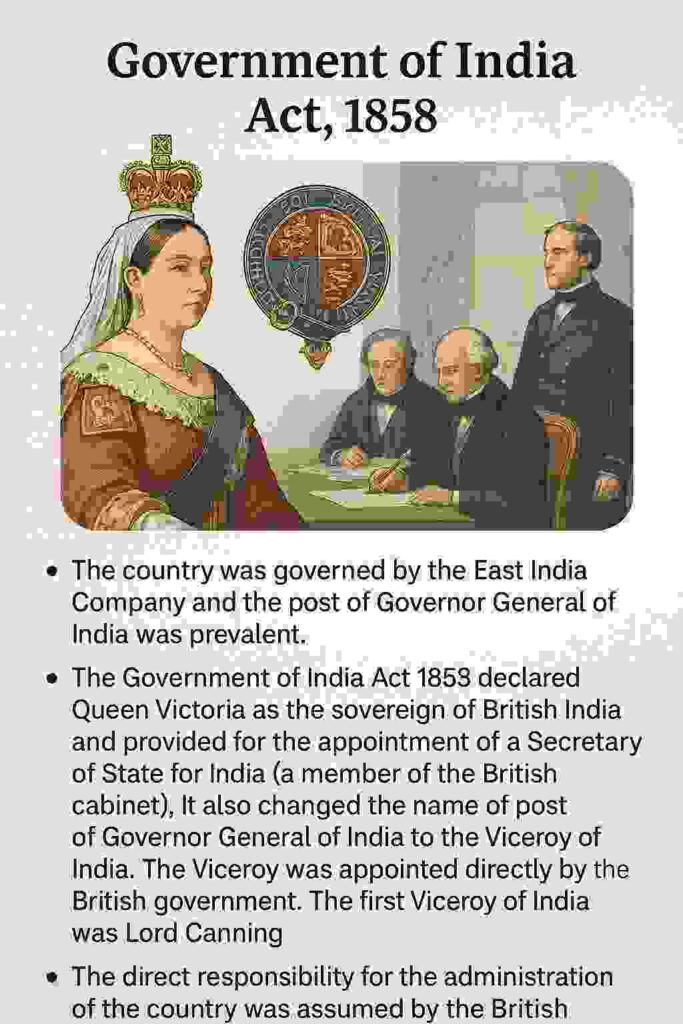
- Act of 1858 of the Government of India: The East India Company oversaw the nation, and the position of Governor General of India was widely held. Queen Victoria was proclaimed the sovereign of British India by the Government of India Act 1858, which also established the appointment of a Secretary of State for India, who would be a member of the British cabinet. Additionally, the Viceroy of India renamed the position of Governor General of India. The British government personally appointed the viceroy. Lord Canning was India’s first viceroy. Company rule was abolished and the British Crown took direct responsibility for the nation’s governance.
Conclusion: We might summarize the points made in the body part by outlining the effects of these developments or how they ultimately contributed to the rise of Indian nationalism.
- In addition to sparking political disputes, protests, and violent acts in the years that followed, the British administrative reforms implemented after 1857 deepened the divide between the governed and the ruled. These policies aided in the rise of communalism and caused issues for the Indian liberation movement.
Practice Question:
Question: The Government of India Act, 1858, signified the formal end of Company rule in India. In this context, analyse its key provisions and their implications for Indian governance. (Answer in 250 words)
MCQs
Question:What was/were the object/objects of Queen Victoria’s Proclamation (1858)? (UPSC 2014)
- To disclaim any intention to annex the Indian States.
- To place the Indian administration under the British Crown.
- To regulate East India Company’s trade with India.
Select the correct answer by using the codes given below.
(a) 1 and 2
(b) Only 2
(c) 1 and 3
(d) All of these
Answer (d)
UPSC General Studies Paper Preparation
| Topic | |
| UPSC Syllabus | GS Genius-50 Program |
| Public administration crash course | UPSC GS Mains 2025 Study Material |
| About the Author: Nitin Kumar Singh |