

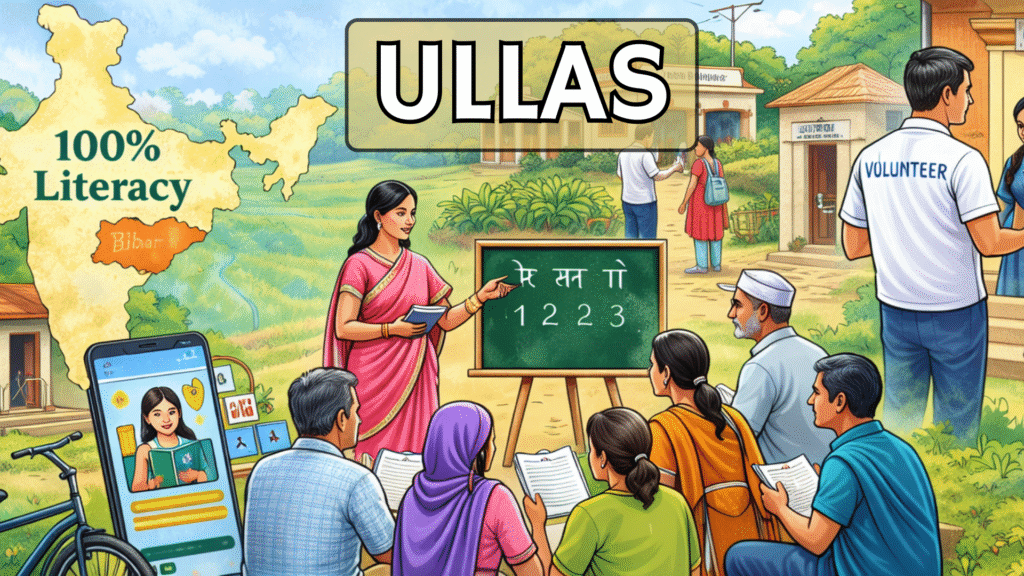
India’s greater commitment to social justice, equitable growth, and the development of human capital is reflected in its aim of 100% literacy. Beyond simply being able to read and write, literacy allows people to improve their quality of life, take advantage of economic possibilities, and actively engage in political processes. But according to recent assessments, Bihar is a significant barrier to India’s goal of achieving universal literacy by 2030, particularly with regard to the ULLAS (Understanding Lifelong Learning for All in Society) program.
ULLAS: India’s Adult Literacy Mission
The New India Literacy Programme, or ULLAS, is designed for those who are at least 15 years old and have never attended formal schooling. In addition to fundamental literacy, it covers digital literacy, important life skills, numeracy, and career knowledge. Volunteers, digital platforms, community involvement, and state-level ownership are essential for the program’s successful implementation.
Bihar’s Literacy Problem
Despite its demographic advantages, Bihar continues to have one of the lowest literacy rates in India, especially among women and marginalised communities. Historically, structural issues like high rates of poverty, migration, gender inequality, and poor educational infrastructure have hindered literacy accomplishments. As demonstrated by slow enrolment, inadequate volunteer mobilisation, and uneven monitoring, the issue is made worse by administrative opposition and a lack of governmental excitement for fully embracing the ULLAS objective.
Administration and Governance Gaps
The federal, state, local, and civil society governments must work closely together to implement the ULLAS program. Bihar’s progress is hampered by deficiencies in last-mile service, institutional capability, and data reliability. Outreach is further diminished by an over-reliance on digital platforms in areas with poor digital access. Furthermore, adult learners frequently put their livelihood ahead of their education, necessitating flexible and incentive-based learning methodologies that have not yet been successfully institutionalised.
Consequences for India’s Literacy Objective
The inequality in Bihar affects the entire country. Bihar’s progress is essential to reaching India’s overall literacy targets because of its big population. The goal of inclusive growth and lifelong learning may be jeopardised if state-specific constraints are not addressed, as this could lead to an increase in social and regional inequality.
The Path Ahead
State ownership, decentralised planning, community incentives, and strong monitoring systems are necessary to reach 100% literacy. Participation can be increased by bolstering Panchayati Raj Institutions, combining literacy with skill and livelihood programs, and customising ULLAS to local socioeconomic circumstances.
To sum up
Uniform policy recommendations are essential to the success of India’s literacy drive. In order to fully realise literacy’s revolutionary potential as a basis for political and economic empowerment, it is necessary to address Bihar’s particular ULLAS difficulties in addition to meeting numerical targets.
UPSC General Studies Paper Preparation
| Topic | |
| UPSC Syllabus | UPSC Free Notes |
| UPSC Optional Subjects | Khushhali Solanki (AIR 61, UPSC CSE 2023) |
Public Administration Optional Exam Preparation
Topic | |
About the Author: Jyoti Verma