

Relevance: GS III Economics
Why in News:
The Central Government provides all funding and implementation for Central Sector (CS) programs, which are related to topics specified in the Constitution’s Union List.
Important Points
The relevant Ministry or Department will designate an organization, such as a State agency, PSU, or autonomous body, as the Central Nodal Agency (CNA) to carry out each Central Sector Scheme.
- Ministries should identify any savings early, particularly by the third quarter, and realistically forecast scheme budgets. Unused monies will expire at the end of the fiscal year and cannot be carried over.
- No more than 25% of funds should be distributed all at once; instead, they should be given only when necessary.
- Additional releases are contingent upon fulfilling all prior requirements and utilizing 75% of the initial cash.
- The system makes sure that funds are spent, not just stored, by restricting releases to 25% at a time and requiring 75% prior use.
- Creating a connection between the appropriate use of previous money and the release of future funds helps implementing agencies become more financially disciplined.
Note: Stay informed about the most recent UPSC current Affairs, where we provide clear explanations of the major stories.
Reforms to Strengthen Central Schemes
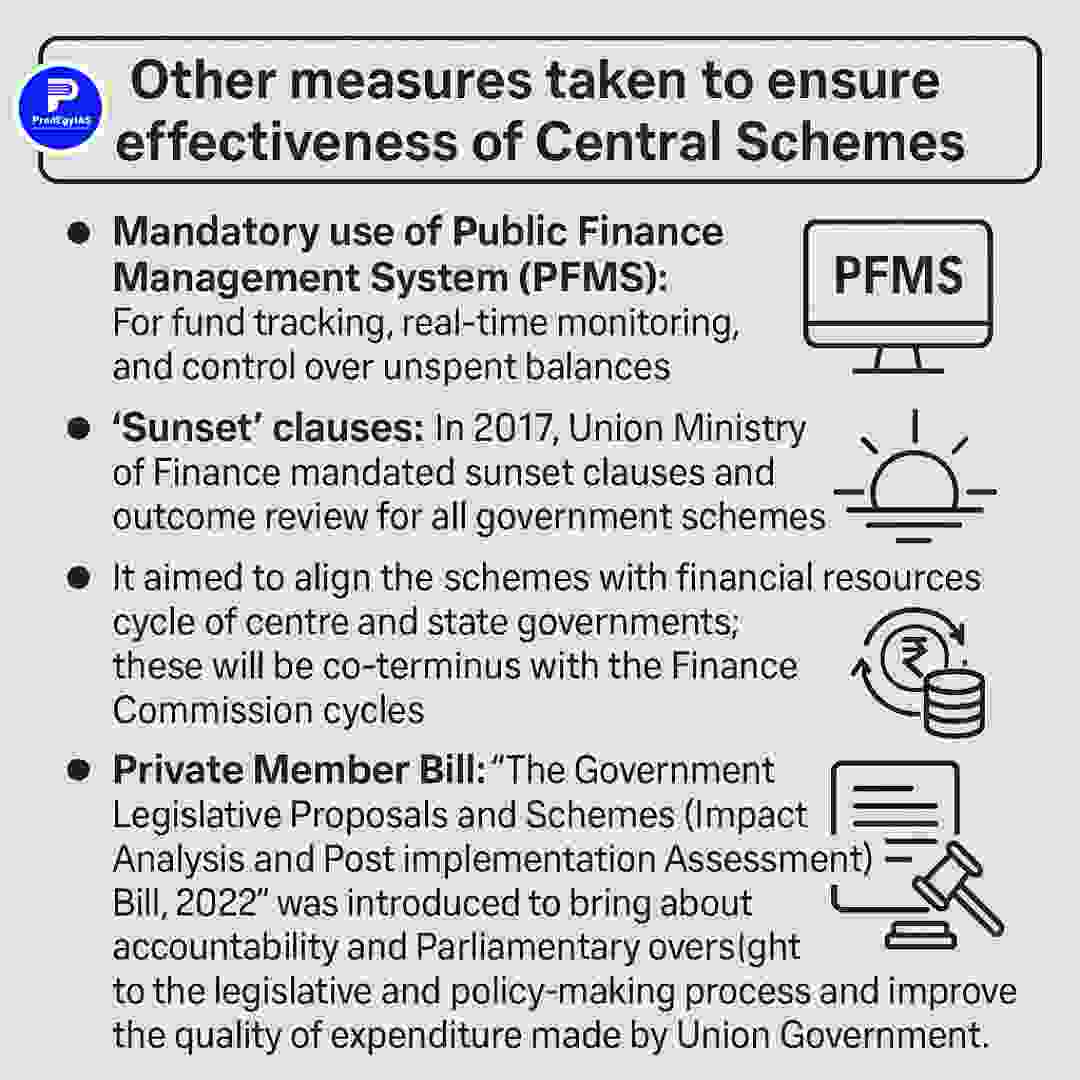
The Public Finance Management System (PFMS) must be used in order to track funds, monitor them in real time, and manage unspent balances.
- The Union Ministry of Finance required all government programs to have sunset clauses and an outcome evaluation in 2017.
- Its goal was to match the plans with the federal and state governments’ cycles of financial resources, which will coincide with those of the Finance Commission.
Mains
Practice Question: “The Public Accounts Committee (PAC) plays a vital role in ensuring legislative oversight over financial accountability, yet its recommendations often remain unimplemented.” In light of the recent PAC report on PFMS, critically examine the institutional challenges in enforcing its findings.
Mains PYQs
Question: How have the recommendations of the 14th Finance Commission of India enabled the States to improve their fiscal position? (2021)
MCQs
Note: To take practice tests on Daily current Affairs MCQs, click the link that is attached.
Q. With reference to the Public Finance Management System (PFMS), consider the following statements:
- PFMS is implemented by the Reserve Bank of India under the Ministry of Finance.
- It was initially launched as a pilot in four states for flagship schemes like MGNREGS and NRHM.
- It enables real-time tracking of fund flow and supports Direct Benefit Transfers (DBTs).
- PFMS was rolled out nationally after the approval of the Planning Commission in 2013.
Which of the statements given above are correct?
a) 2 and 3 only
b) 1, 2 and 4 only
c) 2, 3 and 4 only
d) 1 and 3 only
Answer: a) 2 and 3 only
UPSC General Studies Paper Preparation
| Topic | |
| UPSC Syllabus | GS Genius-50 Program |
| Public administration crash course | UPSC GS Mains 2025 Study Material |
| About the Author: Nitin Kumar Singh |