

🎯Approach
➡️ Introduction: Define refugees and India’s constitutional context on citizenship and nationality.
➡️ Body: Analyze India’s ad hoc policy, challenges, and response to Rohingya crisis.
➡️ Conclusion: Propose a comprehensive policy framework for effective refugee management.
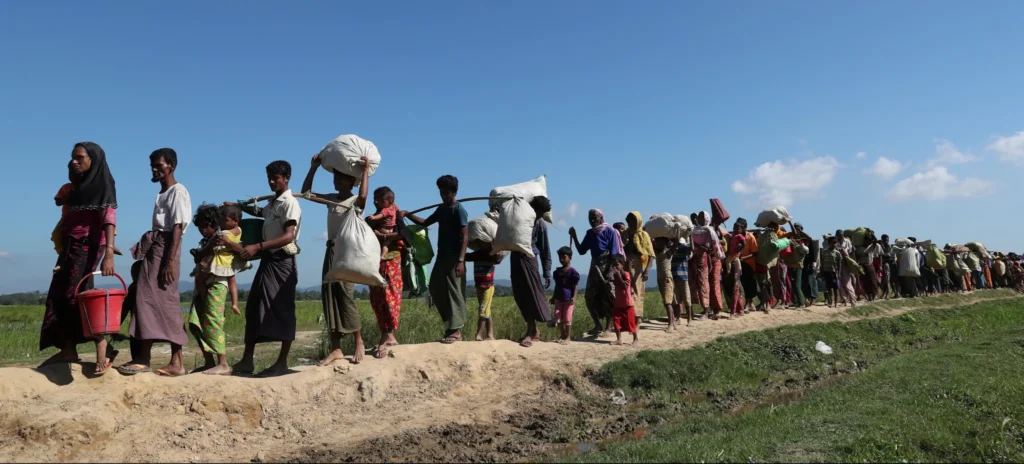
The UNHCR defines a refugee as an individual who has been compelled to leave their country due to persecution, war, or violence. In India, constitutional provisions primarily regulate citizenship and nationality. The Indian Constitution ensures single citizenship for the entire nation. Although law and order fall under state jurisdiction, international relations and borders are managed solely by the Union government. Therefore, all policies concerning refugees are established by the Union government.
India’s Policy on Refugees
✅ Adherence to Non-Refoulement Principle: Despite not being a signatory to the 1951 UN Refugee Convention, India follows the principle of non-refoulement, ensuring that asylum seekers are not returned to their countries of origin where they might face persecution.
✅ Internal Policy Stance: India has opted not to sign the 1967 Protocol, treating refugee matters as domestic issues. The Convention’s requirements for minimum standards of care are challenging for India due to its porous borders, demographic changes, and internal constraints.
✅ Flexible Refugee Management: India’s refugee approach is flexible and situational, enabling differentiation in treatment based on political and strategic considerations rather than purely humanitarian aspects.
✅ Historical Open Borders Approach: India has historically kept its borders relatively open to reflect its status and security, notably accommodating large groups such as Tibetans and Sri Lankans, with a combined total exceeding 150,000.
✅ Legal Framework for Citizenship: India grants citizenship under specific laws and conditions, including the NRC Assam and the Citizenship Amendment Acts (1955 and 2019). Key refugee-related laws include the Registration of Foreigners Act (1939), Foreigners Act (1946), and the Passport Act (1967). Recent controversies, such as the Rohingya crisis and CAA (2019), have sparked criticism for not extending early citizenship benefits to certain Muslim communities.
Strategies for India to Address the Rohingya Crisis
✅ Resettlement Initiatives: India should focus on facilitating resettlement efforts in collaboration with Myanmar, the origin of the Rohingya refugees. Efforts have included extending 7,000 tonnes of relief assistance to refugees in Bangladesh and initiating a $25-million development program to support infrastructure projects in Myanmar’s Rakhine State, aimed at rehabilitating displaced Rohingya.
✅ Cooperation with Neighboring Countries: Continued collaboration with neighboring countries, particularly Bangladesh, is essential to manage the refugee influx effectively and prevent long-term resource strain. India’s Operation Insaniyat exemplifies this approach, providing aid to improve conditions for Rohingya refugees in Bangladesh’s Cox’s Bazar region.
✅ Balancing Human Rights and Security: The Indian Supreme Court has emphasized the need to balance human rights with national security concerns while not halting deportation plans. India must ensure that human rights are upheld, providing necessary health, food, and temporary shelter to Rohingya refugees.
✅ Introducing Identity Cards: Given the strong cultural ties between India and Myanmar, India should consider issuing identity cards for Rohingya refugees. This measure would offer temporary relief to refugees and enhance security, facilitating better management of the refugee situation.
India’s lack of a structured refugee framework leads to inconsistent and ad-hoc responses to refugee crises. To develop a comprehensive refugee policy, it is crucial to address the root causes of migration, such as political instability, insurgencies by non-state actors, and similar factors.