

Earth’s Inner Core Undergoing Structural Changes
Recent Findings
- A study published in Nature Geoscience suggests structural changes in Earth’s inner core.
- Seismic waves from earthquakes were analyzed to examine Earth’s internal structure.
Key Observations
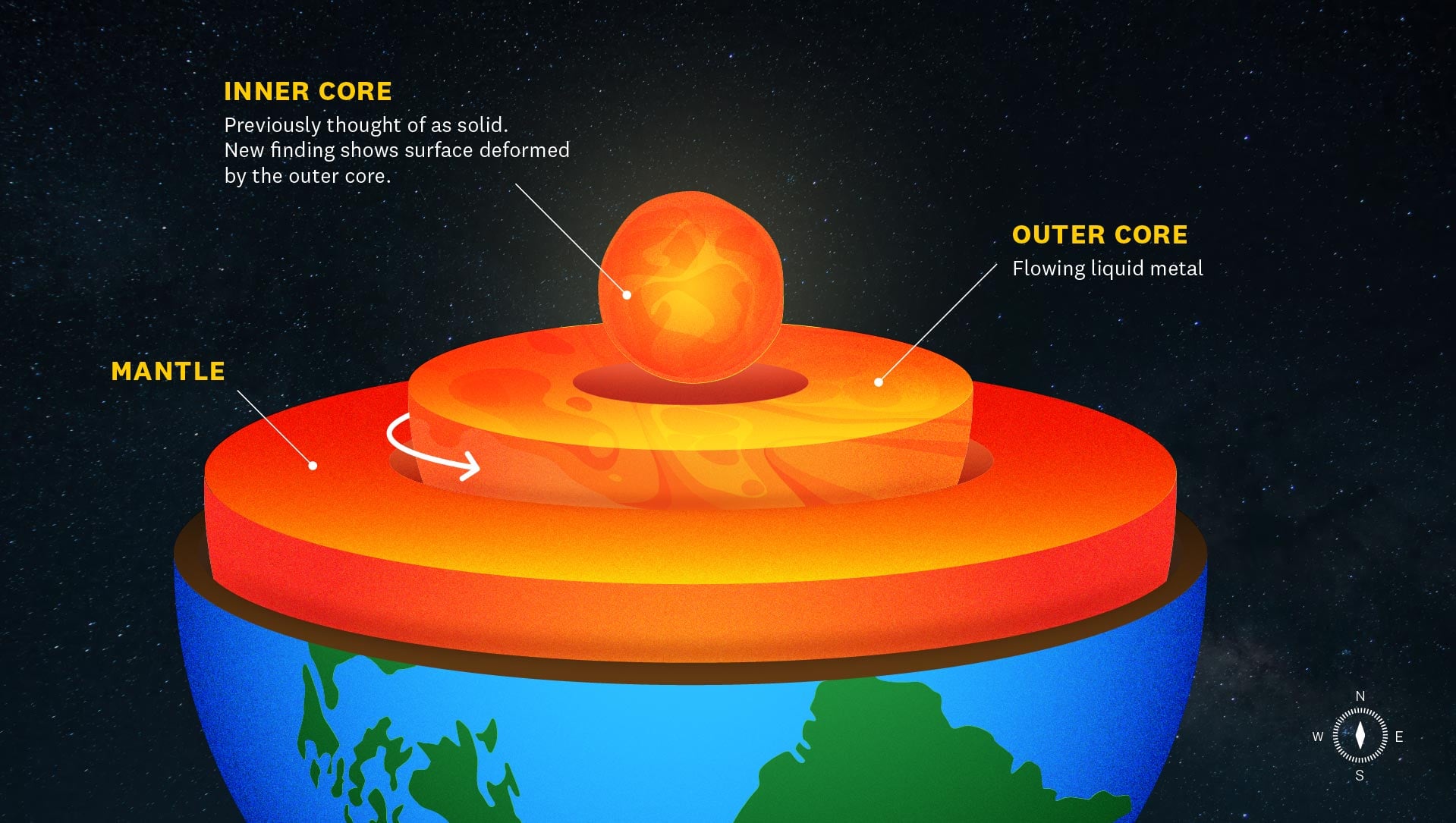
- Inner Core Composition: Previously thought to be solid and rigid, but new evidence indicates a softer surface.
- Influence of Outer Core: The turbulent molten outer core is affecting the inner core’s structure and rotation.
- Impact on Earth’s Rotation:
- Earlier, it was believed that the inner core rotated independently due to interactions with the mantle.
- The study suggests this rotation is slowing down, which could influence Earth’s day length.
Understanding Earth’s Layers
Earth consists of several concentric layers, each with distinct characteristics.
1. Crust (Outermost Layer)
- Thickness: 35 km on continents, 5 km on ocean floors.
- Composition:
- Continental Crust: Silica and alumina (SIAL).
- Oceanic Crust: Silica and magnesium (SIMA).
2. Mantle (Beneath the Crust, Extends to 2,900 km)
- Upper Mantle:
- Asthenosphere (up to 400 km): Source of magma and convection currents.
- Lithosphere (crust + upper mantle): Ranges 10-200 km in thickness.
- Lower Mantle: Solid layer extending beyond the asthenosphere.
3. Core (Beneath the Mantle, Starts at 2,900 km Depth)
- Composition: Mostly nickel and iron (NiFe layer).
- Subdivisions:
- Outer Core: Liquid and turbulent, generating Earth’s magnetic field.
- Inner Core: Previously believed to be solid, but now found to have a softer surface.
- New Understanding:
- The turbulence of the outer core was previously thought to have no immediate impact on the inner core.
- The study suggests outer core movements are affecting inner core structure on human timescales.
Conclusion
The findings challenge existing theories about the Earth’s inner core, indicating dynamic interactions between the inner and outer core. These changes may have long-term implications for Earth’s rotation and magnetic field.
President’s Rule in Manipur
Context
- Four days after the resignation of the Chief Minister of Manipur, President’s Rule has been imposed in the state.
- This highlights the significance of Article 356, its history, application, challenges, and the way forward.
Relevance of the Topic
- Prelims: Key facts about Article 355 and 356.
President’s Rule in Manipur
- The President of India issued a proclamation under Article 356 after receiving a report from the Governor of Manipur.
- The President was satisfied that the state government could not function as per constitutional provisions.
- Article 356(3): The proclamation must be approved by Parliament within two months, or it will cease to operate.
- Impact on Governance:
- The Manipur Legislative Assembly is placed under suspended animation, but not dissolved. Its tenure remains till 2027.
- Governor of Manipur will take key administrative and security decisions.
- Background of Crisis:
- Manipur has faced ethnic violence for two years, with over 250 deaths and 60,000 people displaced.
- The conflict is between Kuki-Zo tribal groups and Meitei people, which began on May 3, 2023.
Emergency Provisions in the Constitution
- These provisions are listed in Part XVIII of the Indian Constitution.
Article 355 and 356
- Article 355:
- It obligates the Centre to protect states from external aggression and internal disturbances.
- It also mandates that state governments function in accordance with the Constitution.
- Article 356:
- Allows the imposition of President’s Rule when a state government fails to function constitutionally.
Grounds for Proclamation of President’s Rule
- Under Article 356:
- The President can act on the Governor’s report or suo motu if the state government cannot function as per the Constitution.
- Under Article 365:
- If a state fails to comply with directions from the Centre, the President can assume that the state government has failed.
Process of Imposition of President’s Rule
- President’s Rule cannot exceed one year unless:
- A National Emergency is in force in India or the state.
- The Election Commission certifies that elections cannot be conducted due to difficulties.
Instances of President’s Rule in India
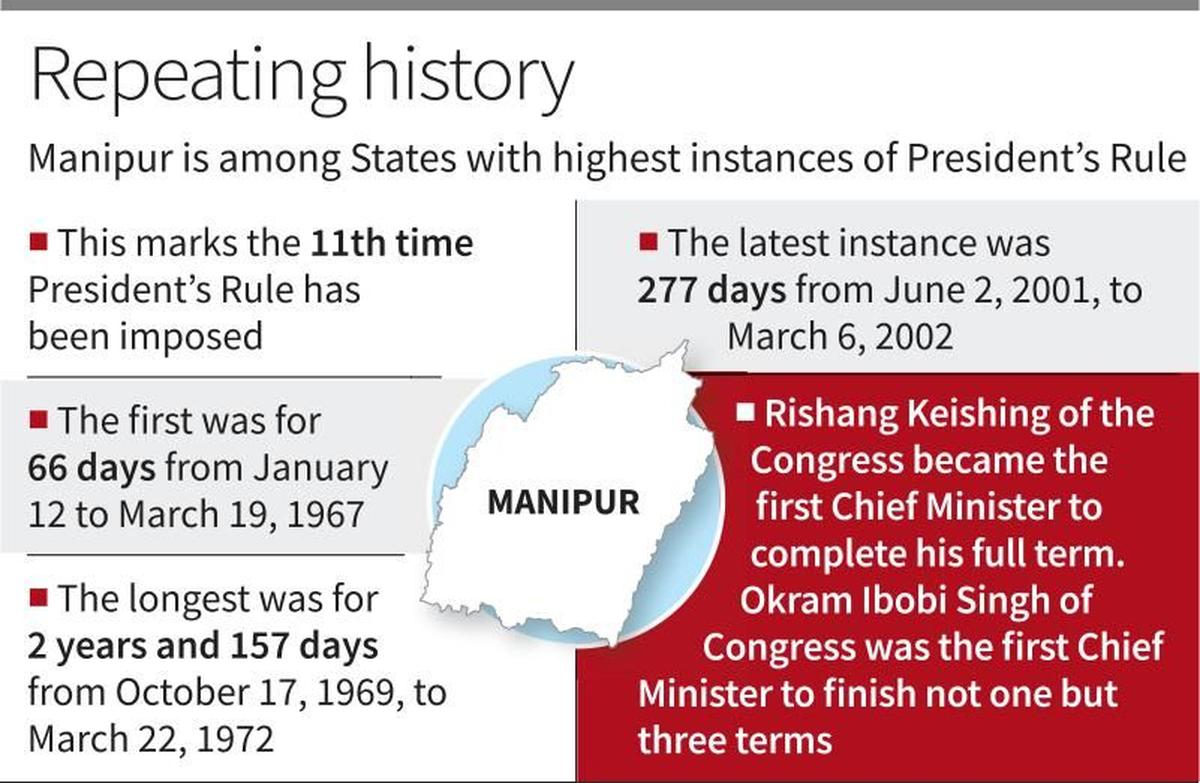
- Since 1950: President’s Rule has been imposed 134 times across 29 states/UTs.
- Most affected states:
- Manipur and Uttar Pradesh (10 times each).
- States with the longest President’s Rule:
- Jammu & Kashmir: 12 years (4,668 days).
- Punjab: 10 years (3,878 days).
- Puducherry: 7 years (2,739 days).
- Jammu & Kashmir and Punjab faced prolonged President’s Rule due to insurgency, separatism, and law-and-order issues.
- Most recent case: Puducherry (2021), after the Congress government lost a vote of confidence.
Issues with President’s Rule
- Often used arbitrarily for political or personal reasons.
- Weakens the federal structure by placing states under central control.
- One of the most controversial and criticized provisions of the Constitution.
Judicial Observations
S.R. Bommai v. Union of India (1994)
- A nine-judge bench ruled that President’s Rule is subject to judicial review.
- Courts can examine if the proclamation is:
- Illegal
- Based on malafide intentions
- An abuse of power
- Fraudulent
Views of Justice Jeevan Reddy
- “Greater power given to the Centre does not mean that states are mere appendages of the Union.”
Suggestions for Reform
- President’s Rule should be a last resort, used only in extreme situations.
- Following SR Bommai Judgment and Sarkaria Commission recommendations, Article 356 should be used in cases such as:
- Hung Assembly after elections with no party securing a majority.
- A majority party refusing to form a government and no coalition is feasible.
- A ministry resigns and no alternative government is possible.
- The state government defies constitutional directions from the Centre.
- Internal subversion, where the government acts against the Constitution.
- Physical breakdown when the government refuses to function, endangering security.
M.M. Punchhi Commission (2007)
- Proposed a localized approach instead of applying President’s Rule to the entire state.
- This would prevent the misuse of the provision by limiting central intervention to affected areas.
Conclusion
- President’s Rule under Article 356 remains a necessary but contentious provision.
- Its misuse for political motives weakens India’s federal structure.
- Strict judicial oversight and constitutional guidelines are essential to ensure its fair application.
Debate Over Mpox as a Sexually Transmitted Disease (STD)
Why in News?
- The scientific community remains divided on whether mpox should be classified as a sexually transmitted disease (STD).
- Some experts advocate for targeted public health interventions to contain the disease, while others argue that such a classification may limit awareness and prevention strategies.
About Mpox
- Previously known as monkeypox, it is a zoonotic viral illness caused by the monkeypox virus (MPXV), belonging to the Orthopoxvirus genus.
- Characterized by rash or skin lesions, primarily appearing on the face, palms, and soles.
- The first human case was reported in 1970 in the Democratic Republic of the Congo (DRC).
Types of Mpox (Subtypes)
- Clade I:
- Endemic to Central Africa.
- Causes more severe illness than Clade II.
- Recent outbreaks have been less deadly.
- Clade II:
- Endemic to East Africa.
- Global outbreak since 2022.
- Less fatal compared to Clade I.
Transmission of Mpox
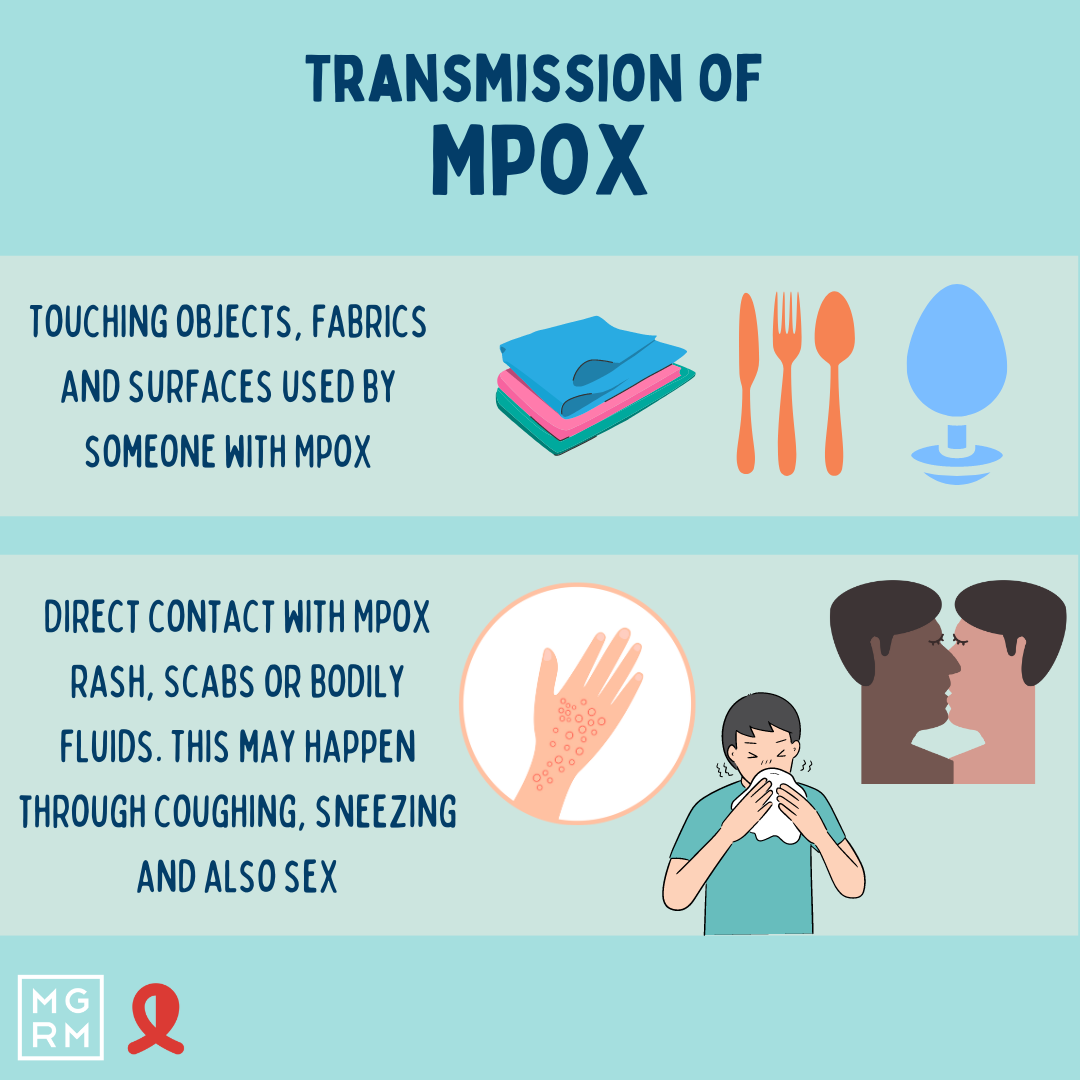
- Close contact with infected animals, people, or contaminated materials.
- Enters the body through small wounds, skin injuries, or mucous membranes.
- Sexual contact can spread the virus.
- Mother-to-child transmission can occur during pregnancy, birth, or after delivery.
Symptoms of Mpox
- Skin rash or mucosal lesions lasting 2–4 weeks.
- Accompanied by:
- Fever
- Headache
- Muscle aches
- Back pain
- Low energy
- Swollen lymph nodes
- Symptoms often resolve without treatment.
Treatment for Mpox
- No specific antiviral treatment for mpox.
- Treatment focuses on symptom relief in most cases.
U.S. AI Export Control Framework
Background
- The U.S. has introduced a regulatory framework for AI exports to maintain technological dominance.
- Aims to control AI diffusion while safeguarding national security.

Core Components of the Framework
Regulation of AI Technology
- Focuses on advanced AI chips, including both hardware and software essential for AI development.
Export Restrictions
- Imposes strict limitations on AI chips, chip-making tools, and closed AI model weights to regulate AI advancements globally.
Country Categorization
- Preferred Nations: U.S. allies with full access to AI technology.
- Restricted Nations: Countries like India with limited access to AI capabilities.
- Banned Nations: Adversarial states such as China, Russia, North Korea, and Iran facing complete bans.
Strategic Elements of the Policy
AI Market Control Strategy
- Ensures AI leadership while controlling the global distribution of advanced AI systems.
Conditional Access for Selected Nations
- Allows restricted AI exports to certain countries under controlled conditions.
Limited AI Technology Flow
- Caps the export volume of AI components to prevent unrestricted access, while maintaining control over AI proliferation.
Potential Challenges and Global Risks
Maintaining U.S. Technological Edge
- Focused on keeping advanced AI research and development within trusted nations.
Disrupting the Global AI Ecosystem
- Could lead to AI sector fragmentation, forcing nations to create independent AI supply chains.
Long-Term Strategic Shifts
- Even close allies may seek self-reliance in AI technology to avoid dependency on the U.S.
Straining U.S.-India Relations
- May weaken India-U.S. technology cooperation, echoing past nuclear technology denials.
Global AI Supply Chain Realignment
- Continual restrictions may drive nations toward alternative AI ecosystems, reducing U.S. influence in AI development.
Impact on India’s AI Sector
Slower AI Development
- Limits access to cutting-edge AI systems, delaying India’s AI growth and investments.
Brain Drain Concerns
- Global AI firms may hesitate to invest in India, leading to migration of AI talent.
Innovation Constraints
- Restricts India’s AI research potential, impacting its technological progress.
Geopolitical Misalignment
- Undermines India’s strategic role in countering regional threats, despite shared U.S.-India interests.