

Shendurney Wildlife Sanctuary
Overview of Shendurney Wildlife Sanctuary
- Located in the southern part of the Western Ghats in Kollam district, Kerala.
- Spans an area of 172 sq.km. and is part of the Agasthyamala Biosphere Reserve.
- The landscape consists mainly of hilly terrain and ravines.
- Major rivers include Shendurney, Kazhuthuruthy, and Kulathupuzha, which form the Kallada River.
Flora of Shendurney Wildlife Sanctuary
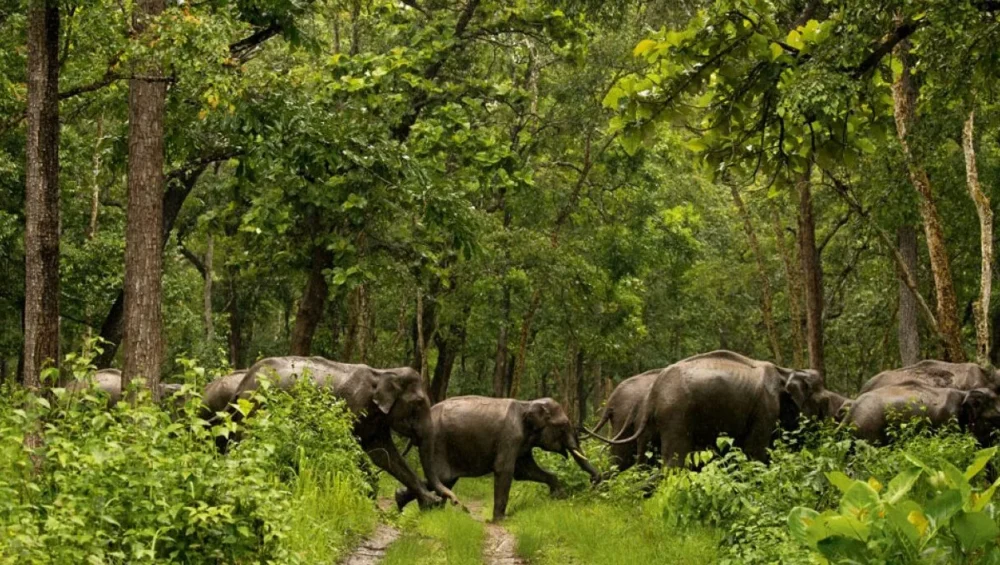
- The vegetation is primarily made up of tropical evergreen forests, semi-evergreen forests, and moist deciduous forests.
- The sanctuary is named after the tree species Gluta travancorica (locally known as Chenkurunji), which is endemic to the region and abundant within the sanctuary.
Fauna of Shendurney Wildlife Sanctuary
- Mammals: Includes elephants, tigers, leopards, gaurs (Indian bison), sambar deer, barking deer, wild boars, and bonnet macaques.
- The sanctuary is home to a significant population of Nilgiri langurs and lion-tailed macaques, both of which are endemic to the Western Ghats.
- Birds: Over 200 species of birds recorded, including notable species like the great Indian hornbill, Malabar pied hornbill, grey-headed bulbul, white-bellied treepie, various species of woodpeckers, flycatchers, and raptors.
Recent Faunal Survey
- A four-day faunal survey conducted at the sanctuary has contributed significant findings to the sanctuary’s biodiversity records.
UNIFIED PENSION SCHEME (UPS)
Context
- The Unified Pension Scheme (UPS) has been notified by the Finance Ministry as an option for workers under the National Pension System (NPS), effective from April 1, 2025.
- This follows the Centre’s announcement of the UPS, which ensures assured benefits for government employees.
Background
- The National Pension System (NPS), introduced in 2004, did not provide an assured pension for government employees joining service after January 1, 2004.
- The previous pension system, which guaranteed pensions equivalent to 50% of the last drawn salary, was replaced due to its fiscal unsustainability.
- The Unified Pension Scheme (UPS) reinstates the assurance of 50% of the salary as a pension for Union government employees.
Key Takeaways
- The UPS is designed to offer greater financial security for government employees.
- Current and future central government employees covered under NPS can choose to switch to UPS or continue with NPS.
- Once an employee opts for UPS, the decision is final and irreversible.
Key Features of the UPS
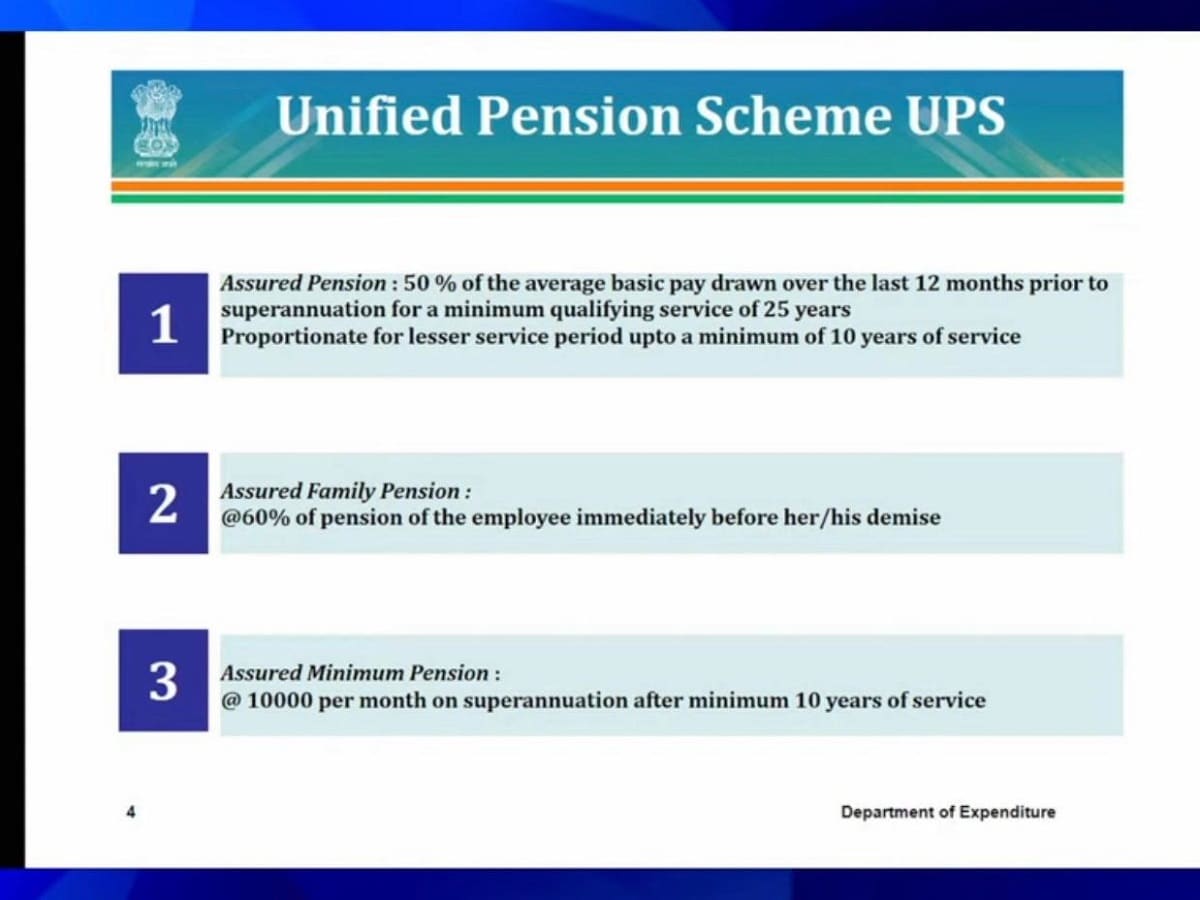
- Assured Pension: Employees will receive 50% of their average basic pay during the last 12 months before retirement, provided they have 25 years of service.
- Minimum Pension: Employees with at least 10 years of service will be guaranteed a minimum pension of Rs. 10,000 per month.
- Family Pension: In the event of the employee’s death, the family will receive 60% of the pension.
- Dearness Relief: Pension will be regularly adjusted to align with inflation.
- Superannuation Benefits: A lump sum payout along with gratuity upon retirement.
- Voluntary Retirement: Employees opting for voluntary retirement after 25 years of service will be eligible for pension from the age they would have reached superannuation.
FISCAL HEALTH INDEX
Context
- Dr. Arvind Panagariya, Chairman of the 16th Finance Commission, launched the inaugural “Fiscal Health Index (FHI) 2025” report by NITI Aayog.
Background
- The FHI aims to provide insights into the fiscal health of states at the sub-national level and guide policy reforms for sustainable economic growth.
Key Features of the Report
- The report ranks 18 major states based on a composite fiscal index, which is derived from five sub-indices:
- Quality of Expenditure: Evaluates the effectiveness of state expenditure allocations.
- Revenue Mobilisation: Measures the ability of states to generate revenue.
- Fiscal Prudence: Assesses the fiscal discipline in managing finances.
- Debt Index: Looks at the debt burden and its sustainability.
- Debt Sustainability: Evaluates the long-term sustainability of state debt.
Ranking of States
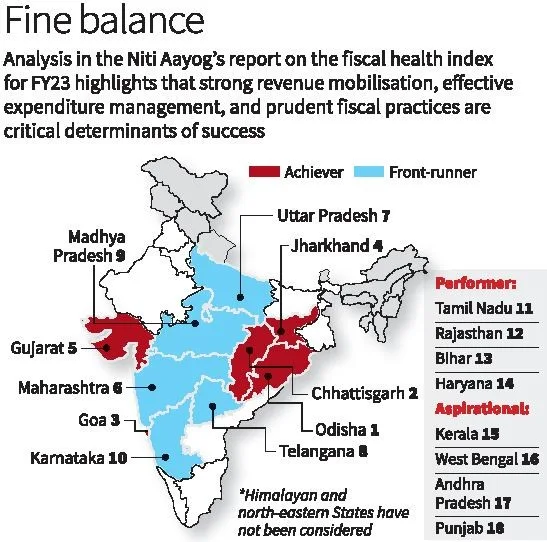
- Odisha ranked first in fiscal health with a score of 67.8.
- Chhattisgarh and Goa followed with scores of 55.2 and 53.6, respectively.
- Revenue Mobilization and Fiscal Prudence Leaders: Goa, Telangana, and Odisha.
- Key Observations:
- Odisha, Jharkhand, Goa, and Chhattisgarh have effectively mobilized non-tax sources.
- Odisha benefits from mining-linked premiums, while Chhattisgarh gains from coal block auctions.
States Facing Challenges
- Punjab was identified as the biggest laggard, followed by Andhra Pradesh, West Bengal, Kerala, and Haryana.
- Kerala and Punjab face issues with low quality of expenditure and debt sustainability.
- West Bengal struggles with revenue mobilization and the debt index.
- Andhra Pradesh has high fiscal deficits.
- Haryana suffers from a poor debt profile.
RBI announces measures to inject liquidity
Current Update
- The Reserve Bank of India (RBI) has introduced enhanced liquidity measures to address the contraction in the banking system.

Actions Taken
- Swap Auction:
- RBI will conduct a USD/INR buy/sell swap auction worth $5 billion, starting January 31, 2025.
- This allows banks to sell US dollars to the RBI in exchange for rupee funds, to be reversed after six months with a premium.
- OMO Purchases:
- The RBI will perform open market operation (OMO) purchase auctions of Government Securities (G-Secs) totaling ₹60,000 crore in three parts:
- ₹20,000 crore on January 30
- ₹20,000 crore on February 13
- ₹20,000 crore on February 20, 2025
- The RBI will perform open market operation (OMO) purchase auctions of Government Securities (G-Secs) totaling ₹60,000 crore in three parts:
- VRR Auction:
- A 56-day Variable Rate Repo (VRR) auction for ₹50,000 crore will be held.
- This marks the first time such a long-tenor VRR auction is being conducted.
Purpose and Goals
- These measures are expected to inject ₹1.50 lakh crore into the banking system in a phased manner from January 30 to February 20, 2025, providing necessary liquidity.
- The liquidity deficit has been worsened by the sharp depreciation of the rupee and reduced government spending.
- RBI’s intervention targets the liquidity tightness caused by tax outflows and limited government expenditure, with the liquidity deficit estimated at ₹3 lakh crore.