

Global Investment Trends Monitor Report
Why in News: The United Nations Conference on Trade and Development (UNCTAD) has recently released the Global Investment Trends Monitor Report, which highlights the ongoing decline in international project finance.
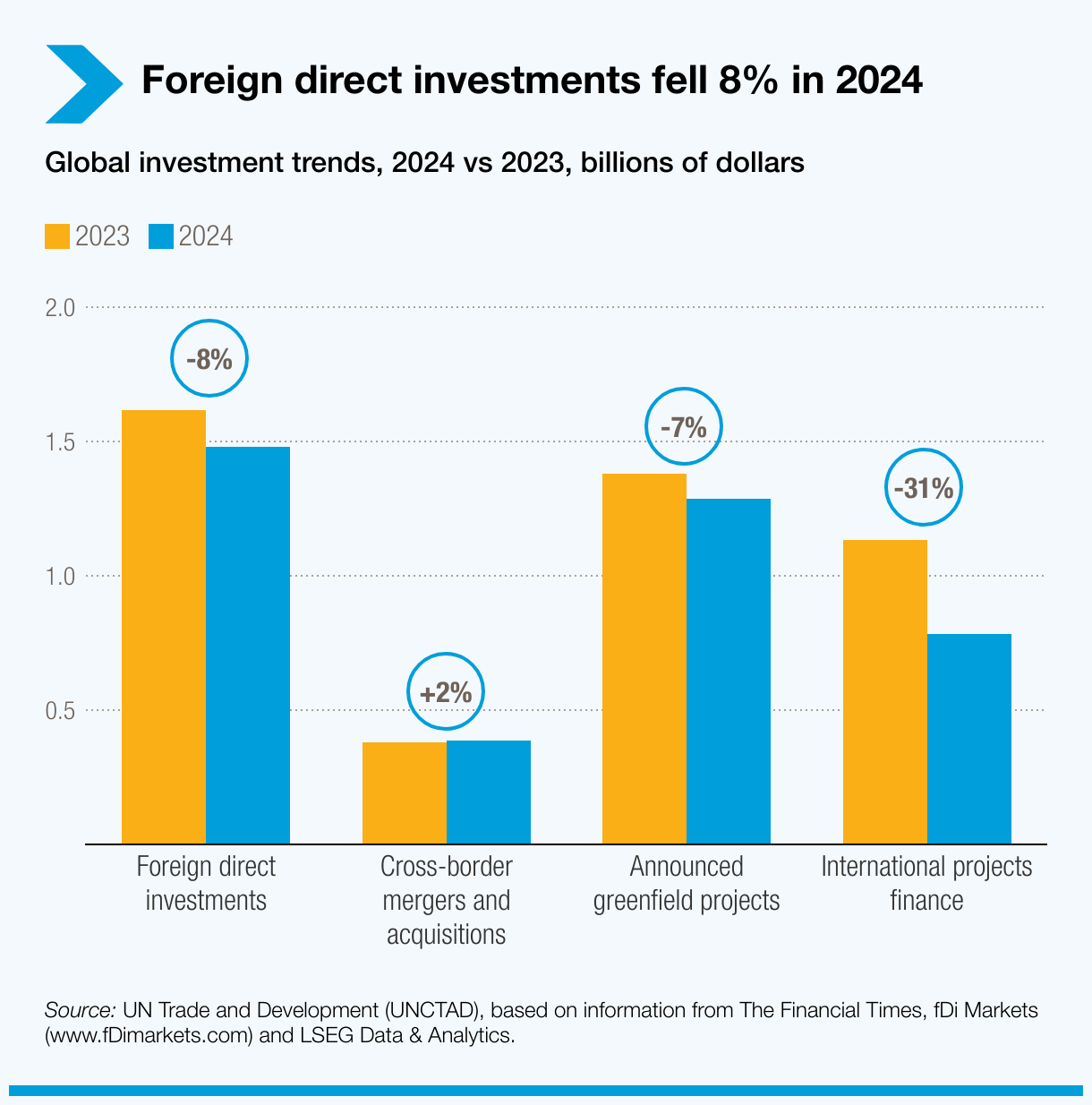
Overall FDI Decline
- Global FDI dropped by 8% in 2024, impacting international project finance, which is crucial for infrastructure and energy investments.
Decline in Developed vs. Developing Economies
- Developed economies saw a 29% decrease in international project finance.
- In developing countries, international project finance fell by:
- 23% in number
- 33% in value
Industry and Country Impact
- In developed countries, the decline was broad-based, affecting almost all industries with a few exceptions.
- In developing countries, Brazil, China, India, Indonesia, and Mexico experienced a drop in project numbers that was significantly larger than the global average.
Renewable Energy Finance Trends
- International project finance in renewable energy slowed by 16% in both number and value.
- Finance flows in renewable energy generation dropped by:
- 22% in North America
- 18% in developing Asia
- 14% in Latin America and the Caribbean
- Africa was the only region to see an 8% increase in renewable energy investments.
SDG-Related Investments and Sector Slowdowns
- The number of SDG-related investments fell by 11% in 2024.
- There was a slowdown in investments in the following sectors:
- Infrastructure
- Agrifood systems
- Water and sanitation
FDI Outlook for 2025
- The report predicts moderate FDI growth in 2025, aided by improved financing conditions.
- However, geopolitical tensions and global economic instability present significant challenges.
Central Groundwater Board (CGWB)
Why in News: According to a report by the Central Groundwater Board (CGWB), the number of districts in India with excessive nitrates in their groundwater has risen to 440 in 2023, up from 359 districts in 2017.

Overview
- CGWB is a multi-disciplinary scientific organization under the Department of Water Resources, River Development and Ganga Rejuvenation, Ministry of Jal Shakti, Government of India.
- It serves as the National Apex Agency responsible for managing, monitoring, assessing, and regulating the country’s groundwater resources.
Mandate
- Develop and disseminate technologies for the scientific and sustainable development of India’s groundwater resources.
- Implement national policies for groundwater exploration, assessment, conservation, protection from pollution, and equitable distribution, ensuring economic and ecological efficiency.
Organizational Setup
- Headed by a Chairman and consists of five members.
- The board includes professionals from various fields:
- Hydrogeologists
- Geophysicists
- Chemists
- Hydrologists
- Hydrometeorologists
- Engineers
- Headquarters: Bhujal Bhawan, Faridabad, Haryana.
Major Activities of CGWB
- National Aquifer Mapping and Management (NAQUIM): Preparation of Aquifer Maps and Management Plans.
- Groundwater Exploration: Identifying groundwater-worthy areas and potential aquifers.
- Geophysical Surveys: To identify groundwater-bearing zones.
- Periodic Groundwater Assessment: Monitoring groundwater resources across the country.
- Groundwater Monitoring: Through observation wells to assess levels and quality.
- Data Dissemination: Sharing groundwater data and knowledge.
- Groundwater Modelling, including GIS and Remote Sensing.
- Regulation and Control: Managing groundwater development in coordination with State Governments.
- Collaboration with States: Establishing benchmark methodologies for groundwater studies.
- Research & Development: Conducting studies and applying new technologies for groundwater management.
- Water Conservation & Recharge: Promoting artificial recharge to groundwater.
- Capacity Building and Knowledge Transfer: Enhancing skills and transferring knowledge related to groundwater management.
Annual Status of Education Report (ASER), 2024
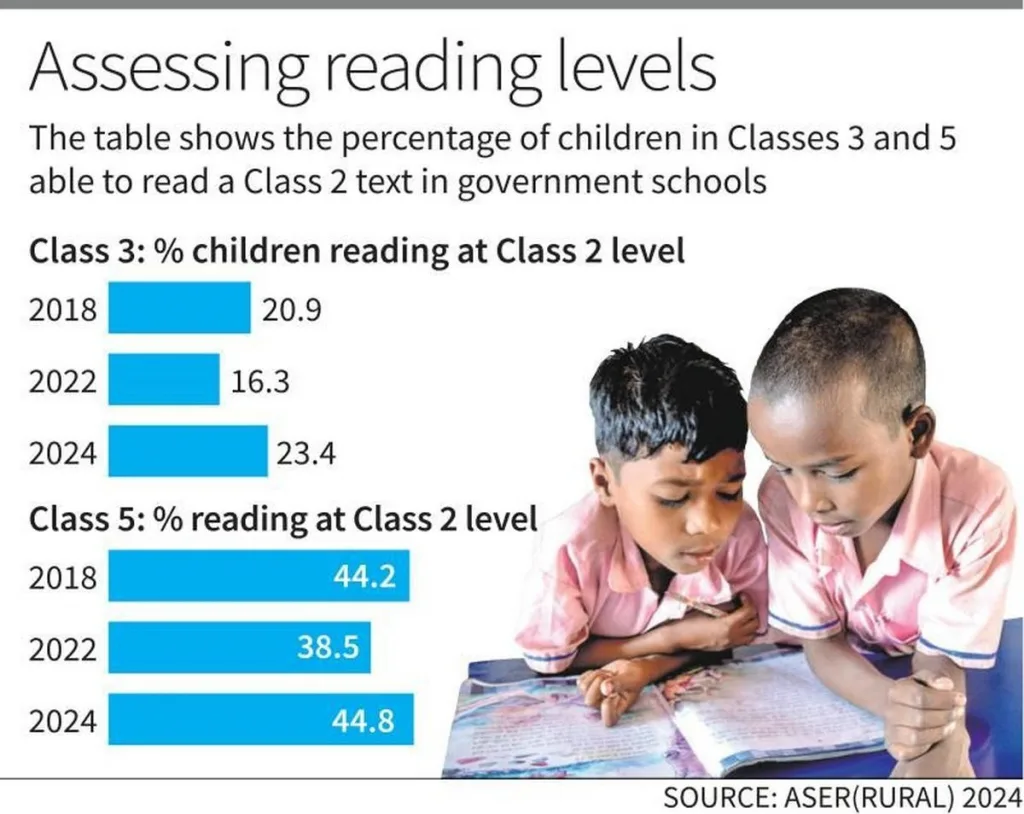
Why in News: The ASER 2024 annual education report, based on household surveys in 618 rural districts, highlights high enrolment rates in rural India, but significant learning gaps persist, with basic reading and math skills continuing to be a major challenge.
Key Highlights of the ASER 2024 Report
Enrolment & Dropouts
- Over 90% of children aged 6-14 are enrolled in school.
- Increased government school enrolment in states like Bihar, Uttar Pradesh, and Madhya Pradesh, while private school enrolment declines.
- 8% of 15-16-year-olds are not in school, with higher dropout rates in states like Uttar Pradesh (13%), Bihar (8.6%), Assam (5%), and West Bengal (5.4%).
Learning Gaps
- Despite high enrolment, only about 50% of Class 5 students can read a Class 2-level text.
- By Class 3, only 27% of children can read at the expected level, and just 22% can perform simple subtraction.
- In some states, reading levels have declined. Less than 30% of Class 5 students can solve basic division problems.
- Class 8 students still struggle with fundamental arithmetic.
- Punjab, Kerala, and Himachal Pradesh show improvement in reading and arithmetic.
- Bihar, Uttar Pradesh, West Bengal, and Madhya Pradesh continue to struggle with foundational learning.
Digital Learning Gap
- Over 80% of children aged 14-16 have access to a smartphone, and many are comfortable using basic digital tools.
- However, only 57% use it for educational purposes (57.7% of boys vs 50.1% of girls).
Infrastructure Gap in Schools
- School facilities have improved, with most schools offering essential services.
- 90% of schools provide mid-day meals, and nearly 80% have drinking water and functional toilets, though some regions face maintenance issues.
- Electricity access has expanded, but library usage remains low, and many schools have books that students rarely use.
Community and Parental Involvement
- Local initiatives and support networks have helped bridge learning gaps.
- Parental involvement in learning activities at home has increased by nearly 10% since 2022.
- States like Rajasthan, Maharashtra, and Tamil Nadu have introduced local initiatives to help bridge learning gaps.
Top-Performing States
- Kerala, Himachal Pradesh, and Punjab lead in learning levels, supported by better school infrastructure and teacher training.
Struggling States
- Bihar, Jharkhand, and Uttar Pradesh have some of the lowest learning outcomes, with students struggling in reading and math.
Mixed Results
- States like Maharashtra and Gujarat show good enrolment numbers but stagnation in learning progress.
- These state-specific differences emphasize the need for region-specific policies rather than a one-size-fits-all approach.
Dissent in Judiciary
Why in News: Dissent plays a crucial role in democracy, particularly within constitutional courts. Although it holds significant influence in both India’s Supreme Court and the U.S. Supreme Court, the reasons behind it vary.
What Is Dissent in Judiciary?
- Definition:
Dissent occurs when one or more judges disagree with the majority opinion in a judicial decision. - Significance:
It presents an alternate legal interpretation, fosters democratic discussion, and can shape future legal reforms.
Types of Judicial Dissents
- Intellectual Dissent:
- Arises from differences in legal interpretation or textual analysis.
- Example: Justice B.V. Nagarathna’s dissent in Lalta Prasad Vaish (2024) on the taxation of industrial alcohol.
- Political Dissent:
- Stems from resistance to political influence on the judiciary.
- Example: Justice H.R. Khanna’s dissent in ADM Jabalpur (1976), advocating for the protection of Article 21 during the Emergency.
- Social Dissent:
- Reflects opposing views on cultural or societal issues.
- Example: Justices Khehar and Nazeer’s dissent in Shayara Bano (2017), supporting triple talaq within Sunni personal law.
Differences Between Indian and U.S. Judicial Dissents
Aspect | India | USA |
Appointment Process | Judges are appointed by the collegium system, independent of politics. | Judges are appointed by the President and confirmed by the Senate, reflecting political tendencies. |
Basis of Dissent | Dissents focus on legal, societal, and intellectual analysis. | Dissents often follow political ideologies (liberal vs. conservative). |
Political Impact | Judgments tend to be neutral, with dissent showing judicial independence. | Dissents often mirror political affiliations (Republican vs. Democrat). |
Judicial Philosophy | Judges consider constitutional morality and societal progression. | Judges’ dissents reflect originalist or progressive views on the Constitution. |
Examples | Justice H.R. Khanna’s dissent in ADM Jabalpur defending individual rights. | Justice Alito’s dissent in Obergefell v. Hodges opposing same-sex marriage. |
Recent Indian Examples of Dissent
- Sita Soren (2023): Dissent on immunity for bribes under parliamentary privilege, overruling P.V. Narasimha Rao (1998).
- Hijab Case (2022): Justice Dhulia’s dissent emphasizing diversity over secularism in state schools.
- Lalta Prasad Vaish (2024): Justice Nagarathna’s dissent on states’ power to tax industrial alcohol.
Consequences of Political Dissents
- Democratic Strengthening:
Ensures judicial independence, acting as a counterbalance to executive and legislative powers. - Catalyst for Reform:
Highlights flaws in majority opinions and pushes for constitutional amendments and new legislation. - Public Perception:
Affects public understanding of judicial neutrality, though political dissents may cause concerns about bias. - Judicial Integrity Risks:
Political dissents may appear partisan, potentially eroding trust in judicial fairness. - Professional Repercussions:
Judges who dissent in politically charged matters might face criticism or professional isolation.
Way Forward
- Fostering Judicial Independence:
Safeguard judicial autonomy from political influence. - Encourage Open Discourse:
Facilitate constructive discussions within the judiciary to strengthen legal reasoning. - Training and Awareness:
Expose judges to global judicial practices, balancing individual rights and societal needs. - Institutional Safeguards:
Protect dissenting judges from external criticism or professional alienation. - Leveraging Technology:
Improve access to dissenting opinions to educate the public on alternative legal perspectives.
Conclusion
Judicial dissent is essential to a robust democracy, offering alternate viewpoints that refine the legal framework and protect constitutional principles. In India, dissents have significantly shaped the interpretation of the Constitution and increased public confidence in the judiciary.