

Asian Waterbird Census
Why in News: According to the Asian Waterbird Census-2025, a record 39,725 birds from 106 species have been observed in the Coringa Wildlife Sanctuary and its surrounding wetlands.
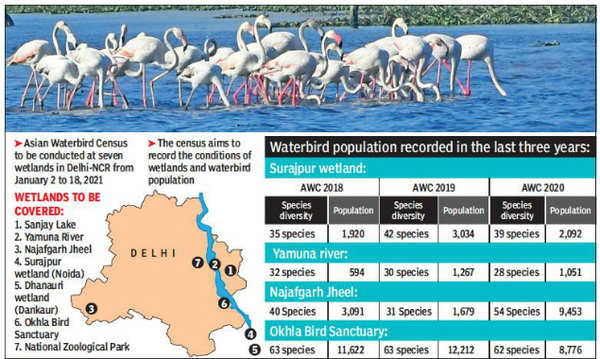
About Asian Waterbird Census:
- Purpose: The Asian Waterbird Census is a citizen-science initiative aimed at supporting the conservation and management of wetlands and waterbirds worldwide.
- Frequency and Coordination: Conducted annually, it monitors waterbird populations across Asia and is part of the global International Waterbird Census (IWC) coordinated by Wetland International.
- Initiation: Launched in 1987, it has expanded to cover significant regions of Asia, stretching from Afghanistan to Japan, Southeast Asia, and Australasia.
- Flyway Coverage: It spans the entire East Asian-Australasian Flyway and a large portion of the Central Asian Flyway.
- In India: In India, the census is carried out by the Bombay Natural History Society (BNHS) and the Wildlife Institute of India (WII) in early January.
About Bombay Natural History Society (BNHS):
- Overview: BNHS is a Non-Governmental Organization (NGO) in India, focused on conservation and biodiversity research.
- Designation: It has been recognized as a ‘Scientific and Industrial Research Organisation’ by the Department of Science and Technology.
- International Partnership: BNHS is the Indian partner of BirdLife International.
Pradhan Mantri Fasal Bima Yojana (PMFBY)
Why in News: The Union government has announced an expansion of the PM Fasal Bima Yojana to cover crop damage caused by animals, addressing a long-standing request from farmers, according to an official statement.
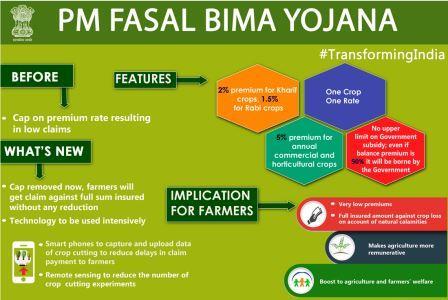
About Pradhan Mantri Fasal Bima Yojana (PMFBY):
Launch and Purpose:
- Launched on 18th February 2016 by the Ministry of Agriculture, PMFBY is a crop insurance scheme aimed at providing financial protection to farmers against crop losses caused by natural disasters, pests, and diseases.
Key Features:
- Offers cost-effective crop insurance to all Indian farmers.
- Implemented through insurance companies and banks.
Objectives:
- Provide financial support to farmers experiencing crop damage due to unforeseen events.
- Stabilize farmers’ income and promote continuous farming.
- Encourage the adoption of modern agricultural practices.
- Support crop diversification and enhance the agriculture sector’s growth.
Eligibility:
- All farmers, including sharecroppers and tenant farmers, are eligible for coverage if they are growing notified crops in notified areas.
- Compulsory: Farmers availing Seasonal Agricultural Operations (SAO) loans from financial institutions for notified crops.
- Voluntary: Non-loanee farmers can opt into the scheme.
- Farmers must have a valid land ownership certificate or land tenure agreement and must not have received compensation from other sources for the same crop loss.
- Special focus is given to SC/ST/Women farmers, ensuring equitable coverage.
Benefits of the Scheme:
Affordable Premiums:
- Maximum premiums: 2% for Kharif food and oilseed crops, 1.5% for Rabi food and oilseed crops, and 5% for commercial or horticultural crops.
- Remaining premium subsidized by the government.
- In certain regions like North-Eastern States and Jammu & Kashmir, the government covers the entire premium.
Comprehensive Coverage:
- Covers natural disasters (e.g., drought, floods), pests, diseases, and post-harvest losses due to local risks like hailstorms.
- Excludes losses due to war, nuclear risks, and preventable damage.
Timely Compensation:
- Aims to process claims within two months of harvest, ensuring farmers receive prompt compensation to avoid financial strain.
Technology-Driven Implementation:
- Uses satellite imaging, drones, and mobile apps for accurate crop loss estimation and claim settlement.
- The National Crop Insurance Portal (NCIP) enables smooth interaction between farmers, insurers, and banks.
- YES-TECH (Yield Estimation System Based on Technology) uses remote sensing for precise yield estimation.
- CROPIC (Collection of Real-time Photos and Observations of Crops) helps verify crops using geotagged photos for accurate damage assessment.
Liquid Propulsion Systems
Why in News: ISRO has recently appointed M. Mohan as the director of the Liquid Propulsion Systems Centre in Thiruvananthapuram.
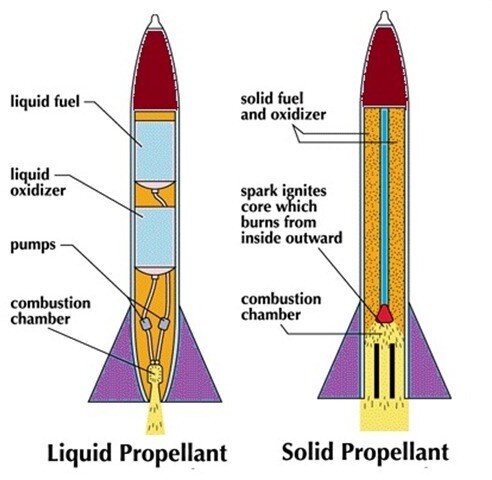
About Liquid Propulsion Systems
- Working Principle: Liquid propulsion systems use liquid propellants like liquid oxygen (LOX) and liquid hydrogen (LH2) to generate thrust.
- Advantages: These systems are preferred over solid propulsion systems due to their higher efficiency, controllability, and ability to be restarted multiple times.
ISRO’s Liquid Propulsion Systems Centre (LPSC)
- Key Role: LPSC is a vital ISRO facility responsible for designing, developing, and realizing liquid propulsion stages for the organization’s launch vehicles.
- Locations: It has two units in Thiruvananthapuram (Valiamala) and Bengaluru, each specializing in different aspects of liquid propulsion systems.
Recent Developments
- Gaganyaan Mission: Advanced liquid propulsion systems have been integrated into the Crew Module for the uncrewed mission of the Gaganyaan project. The Crew Module Propulsion System (CMPS) is a bi-propellant based Reaction Control System (RCS), designed for precise three-axis control during descent and re-entry.
- Cryogenic Upper Stage: ISRO has developed an indigenous cryogenic upper stage for the Geosynchronous Satellite Launch Vehicle (GSLV), significantly boosting India’s ability to launch heavier payloads into space.
- Satellite Propulsion Systems: LPSC is also responsible for developing propulsion systems for satellites, including monopropellant thrusters and components for satellite control and maneuvering.
Enhanced Certificate of Origin (eCoO) 2.0 System
Why in News: The Directorate General of Foreign Trade (DGFT) launched the Enhanced Certificate of Origin (eCoO) 2.0 System, a digital platform designed to streamline export certification and improve trade efficiency.

What is eCoO 2.0?
- The eCoO 2.0 system is a digital platform for issuing Certificates of Origin (CoO), which confirm the origin of exported goods.
- It simplifies access to both preferential and non-preferential CoOs, ensuring compliance with global trade regulations.
- Managed by the Directorate General of Foreign Trade (DGFT), Ministry of Commerce and Industry, Government of India.
Aims of eCoO 2.0:
- Streamlining Export Processes: Makes the CoO certification process easier for exporters.
- Enhancing Trade Efficiency: Reduces processing times and improves accuracy in trade documentation.
- Supporting Global Supply Chains: Ensures transparency for intermediary and re-export trades.
Key Features of eCoO 2.0:
- Multi-User Access: Allows exporters to grant access to multiple users under a single Importer Exporter Code (IEC).
- Aadhaar-Based e-Signing: Provides flexible document authentication options along with digital signature tokens.
- Back-to-Back Certificates of Origin: Enables certification for re-export and transshipment of non-Indian-origin goods based on verified documentation.
- Mandatory Electronic Filing: Non-preferential CoOs must be processed online starting January 1, 2025.
- In-Lieu Certificate of Origin: Allows correction of previously issued CoOs through a simple online application.