

India Surpasses Montreal Protocol Target |
Why in News: According to a report from the government, India has effectively eliminated the use of HCFC 141b, a chemical known for depleting the ozone layer and contributing to climate change.
About Hydrochlorofluorocarbon (HCFC)-141 b:
- Characteristics and Application:
- HCFC-141b is a chemical commonly employed by foam manufacturing industries and is recognized as one of the most potent ozone-depleting substances.
- Its primary application lies in serving as a blowing agent in the production process of rigid polyurethane (PU) foams.
Hydrofluorocarbons (HFCs): l Initially introduced as alternatives that do not deplete the ozone layer, HFCs were adopted to facilitate the phased withdrawal of CFCs and HCFCs. l Usage: HFCs have become widely used in various products such as air conditioners and refrigerators. |
About the Report:
The report was collaboratively issued by the Environment Ministry and UNDP during a side event held at the annual climate talks COP28.
- Achievements Highlighted:India’s accomplishments highlighted in the report include a remarkable 33% reduction in the emission intensity of the economy by the year 2019, surpassing the targeted goal set for the year 2030.
COP28 |
Why in News: The recent conclusion of the 28th session of the Conference of the Parties (COP28) of the UN Framework Convention on Climate Change took place in Dubai, United Arab Emirates (UAE).

Key Outcomes of the Summit:
- Global Stocktake Agreement (GST):The summit concluded with the adoption of an agreement known as the Global Stocktake (GST), which advocates for a transition from fossil fuels to renewable energy sources.
- Declaration on Fossil Fuel Transition: A declaration was adopted emphasizing the necessity of transitioning away from fossil fuels and replacing them with clean energy alternatives.
- Targets for Renewable Energy and Energy Efficiency: Countries are urged to contribute to tripling the global installed capacity of renewable energy and doubling annual improvements in energy efficiency.
- Reduction of Unabated Coal Power Usage: Nations are encouraged to expedite the reduction of unabated coal power usage. A compromise was reached following strong opposition from India and China against exclusively targeting coal.
- Phase-out of Inefficient Fossil Fuel Subsidies:The summit includes a commitment to phase out inefficient fossil fuel subsidies that do not address energy poverty or just transitions.
- Global Net Zero Target: A target of achieving global net zero emissions by 2050 is set, involving tripling renewable energy capacity globally and doubling the global average annual rate of energy efficiency improvements by 2030.
Agreements Not Signed by India: l Declaration on Climate and Health: This declaration targets addressing climate-related health impacts. l Global Renewables and Energy Efficiency Pledge: It pledges to triple the world’s installed renewable energy generation capacity to at least 11,000 GW by 2030. l Declaration to Triple Nuclear Energy: This declaration aims to advance the goal of tripling nuclear energy capacity by 2050. l Declaration on Food Systems, Agriculture, and Climate Action: It aims to strengthen efforts to integrate agriculture and food systems into national climate plans. l Global Methane Pledge: This pledge aims to reduce methane emissions by at least 30 percent by 2030. l Initiatives led by India at COP28: Global River Cities Alliance (GRCA): This initiative aims to foster the sustainable development of river cities. l Green Credit Initiative: It incentivizes voluntary environmental actions among various stakeholders. |
Dry Spell in Western Himalayas |
Why in News: During December and January, Kashmir experienced approximately a 75% shortfall in rainfall, resulting in significant dry spells and adverse effects on groundwater levels, horticulture, and tourism.
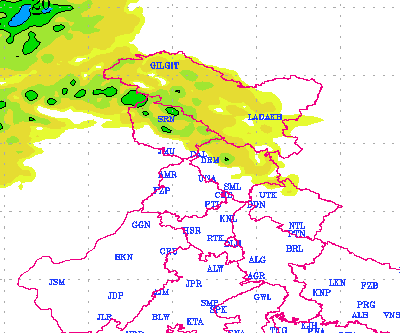
Winters in Kashmir: l Duration a: The winter season in Kashmir spans approximately 70 days, starting from December 22nd. l It consists of three phases: Chilla Kalan (first forty days), Chilla Khurd (next twenty days), and Chilla Bachi (last ten days), which are crucial for water recharge through snowfall. |
Dry Spell Causes:
- Absence of Western Disturbance (WD):The lack of Western Disturbance (WD) activity has resulted in the absence of snowfall, as snowfall typically occurs due to the presence of WDs.
- El Nino Impact: In an El Nino year, the frequency of WDs usually increases before its onset. However, this year, the dominance of global warming appears to have overridden this pattern.
- Impact of Global Warming:Global warming has led to a reduction in the frequency of WDs, as the mid-latitude jet streams responsible for such circulations are shifting towards the polar region.
- North Atlantic Oscillation (NAO):
- Experts have observed a strong positive correlation between the North Atlantic Oscillation (NAO) and winter precipitation in Kashmir.
- Positive NAO usually brings more active WDs, which are the primary source of winter precipitation in the region.
- December 2023 experienced a negative NAO, and a strongly negative NAO is predicted for January 2024, resulting in significantly reduced snowfall this season.
Skyglow |
Why in News: A recent study revealed that artificial light has been responsible for an annual increase in skyglow by 9.2% from 2011 to 2022.
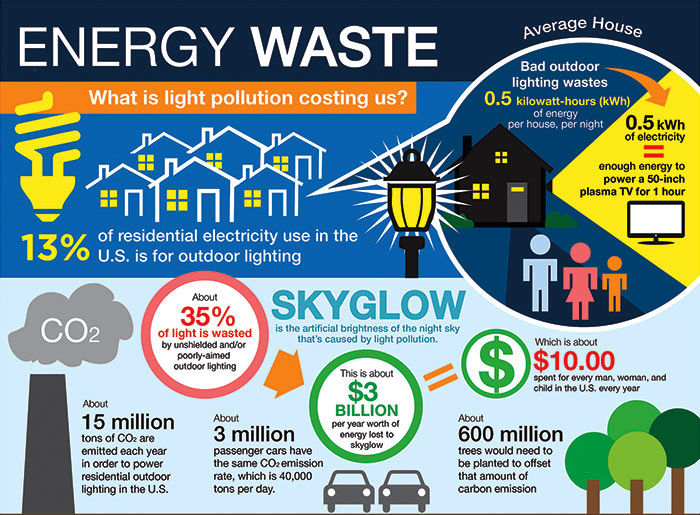
About Skyglow:
Skyglow refers to the artificial brightness that illuminates the night sky over populated regions.
Consequences of Skyglow:
- Impact on Migratory Birds:Skyglow affects the navigation of migratory birds, such as the Arctic Tern.
- Disruption of Circadian Rhythm:It disrupts the circadian rhythm, leading to hampered melatonin production, a crucial hormone influencing sleep, mood, and cognition in humans.
Health Risks: Circadian disruption associated with skyglow has been linked to an increased risk of breast cancer among night shift workers.