

Dark matter |
Why in News: Astronomers have just produced the most intricate map to date of enigmatic dark matter by analyzing the earliest light in the universe.
About Dark matter
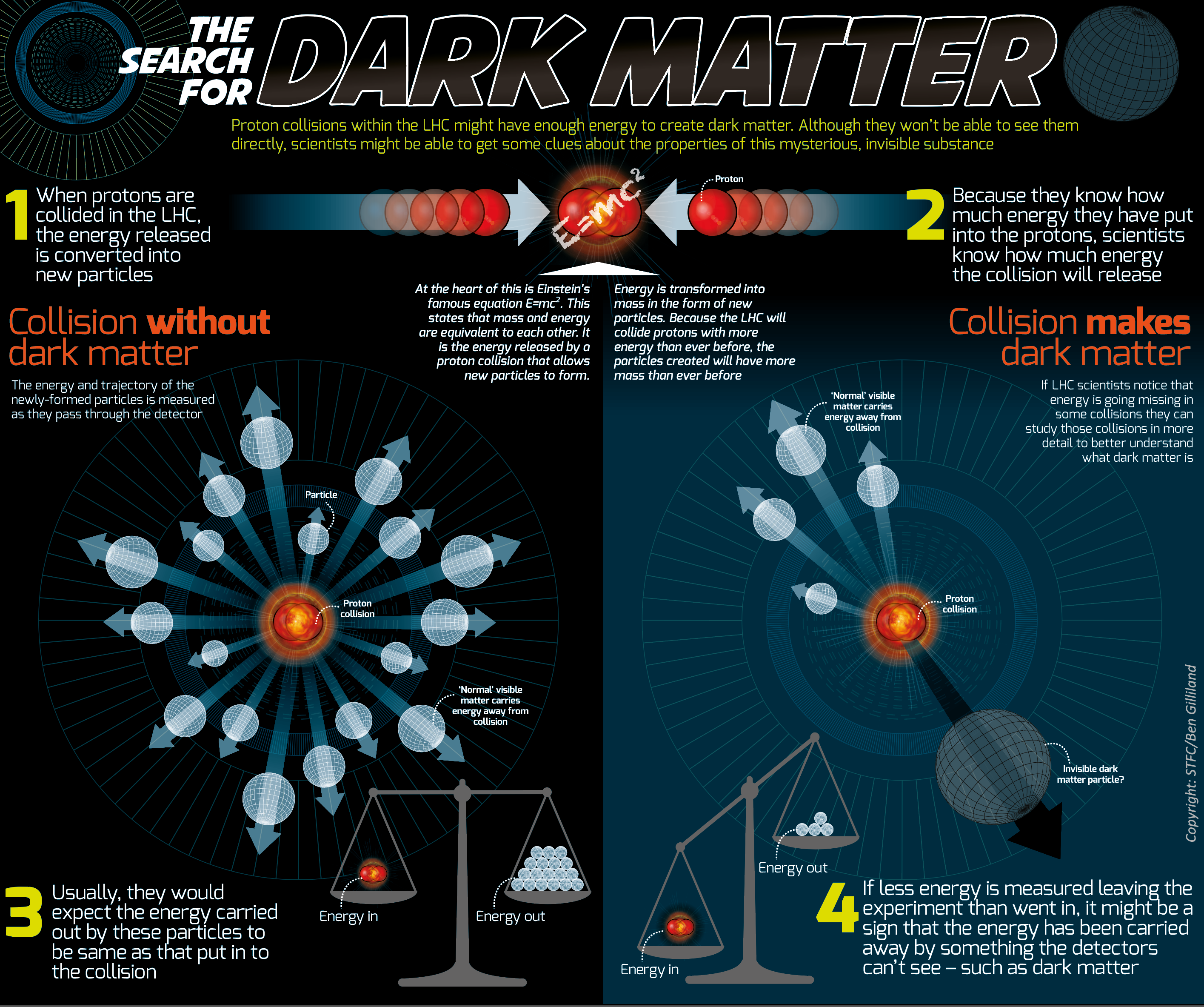
Dark matter is a hypothetical form of invisible mass believed to contribute to gravitational forces acting on galaxies and other cosmic bodies.
- Quantity:It comprises approximately 27% of the universe’s total mass, overshadowing visible matter by roughly six to one, according to NASA’s estimates.
- Relative Composition:Dark energy constitutes about 68% of the universe, while visible matter accounts for a mere 5%.
- Characteristics:Unlike ordinary matter, such as stars and galaxies, dark matter does not engage with electromagnetic forces.
- Nomenclature:It derives its name from its elusive nature, as it neither absorbs, reflects, nor emits any form of electromagnetic radiation.
- Detection Challenges:
- Interaction with Light:Dark matter’s lack of interaction with electromagnetic forces renders it invisible to conventional optical detection methods.
- Detection Method:Its presence can only be inferred through gravitational effects on visible matter.
- Significance: Dark matter’s gravitational influence plays a crucial role in maintaining the structural integrity of galaxies like our Milky Way, preventing stellar components from dispersing.
Dark Energy |
Why in News: An international team of researchers has unveiled the most extensive “three-dimensional” map of the cosmos to date. This milestone holds promise for shedding light on the mysteries surrounding dark energy.

About Dark Energy
Dark energy is an enigmatic form of energy believed by astronomers to drive the accelerated expansion of the universe.
- Conceptualization:Some liken it to a negative pressure exerting outward force on space, though its exact nature remains uncertain.
- Cosmic Proportion:Dark energy potentially constitutes about 68% of the universe’s total energy content, surpassing even dark matter in prevalence.
- Properties of Dark Energy:
- Uniformity: Unlike ordinary and dark matter, dark energy exhibits uniformity across both space and time.
- Gravitational Behavior:It possesses a repulsive gravitational effect within its spatial domain, contrasting with the attractive forces associated with matter. However, the precise mechanisms of dark energy remain elusive.
- Detection and Study:
- Detection Methods: Scientists discern dark energy’s presence through its influence on the rate of cosmic expansion and the formation of large-scale structures like galaxies and galaxy clusters.
- Scientific Imperative:Understanding dark energy is crucial for gaining insights into the universe’s origin, evolution, and ultimate fate.
Aspect | Dark Matter | Dark Energy |
Definition | Dark matter is a form of matter that does not interact with electromagnetic forces, making it invisible and undetectable by normal means. It is believed to make up about 27% of the universe. | Dark energy is a form of energy that is believed to make up about 68% of the universe. It is thought to be responsible for the accelerated expansion of the universe. |
Composition | Dark matter is composed of hypothetical particles such as axions, sterile neutrinos, weakly interacting massive particles (WIMPs), supersymmetric particles, atomic dark matter, or primordial black holes. | Dark energy is a theoretical form of energy that is believed to be distributed evenly throughout the universe. It is thought to be a property of space itself, causing it to expand. |
Detection | Dark matter can only be detected through its gravitational effects, or weak lensing. It does not emit, absorb, or reflect light, making it invisible to normal detection methods. | Dark energy is even more difficult to detect than dark matter. It can only be inferred through its effects on the large-scale structure of the universe and the accelerated expansion of the universe. |
Role in the Universe | Dark matter plays a crucial role in the formation of galaxies and the large-scale structure of the universe. Its gravitational effects help to hold galaxies together and shape the distribution of matter in the universe. | Dark energy is responsible for the accelerated expansion of the universe. It is thought to be pushing matter apart, causing the universe to expand at an ever-increasing rate. |
Evidence | The evidence for dark matter includes gravitational lensing, the rotation curves of galaxies, and the large-scale structure of the universe. | The evidence for dark energy includes the accelerated expansion of the universe, the cosmic microwave background radiation, and the large-scale structure of the universe. |
Theories | There are several theories about the nature of dark matter, including the existence of hypothetical particles such as axions, sterile neutrinos, and weakly interacting massive particles (WIMPs). | There are several theories about the nature of dark energy, including the cosmological constant, quintessence, and the zero-point field. |
Uncertainties | There are still many uncertainties about the nature of dark matter, including its composition, distribution, and interactions with other forms of matter. | There are still many uncertainties about the nature of dark energy, including its origin, distribution, and energy density. |
Importance | Understanding dark matter and dark energy is crucial for our understanding of the universe and its evolution. They play a key role in the formation of galaxies, the large-scale structure of the universe, and the fate of the universe. | |
Spectrum |
Why in News: The Cabinet has given the green light for a telecom spectrum auction spanning various bands, with a starting price set at Rs 96,317.65 crore.
About Spectrum
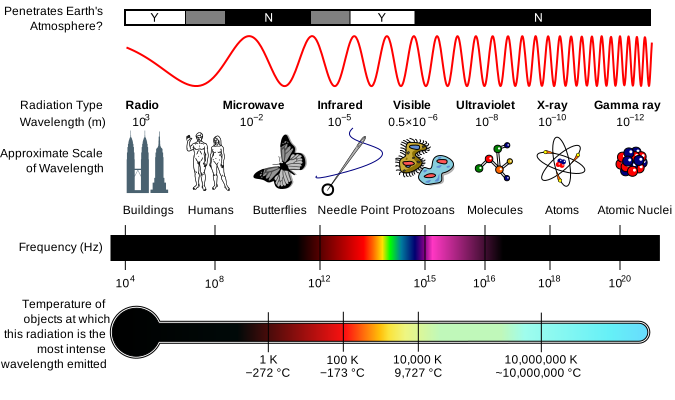
Spectrum encompasses the unseen range of radio frequencies utilized by wireless signals.
- Wireless devices like cellphones, radios, and WiFi rely on signals transmitted through airwaves within this spectrum.
- These signals must be transmitted at specific frequencies to prevent interference, constituting what we term as the spectrum.
- Types of spectrum band
Spectrum can be categorized into bands spanning from lower to higher frequencies, dictating their respective purposes and aiding in their allocation.
Spectrum Band | Frequency Range | Characteristics |
Low band | Less than 1 GHz | l Offers extensive coverage suitable for serving numerous customers over long distances with minimal infrastructure. l Ideal for wide and in-building coverage. l Can be utilized for commercial mobile and broadcasting services when combined with high-spectrum bands. |
Mid-band | 1 GHz to 6 GHz | l Provides both coverage and the capacity to transmit larger amounts of data over considerable distances. |
High band | 24 GHz to 40 GHz | l Also known as the millimeter-wave spectrum. l Best suited for high-speed networks over short distances. l Susceptible to interference from dense objects. |
Centre for Fourth Industrial Revolution (C4IR) |
Why in News: Telangana has entered into a partnership with the World Economic Forum (WEF) to set up the Centre for Fourth Industrial Revolution (C4IR) in Hyderabad, the capital city of the state.

About Centre for Fourth Industrial Revolution (C4IR)
- Initiative by the World Economic Forum (WEF):The establishment of the Centre for Fourth Industrial Revolution (C4IR) is spearheaded by the World Economic Forum (WEF).
- Focus on Emerging Technologies: C4IR is dedicated to exploring the capabilities of emerging technologies such as artificial intelligence, blockchain, data policy, and precision medicine, all associated with the Fourth Industrial Revolution.
- Global Network of Centres:Operating as part of a global network, C4IR comprises multiple centres, each concentrating on distinct geographical and thematic domains.
Collaborative Approach: C4IR emphasizes collaboration with governments, businesses, academia, and civil society to devise policies and frameworks that promote responsible adoption of technology.