

Crypto Currency |
Why in News: As per a recent research paper released by the Bank for International Settlements, more than 73% of cryptocurrency users experienced financial losses.
![Burning Issue] Crypto Banking and Decentralized Finance - Civilsdaily](https://d18x2uyjeekruj.cloudfront.net/wp-content/uploads/2021/11/grafico_crypto-vs-banking-1024x436.jpg)
About Cryptocurrency:
Cryptocurrencies are digital or virtual currencies utilizing encryption techniques to control unit generation and fund transfer verification.
- Independence from Central Authority:Operates without reliance on a central bank for regulation or control.
- Decentralized Economic Transactions: Economic transactions within cryptocurrency networks are decentralized, distributed, and widely dispersed.
- Introduction of Bitcoin: Bitcoin, the pioneering and most renowned cryptocurrency, was introduced in 2009.
Facial Recognition Technology |
Why in News: Israel Deploys Expansive Facial Recognition Program in Gaza

About Facial Recognition Technology
Facial recognition technology identifies or verifies a subject through facial images, videos, or other audiovisual elements.
- Commonly used as a form of access control, operating akin to a face scanner.
- Biometric Identification Method:
- Utilizes body measurements, particularly of the face and head, for biometric identification.
- Verifies a person’s identity by analyzing facial biometric patterns and data.
- Data Collection and Usage:
- Gathers unique biometric data associated with each individual’s face and expressions.
- Used for identification, verification, and authentication purposes.
Fuel Cell |
Why in News: ISRO has announced the successful testing of an advanced fuel cell-powered energy system.
About Fuel Cell
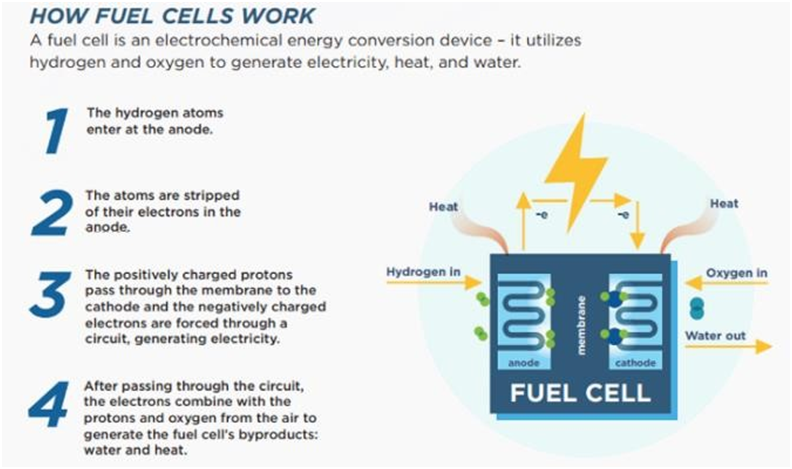
A fuel cell is a device that produces electricity through a chemical reaction.
- Applications: Fuel cells find utility across various sectors, including transportation, industrial, commercial, residential buildings, and reversible systems for long-term energy storage in the grid.
- Operation:
- Fuel cells comprise two electrodes:a negative electrode (anode) and a positive electrode (cathode).
- Both electrodes are immersed in an electrolyte,which conducts ions between them.
- During operation, a fuel such as hydrogen is suppliedto the anode, where it undergoes oxidation, generating hydrogen ions and electrons.
- Simultaneously, an oxidizer like oxygen is fed to the cathode, where it reacts with hydrogen ions and electrons from the anode to produce water.
- The voltage per unit cell is determined by the difference in energy levels at the electrodes.
- The quantity of available electric current to the external circuit is contingent upon the chemical activity and quantity of the supplied substances.
- While a single fuel cell generates a minimal amount of direct-current (DC) electricity, multiple fuel cells are typically arranged into a stack for practical applications.
Metaverse |
Why in News: According to a recent study, the number of Metaverse users is projected to exceed 600 million by 2026, largely attributed to advancements in generative artificial intelligence (AI).
About Metaverse:
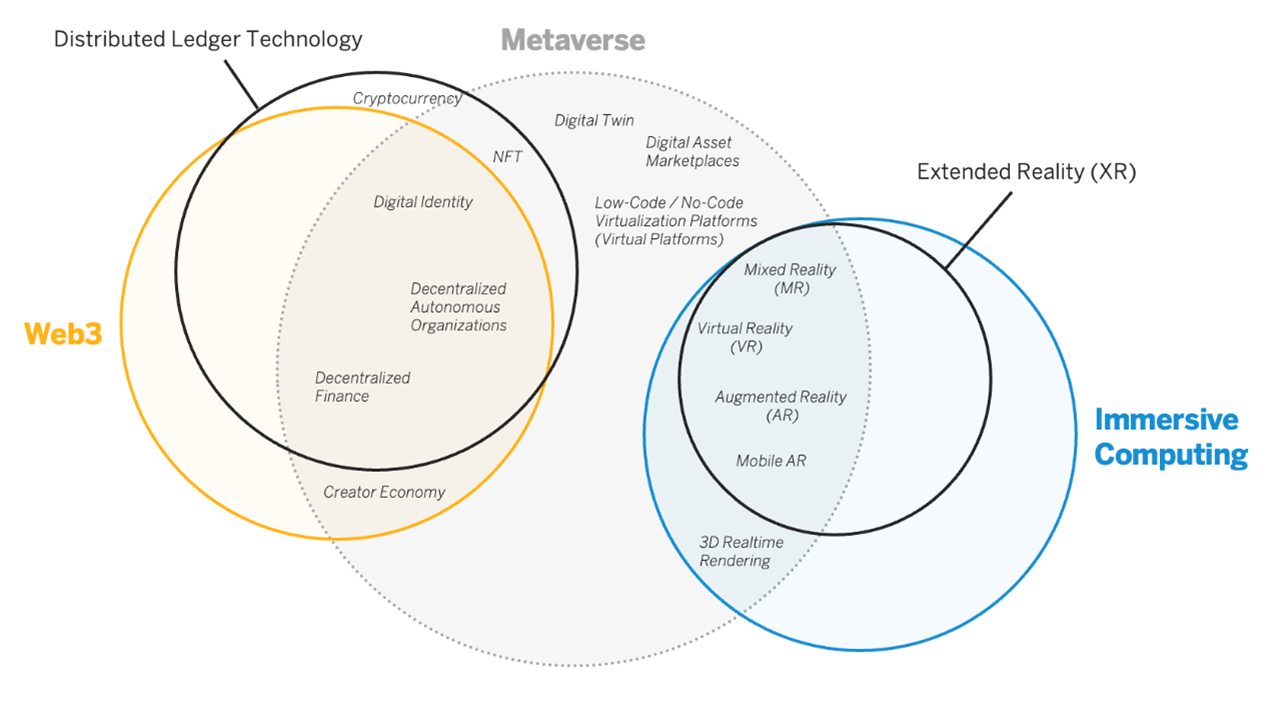
The Metaverse denotes a virtual or digital universe enabling interaction among individuals and digital entities within a shared online environment.
- Origin: Coined by author Neal Stephenson in his 1992 science-fiction novel Snowcrash, envisioning a future where users engage through virtual avatars in a cyberspace realm.
- Structure:Comprises an interconnected network of virtual worlds, augmented reality, and virtual reality environments accessible via the internet.
- Functionality:Users can create avatars, socialize, partake in activities, explore virtual landscapes, and conduct business or trade virtual goods and services.
- Components:Encompasses virtual reality (VR) platforms, augmented reality (AR) experiences, online gaming, social media, virtual commerce, and virtual art galleries.
- Immersive Experience:Aims for seamless immersion, blurring boundaries between physical and digital realms.
- Industry Investment:Companies like Meta (formerly Facebook), Microsoft, and Roblox are heavily investing in the Metaverse, viewing it as a potential catalyst for technological industry growth in the future.
Kavach System |
Why in News: Supreme Court appreciates Indian Railways for installation of ‘Kavach’ anti-collision system in trains.
About Kavach System
Developed as an Automatic Train Protection (ATP) system, Kavach is a homegrown solution.
An Automatic Train Protection (ATP) System encompasses all the equipment responsible for ensuring the safe operation of trains on the main line. Its primary function is to prevent train collisions by maintaining a safe distance between them on the same track and regulating train speed. |
- Development Collaboration:Created by the Research Design and Standards Organisation (RDSO) in collaboration with Medha Servo Drives Pvt Ltd, HBL Power Systems Ltd, and Kernex Microsystems.
- Functionality:
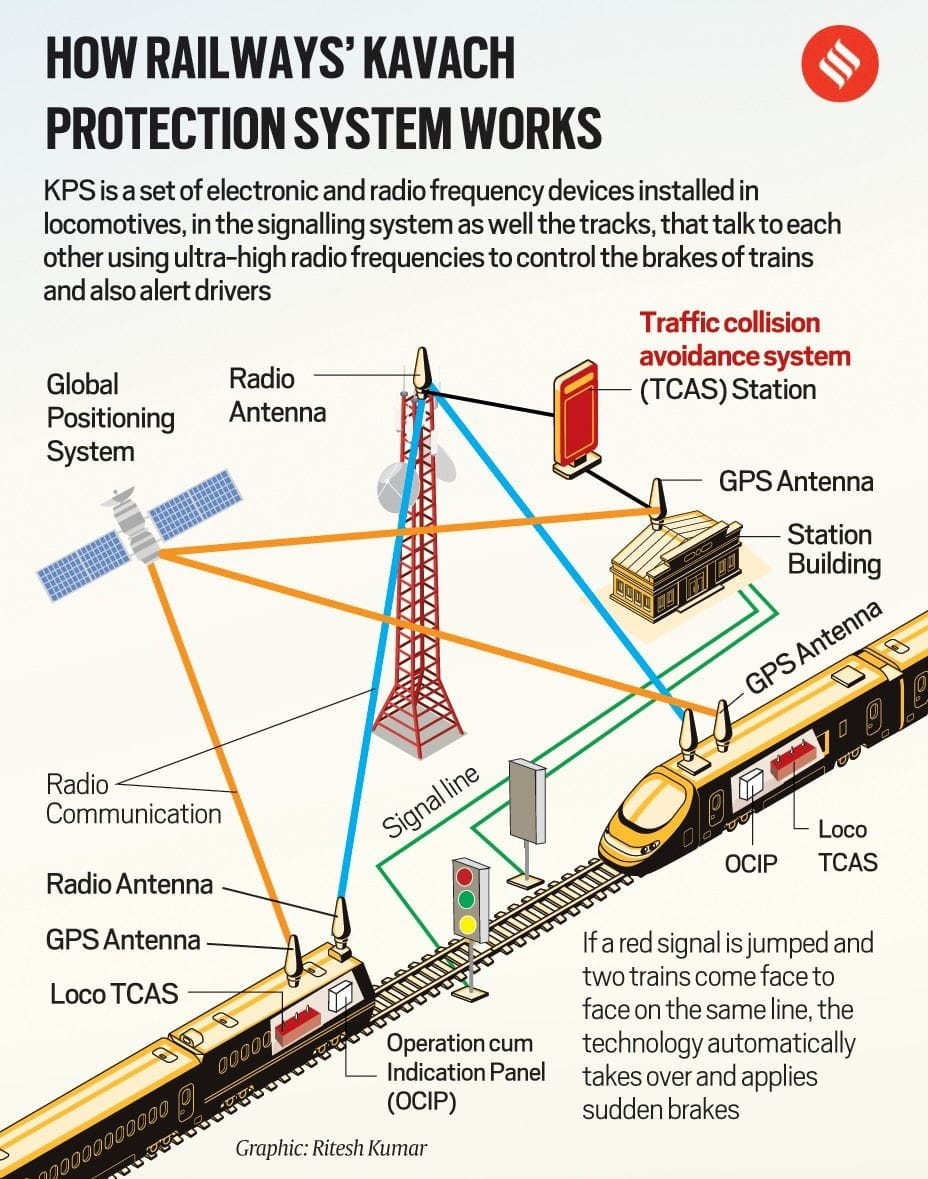
- Comprises electronic and Radio Frequency Identification (RFID) devices installed in locomotives, signaling systems, and tracks.
- Utilizes ultra-high radio frequencies for communication, enabling brake control and driver alerts based on programmed logic.
Applications:
- Designed to aid locomotive pilots in avoiding Signal Passing At Danger (SPAD)and overspeeding.
- Alerts pilots and automatically haltstrains upon detecting another train within a specified distance.
- Continuously transmits signalsahead to locomotives, particularly beneficial during low visibility conditions.
- Controls train speed by applying brakes automatically if the pilot fails to act.
- Assists pilots innavigating trains during adverse weather conditions like dense fog.
NIDHI Program |
Why in News: Recently, the Union Minister of State (Independent Charge) for Science & Technology briefed the Rajya Sabha regarding the NIDHI Program.

About NIDHI Program
The National Initiative for Developing and Harnessing Innovations (NIDHI) program commenced in 2016.
- Initiative Origin: Conceived and developed by the Innovation & Entrepreneurship division within the Department of Science & Technology.
- Objective:Aimed at nurturing startups by facilitating the scouting, support, and scaling of innovations.
- Key Stakeholders:Involves various stakeholders including central and state government departments, academic and research institutions, mentors, financial institutions, angel investors, venture capitalists, and private sectors.
- Funding: Funding provided by the National Science & Technology Entrepreneurship Development Board (NSTEDB).
Key Components of the NIDHI Program:
- NIDHI-PRAYAS (Promoting and Accelerating Young and Aspiring Innovators and Startups):Offers mentoring and financial support at the Proof-of-Concept level to innovators, aiding them in transforming their ideas into prototypes.
- NIDHI Entrepreneurs-In-Residence (EIR) Program:Grants fellowships to students pursuing entrepreneurship, providing them with resources and support.
- NIDHI Seed Support Program: Provides early-stage seed funding to startups, facilitating their initial development phase.
- NIDHI Accelerator Program: Accelerates the investment readiness of startups through a structured program, typically lasting 3-6 months.
- Infrastructure Development:Facilitates the establishment of state-of-the-art infrastructure for incubating startups in technology sectors, managed through Technology Business Incubators (TBIs) and Centres of Excellence (CoEs).