

Predicting Dengue Risk: Early Warning System Based on Weather Data
Context:
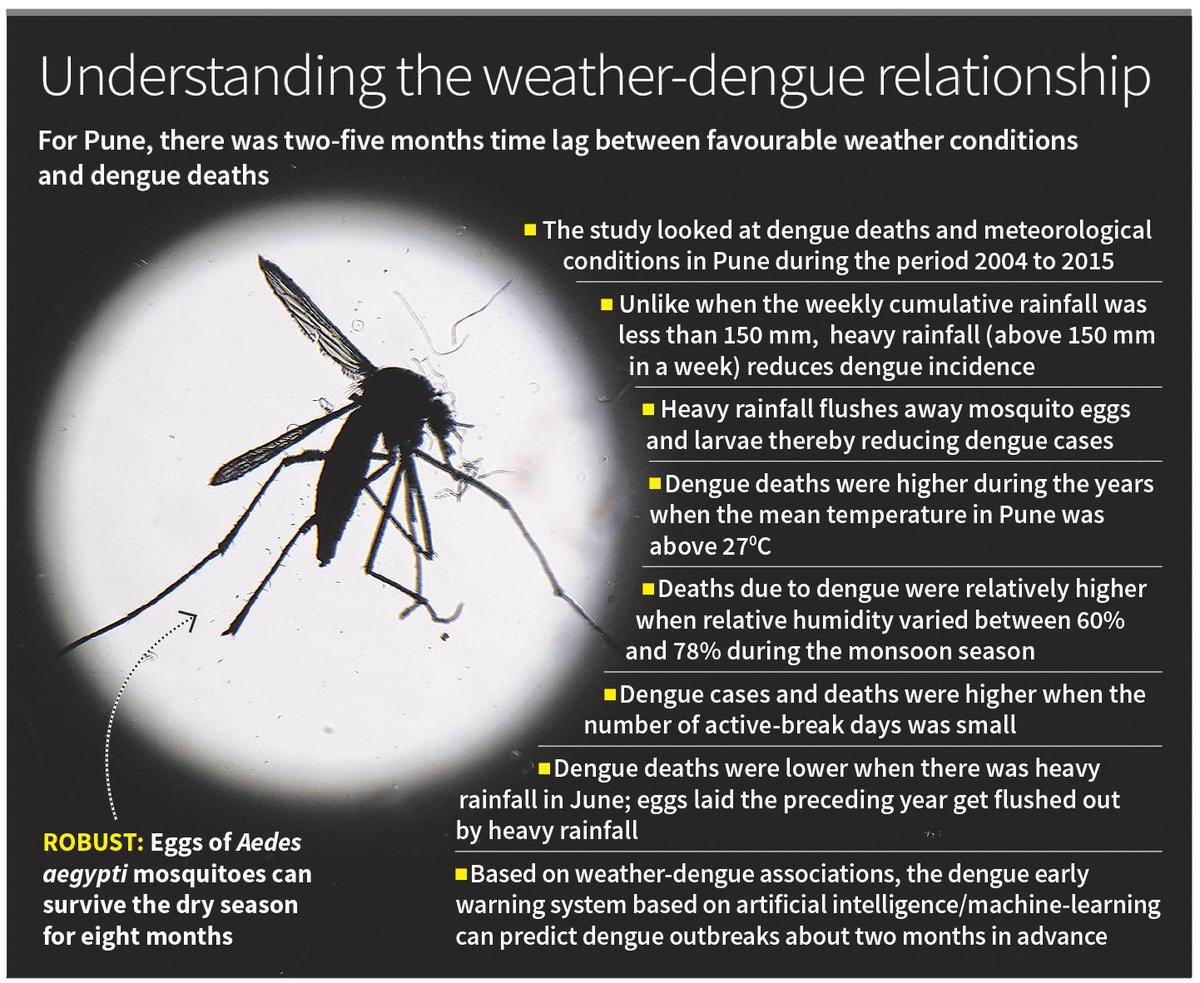
A study conducted by researchers from Pune’s Indian Institute of Tropical Meteorology explored the connection between weather patterns and dengue deaths between 2004 and 2015. The findings suggest that temperature, rainfall, and humidity significantly affect dengue transmission, and an AI-based early warning system can predict potential outbreaks up to two months in advance.
Dengue and Weather Patterns
1. Influence of Temperature on Dengue
- Dengue deaths in Pune were higher when the mean temperature was above 27°C.
- Optimal temperatures contributed to longer mosquito lifespans, increased egg deposition, and higher mosquito activity.
- A positive correlation was found between dengue deaths and days with temperatures above 27°C during the monsoon season.
2. Rainfall’s Impact on Dengue
- Moderate rainfall spread over the summer monsoon season was linked to higher dengue deaths.
- Heavy rainfall (above 150 mm in a week) was found to reduce dengue incidence by washing away mosquito eggs and larvae.
- The study showed that dengue deaths were lower during years with heavy rainfall in June, as it washed off the eggs laid in the previous season.
3. Role of Relative Humidity
- Dengue deaths were higher when relative humidity during the monsoon season ranged from 60% to 78%.
- Humidity affects mosquito survival, hatching rates, and biting frequency. A minimum of 60% is required for mosquitoes to survive.
4. Active-Break Phases of the Monsoon
- Fewer active-break days (dry periods during the monsoon) were associated with higher dengue cases and deaths.
- Consistent rainfall with fewer active-break days promotes dengue transmission, while more variable rainfall reduces it.
Dengue Early Warning System
1. Development of the AI-Based Model
- The study led to the development of a dengue early warning system using artificial intelligence (AI) and machine learning (ML).
- The model predicts dengue outbreaks up to two months in advance by analyzing temperature, cumulative rainfall, and relative humidity patterns.
- Key factors influencing the model’s accuracy: 41% mean temperature, 29% cumulative rainfall, and 20% relative humidity.
2. Future Projections of Dengue Mortality
- The model used climate projections for the future to estimate dengue mortality in Pune.
- Dengue-related deaths are projected to increase by 12-112% from 2021 to 2100 under different climate scenarios.
Conclusion
This study highlights the significant role of weather patterns in the transmission of dengue and provides valuable insights into how climate change may affect future dengue outbreaks. The development of an AI-based early warning system offers a promising tool for predicting and mitigating dengue outbreaks, potentially saving lives through timely interventions.
China’s EAST Reactor Advances Magnetic Fusion Research
Context:
China’s Experimental Advanced Superconducting Tokamak (EAST) has set a new record by sustaining plasma at 100 million degrees Celsius for 1,066 seconds. EAST serves as a testbed for ITER, an international fusion megaproject facing delays and cost overruns. While alternatives like inertial confinement are also being explored, EAST continues to demonstrate the feasibility of tokamak-based fusion.

Key Insights on EAST and Nuclear Fusion
1. Fusion vs. Fission
- Nuclear fission (splitting atomic nuclei) was discovered in 1938 and quickly led to the first nuclear reactors.
- Nuclear fusion (merging atomic nuclei) is a cleaner alternative but requires extremely high temperatures.
- Unlike fission, fusion does not produce long-lived radioactive waste.
2. The Tritium Challenge
- Deuterium (D) and Tritium (T) are preferred for fusion due to their relatively low ignition temperatures.
- Tritium is rare, mostly produced as a by-product in heavy-water reactors in countries like India, Canada, and South Korea.
- ITER and future reactors may exhaust global tritium reserves, necessitating new production methods.
3. High-Temperature Requirement
- Fusion requires overcoming the electrostatic repulsion between atomic nuclei.
- Temperatures exceeding 100 million degrees C are needed for nuclei to come within 1 femtometre and fuse.
4. Magnetic Confinement in Tokamaks
- Tokamaks, including EAST and ITER, use powerful magnetic fields to contain and heat plasma.
- EAST is the only tokamak with both toroidal and poloidal superconducting electromagnets for enhanced stability.
- The poloidal field induces an electric current, further heating the plasma.
5. EAST’s Progress and Records
- 2016: Sustained plasma for 60 seconds at 50 million degrees C.
- 2017: Extended duration to 100+ seconds.
- 2023: Held steady-state plasma for 403 seconds.
- 2025: New record of 1,066 seconds, with double the thermal power of the 2023 experiment.
6. EAST vs. ITER
- EAST supports ITER, an €18 billion megaproject with multiple delays.
- ITER was launched in 2007 and is expected to generate its first plasma in 2033.
- The high cost of fusion research has led to concerns, prompting private companies to explore alternatives.
7. Alternative Fusion Methods
a. Stellarators
- More complex than tokamaks but do not require a poloidal field for plasma stability.
b. Inertial Confinement
- Uses high-energy lasers to compress fuel pellets.
- The National Ignition Facility (NIF) in the U.S. achieved fusion ignition in 2022, producing more energy than input.
- Unlike EAST, which focuses on magnetic confinement, NIF relies on laser-driven compression.
8. The Future of Fusion Energy
- EAST is proving that magnetic fusion can be sustained, keeping tokamaks in the race.
- ITER’s slow progress and high costs raise doubts about its feasibility.
- Which approach—magnetic, inertial, or a new breakthrough—will lead to commercial fusion remains uncertain.
DDoS Attack on Kaveri 2.0: Impact and Prevention
Context:
In January 2025, Karnataka’s web-based property registration portal, Kaveri 2.0, faced severe server disruptions. Investigations revealed that a Distributed Denial of Service (DDoS) attack, rather than technical glitches, caused the outage. The attack highlights the growing threat of cyberattacks on critical government infrastructure.

1. What Happened to Kaveri 2.0?
- The portal experienced performance issues in December 2024 and January 2025.
- Fake accounts were created, making fraudulent entries into the database.
- Attackers used 62 email accounts from 14 IP addresses.
- A surge in traffic—6.2 lakh requests in two hours—crippled the system.
- Property registrations declined significantly on February 1 and 4 before recovery on February 5.
2. Understanding DDoS Attacks
- A Distributed Denial of Service (DDoS) attack floods a server, network, or service with excessive internet traffic, causing it to crash.
- Unlike Denial of Service (DoS) attacks, which originate from a single source, DDoS attacks use multiple compromised systems (botnets).
- These attacks do not directly steal data but can serve as a distraction for data breaches.
- Effects include service downtime, revenue loss, and reputational damage.
3. How Can Companies Protect Against DDoS Attacks?
- Traffic Filtering: Identify and block malicious traffic.
- Monitoring & Early Detection: Use analytics tools to detect unusual traffic patterns.
- Rate Limiting: Restrict excessive requests from a single user or IP.
- Bot Detection: Implement CAPTCHA and behavioural analysis to prevent automated attacks.
- Regular Security Audits: Strengthen authentication measures and system resilience.
- Collaboration with Cybersecurity Agencies: Share intelligence to prevent future attacks.
- User Awareness: Educate users on phishing and social engineering tactics.
4. Other Major DDoS Attacks
- Elon Musk’s X (August 2024): A massive DDoS attack disrupted the platform before his scheduled talk with U.S. President Donald Trump.
- GitHub (2015): A China-based botnet targeted GitHub projects that circumvented Chinese censorship, using malicious JavaScript injected into browsers via Baidu’s analytics.
5. Lessons from the Attack on Kaveri 2.0
- Government agencies must prioritize cybersecurity and adopt proactive defense mechanisms.
- The attack demonstrates how DDoS threats can disrupt essential public services and highlights the need for stronger cyber resilience in India’s digital infrastructure.
Aravali Safari Park Project: A Controversial Initiative
Context:
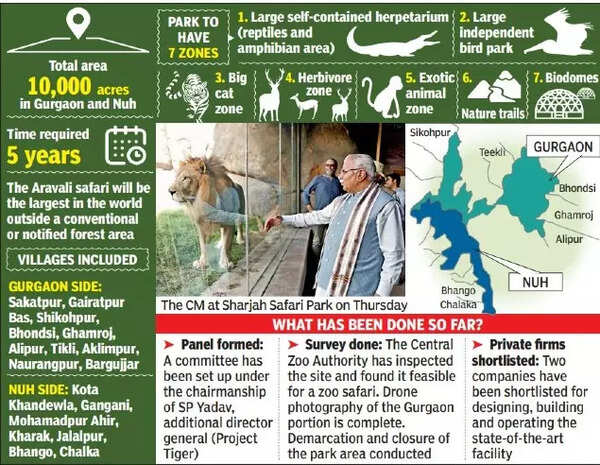
The Haryana government has proposed the Aravali Safari Park across Gurugram and Nuh, aiming to be the world’s largest safari park. However, concerns over environmental damage, legal protection of Aravali hills, and groundwater depletion have sparked strong opposition, including from retired Indian Forest Service (IFS) officers.
What is the Aravali Safari Park Project?
- The project spans 3,858 hectares, with 2,574 hectares in 11 villages of Gurugram and 1,284 hectares in 7 villages of Nuh.
- Proposed facilities include:
- Animal enclosures, guest houses, hotels, and restaurants.
- Children’s parks, botanical gardens, aquariums, and cable cars.
- Originally planned by the Haryana Tourism Department, it has now been transferred to the Forest Department, with an expert committee overseeing the project.
Why is there Opposition?
- Ecological Sensitivity:
- The Aravali range is the oldest fold mountain range, playing a crucial role in preventing desertification and recharging groundwater.
- The hills are home to diverse wildlife and plant species, making conservation essential.
- Impact on Groundwater Reserves:
- The Aravali hills act as natural aquifers, supplying water to the already water-scarce regions of Gurugram and Nuh.
- Increased tourist footfall, construction, and vehicular traffic could disturb water percolation and lead to further depletion.
- Legal Protection:
- 37 retired IFS officers have opposed the project, citing that it prioritizes tourism over conservation.
- The land falls under forest classification, protected by the Forest Conservation Act, 1980.
- Haryana’s forest cover is only 3.6%, necessitating rewilding efforts instead of infrastructure-heavy projects.
Legal Protections for Aravali
- Punjab Land Preservation Act (PLPA), 1900 – Restricts deforestation and non-agricultural use in the Aravalis.
- Indian Forest Act – 24,000 hectares recently notified as Protected Forest under this Act.
- T.N. Godavarman Thirumulpad Judgment (1996) – Extends legal protection to all forests, including those not formally notified.
- National Capital Region (NCR) Regional Plan-2021 – Classifies Aravalis as Natural Conservation Zone (NCZ), restricting construction to just 0.5% of the area.
Alternative Proposals
- Environmentalists and experts suggest declaring Aravalis a National Park or Wildlife Sanctuary instead of developing a tourism-driven safari park.
- A nature reserve with minimal human interference could serve the conservation objective while preserving the fragile ecosystem.
Conclusion
The Aravali Safari Park project has sparked a debate between development and conservation. While it aims to boost tourism, environmental and legal concerns make its feasibility questionable. Experts argue for sustainable conservation efforts, emphasizing the ecological importance of the Aravali range over commercial projects.