

Neuromorphic Computing |
Why in News: A group of researchers from the Jawaharlal Nehru Centre for Advanced Scientific Research (JNCASR) has recently created an Artificial Synapse for Brain-Like Computing, also known as Neuromorphic Computing.
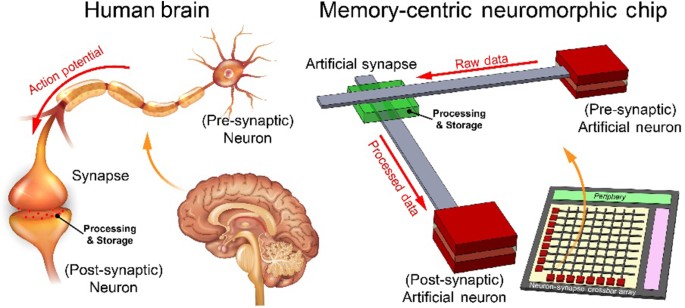
About Neuromorphic Computing
- Origins:Inspired by the human brain and nervous system, Neuromorphic Computing emerged as a concept in the 1980s.
- Design Principle:Neuromorphic Computing involves crafting computers based on human brain and nervous system structures.
- Efficiency:Neuromorphic computing devices operate efficiently, mirroring human brain functionality without necessitating large software storage space.
- Working Mechanism:
- Artificial Neural Networks (ANN): Neuromorphic computing utilizes Artificial Neural Networks (ANN), comprising millions of artificial neurons resembling those in the human brain.
- Neural Communication:Neurons within these networks communicate through layers, converting input into output via electric signals, adhering to the Spiking Neural Networks (SNN) architecture.
- Functionality:This setup enables machines to replicate human brain neural networks, performing tasks such as visual recognition and data interpretation effectively and accurately.
Edge computing |
Why in News: Based on research findings, it is projected that by 2025, over 75% of data generated and processed by companies will occur outside of conventional centralized data centers, specifically at the periphery or “edge” of the cloud.
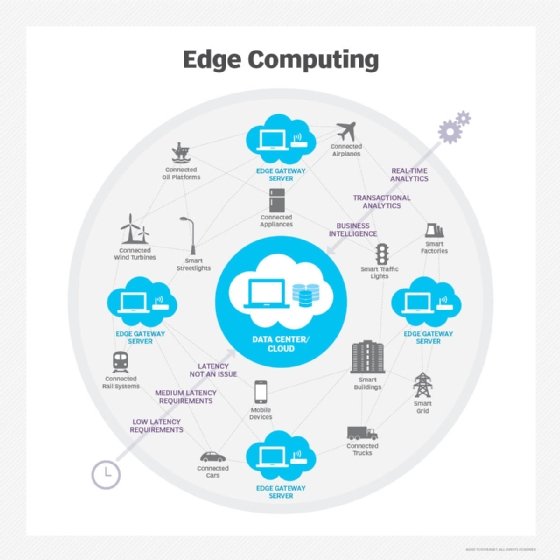
About Edge computing
Edge computing involves a decentralized IT setup where data is processed at the outskirts of the network, situated close to its original source, often an Internet of Things (IoT) sensor.
- Nature:Edge Computing is not a singular technology but rather an architectural strategy aimed at enhancing overall computing performance.
- Examples:Self-driving vehicles, intelligent energy grids, autonomous robots, data collected from smart devices, and automated retail systems.
How Edge Computing Works:
Edge computing functions by bringing computing and storage closer to both data producers and consumers, minimizing the distance data needs to travel.
- Edge Computing Architecture:Edge computing architecture is characterized by its deployment closer to data sources and consumers, with two primary categories of use cases.
- Upstream Applications:
- In upstream applications, the emphasis lies on gathering data from smart sensors and devices, then forwarding it to data centers for further processing.
- Strategies in upstream applications involve discerning between different types of data sources and transmitting only essential data to the data center.
- Downstream Applications:
- Downstream applications prioritize delivering data to end users, such as live video streaming, online gaming, or virtual reality feeds.
- Edge computing in downstream use cases aims to minimize network latency, ensuring users have a real-time experience of events.
Factor | Edge Computing | Cloud Computing |
Definition | Edge computing is a decentralized computing model that brings processing and storage closer to the source of data, reducing latency and bandwidth requirements. | Cloud computing is a centralized computing model that provides scalable computing and storage resources over the internet or a private network. |
Architecture | Edge computing involves distributed computing resources at the edge of the network, near the source of data. | Cloud computing involves centralized computing resources in large data centers. |
Latency | Edge computing reduces latency by processing data closer to the source, making it ideal for real-time applications. | Cloud computing may experience higher latency due to the distance between the user and the centralized data centers. |
Bandwidth | Edge computing reduces bandwidth requirements by processing data locally, minimizing the need for data transmission. | Cloud computing requires more bandwidth for data transmission to and from centralized data centers. |
Scalability | Edge computing may have limitations in scaling computing resources due to the distributed nature of edge devices. | Cloud computing offers high scalability, allowing users to easily increase or decrease computing resources as needed. |
Examples | Autonomous vehicles, industrial automation systems, real-time video processing, IoT devices, satellite imagery analysis. | Virtual machines, storage solutions, databases, development platforms, Infrastructure as a Service (IaaS), Platform as a Service (PaaS), and Software as a Service (SaaS). |
Cloud Computing
Why in News: India leads use of hybrid multi-cloud with 44% of companies using it: Study
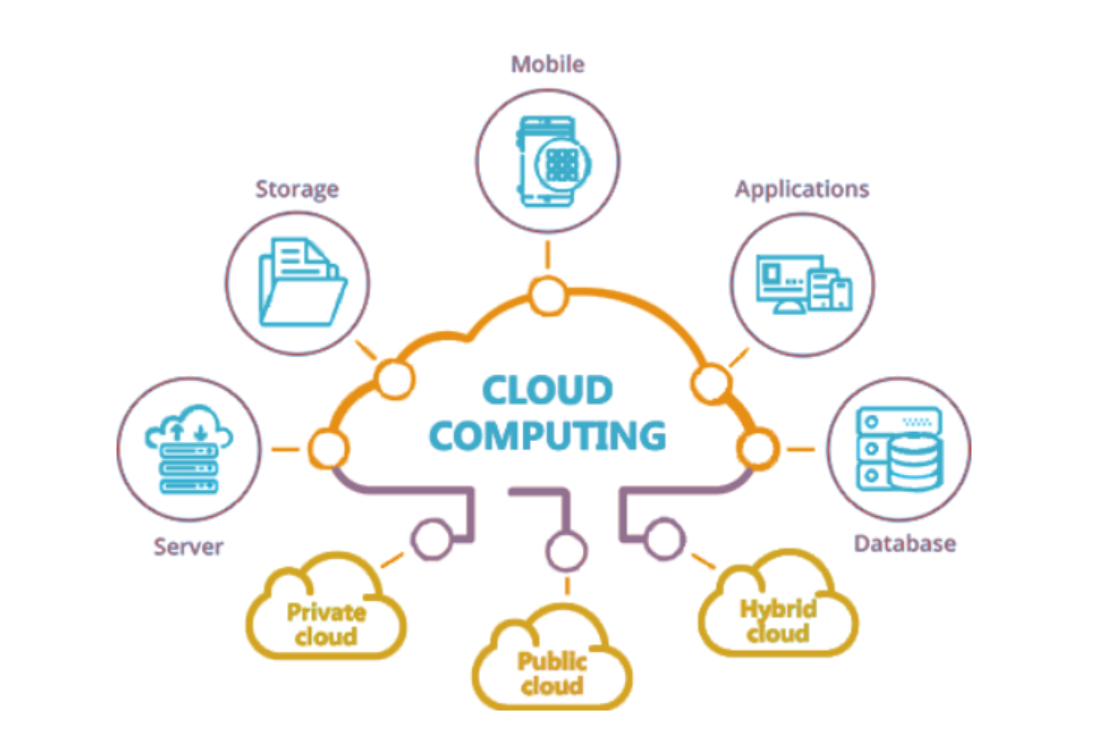
About Cloud Computing:
Cloud computing is a model for delivering IT services where resources are accessed over the internet via web-based tools and applications, rather than directly through a server. It facilitates on-demand access to computing power and data storage.
Working Mechanism of Cloud Computing:
- Centralized Data Storage:Cloud computing centralizes data storage on remote servers accessible via the internet.
- Resource Pooling:Cloud computing pools physical and virtual resources, dynamically allocating them to users based on demand.
- Data Retrieval and Management: Users can retrieve, manage, and interact with their data and applications hosted on remote servers.
- On-demand Availability:Cloud computing offers scalable services that are available on-demand to users, often with pay-as-you-go billing.
- Virtualization: Cloud computing utilizes virtualization technology to create and manage scalable virtual machines and environments.
- Automated Management:Cloud computing automates system maintenance tasks, including backup, software updates, and network security.
- Accessibility:Cloud computing allows access from any device with internet connectivity, facilitating remote work and data sharing.
Quantum dot |
Why in News: Researchers develop stretchable quantum dot display

About Quantum Dots (QDs):
Quantum dots, often termed “artificial atoms,” are tiny semiconductor nanoparticles with distinctive optical and electronic properties due to their diminutive size.
- Composition and Synthesis:
- Various semiconductor materials,like cadmium selenide, cadmium sulfide, or indium arsenide, can serve as quantum dots.
- Nanoparticles of these substances, or any other semiconductor material, exhibit quantum dot characteristics.
- Size and compositionof quantum dots can be precisely controlled during synthesis, allowing customization for different applications.
- Optical Properties:
- Quantum dots possess tunable emission properties, with their emitted or absorbed light wavelength precisely controlled by their size.
- They can emit light spanning the entire visible spectrum, extending into infrared and ultraviolet ranges, offering diverse color options for applications.
- Smaller quantum dots emit higher energy waves, producing blue light, while larger dots emit lower energy waves, creating red light, with intermediate sizes producing colors in between.
Applications:
- Displays:
- Quantum dots are utilized in display technology to enhance color and efficiency for TVs, monitors, and electronic devices.
- Compared to organic luminescent materials in OLEDs, quantum dot-based materials offer purer colors, longer lifespan, lower manufacturing costs, and reduced power consumption.
- Photovoltaics: Quantum dots can enhance light absorption and energy conversion efficiency in solar cells.
- Biomedical Applications: Their small size enables diverse biomedical applications such as medical imaging, biosensors, and targeted drug delivery, owing to their ability to navigate throughout the body.
- Quantum Computing:Quantum dots are under investigation for their potential as qubits, the fundamental units of quantum information, in quantum computing.
Quantum Computer |
Why in News: A powerful “anti-quantum attack shield” was installed in Origin Wukong, China’s most advanced superconducting quantum computer.

About Quantum computers
Quantum computers represent more than just the next evolution of faster and more efficient computing devices; they leverage the unique properties of matter at the subatomic level to perform calculations beyond the scope of conventional computers.
- Special Properties: Quantum computing harnesses the principles of Superposition and Entanglement to tackle calculations and complex problems with unprecedented speed and efficiency.
- Superposition:
- At the subatomic scale, particles like atoms, protons, or electrons exhibit peculiar behaviors that defy everyday intuition.
- These particles can simultaneously exist in multiple locations, a phenomenon known as superposition.
- Entanglement: Entanglement refers to the ability of particles to instantaneously influence each other’s behavior, even when separated by vast distances, as a result of a previous interaction.
Aspect | Conventional Computers | Quantum Computers |
Data Storage and Processing | Information is stored and processed in bits (0 and 1). | Quantum computers use quantum bits or qubits. The concept of superposition allows them to process ones and zeroes simultaneously. |
States and Processing Steps | A two-bit system can have four states (0,0), (0,1), (1,0), and (1,1), but only one state can be processed at a time. | Quantum computers can handle multiple states simultaneously due to superposition, drastically reducing the number of processing steps required. |
Processing Capability | Limited by the sequential processing of bits. | Can process significantly more information than conventional computers due to parallel processing enabled by superposition. |
Efficiency | Requires numerous steps to process each state individually. | With just a few qubits, quantum computers can surpass traditional computers in processing efficiency. |
Fundamental Difference | Handles and processes information sequentially. | Processes information fundamentally differently by exploiting quantum phenomena, offering exponential increases in processing capability. |
Applications | Used in various domains but can be inadequate for specific tasks. | Particularly useful in situations where traditional computing methods fall short, such as complex simulations, cryptography, and optimization problems. |
Scalability | Limited scalability with increasing complexity of tasks. | As more qubits are added, the processing power of quantum computers increases exponentially, enabling rapid completion of tasks that would otherwise take millions of years. |
Impactful Domains | Domains like Internet security, Health research, Artificial Intelligence, and Machine Learning. | Quantum computers have transformative potential in domains where complex calculations and rapid data processing are critical, such as cryptography, drug discovery, and optimization. |