

Why is Mumbai Experiencing Unusual February Heat? Key Weather Factors Explained
Context
Mumbai is experiencing unusually high temperatures in February, with daytime highs exceeding 36°C, following the hottest January on record. The heatwave is driven by changing wind patterns, the absence of western disturbances, and an anticyclonic system over the Arabian Sea, with temperatures expected to remain high for the next few days.

Factors Driving the Temperature Rise
- Wind Patterns
- Easterly winds in the morning provide some cooling.
- North-westerly winds in the afternoon increase temperatures.
- Absence of Western Disturbances
- These usually bring cooler northerly winds to Mumbai in February.
- Lack of these systems has allowed temperatures to rise.
- Anticyclone Over Arabian Sea
- Winds are moving clockwise due to an anticyclonic system off the west coast.
- This has resulted in the dominance of warm north-westerly winds.
- Clear Skies and Bright Sunlight
- Increased solar radiation leads to higher daytime temperatures.
- Night temperatures, however, drop faster, creating a larger diurnal temperature range.
Is February Heat in Mumbai Unusual?
- Warm February days have been recorded before:
- 37.5°C in February 2024
- 37.9°C in February 2023
- 39.6°C in February 1966 (all-time February record)
- However, large day-night temperature variations are atypical for February.
Does This Mark the End of Winter in Mumbai?
- February is a transition month between winter and summer.
- Summer officially begins in March, but there is no fixed IMD date for winter’s end.
- IMD predicts temperatures will remain high for the next 4-5 days, with a slight dip after February 22, when the anticyclone is expected to weaken.
Middle Class 2.0: Changing Employment Sector in India and Its Major Challenge
Context:
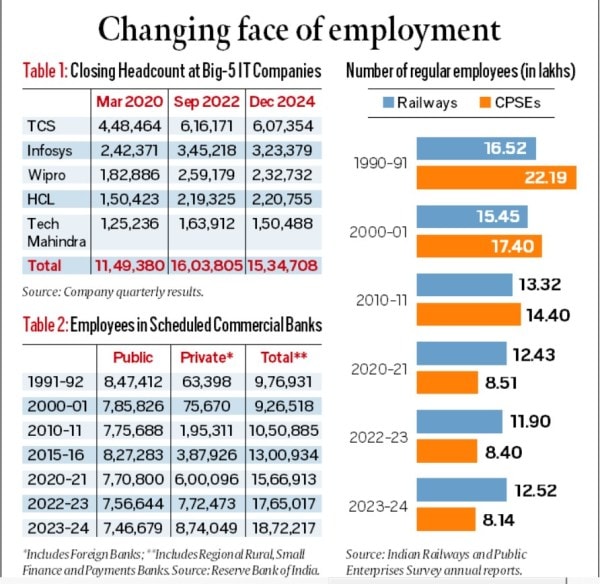
India’s employment landscape has shifted significantly, with private sector employment surpassing traditional public sector jobs. IT firms and private banks now employ more people than state-run enterprises like Indian Railways and the armed forces. However, this transition poses a major challenge: the lack of structural transformation, particularly in manufacturing, leading to limited high-paying jobs.
1. The Shift from Public to Private Sector Employment
- Declining Public Sector Jobs:
- Public sector employment fell from 194.7 lakh (1995) to 176.1 lakh (2012).
- Railways reduced its workforce from 16.5 lakh (1990-91) to 12.5 lakh (2023-24).
- Central public sector enterprises’ employment dropped from 22.2 lakh (1990-91) to 8.1 lakh (2023-24).
- Rise of Private Sector Employment:
- Economic reforms (1991) accelerated private sector expansion.
- Organised private sector employment grew from 80.6 lakh (1995) to 119.7 lakh (2012).
- The IT industry saw massive growth, with major firms employing over 15.34 lakh people by 2024.
2. Transformation in the Banking Sector
- Public Sector Banks (PSBs) Losing Ground:
- PSB employment fell from 8.5 lakh (1991-92) to 7.5 lakh (2023-24).
- Private Banks Surpassing PSBs:
- Private bank employment rose from 6 lakh (2020-21) to 8.74 lakh (2023-24).
- HDFC Bank alone had 2,13,527 employees, nearly matching SBI’s 2,32,296.
3. Growth of Middle Class 2.0 and Services-Based Jobs
- Liberalisation and globalisation created jobs in IT, banking, healthcare, tourism, logistics, media, and real estate.
- India became a global services hub, but job creation remained concentrated in high-skill industries.
- Informal sector jobs like delivery services (Uber, Zomato, Swiggy) grew but lack long-term stability.
4. The Structural Challenge: Missing Manufacturing Growth
- Agricultural Workforce Stagnation:
- The farm sector’s workforce share fell from 64% (1993-94) to 42.5% (2018-19) but rebounded to 46.2% (2023-24).
- Limited Manufacturing Expansion:
- Manufacturing employment peaked at 12.6% (2011-12) but declined to 11.4% (2023-24).
- The share of construction (12%), trade/hotels (12.2%), and other services (11.9%) now exceeds manufacturing.
5. The Core Employment Challenge
- Service Sector Dominance:
- Most new jobs are in low-paying service roles like construction labor, security staffing, retail, and gig work.
- Highly skilled jobs (IT, finance, legal, healthcare) benefit the educated but leave many behind.
- Need for Industrial Growth:
- Unlike China, India has not shifted surplus labor into high-productivity manufacturing.
- Without industrial expansion, Middle Class 2.0 will remain inaccessible to many workers.
Conclusion
India’s employment sector has evolved post-liberalisation, with private enterprise leading growth. However, without a manufacturing-driven transformation, job creation will remain skewed towards services, limiting upward mobility for a large segment of the workforce. Addressing this imbalance is crucial for sustainable middle-class expansion.
Vice President JD Vance’s Munich Security Conference Speech Sparks European Criticism
Context: At the Munich Security Conference on February 14, 2025, U.S. Vice President JD Vance delivered a speech that drew significant criticism from European leaders. His remarks, focusing on Europe’s internal policies and transatlantic relations, have been perceived as indicative of a shifting dynamic between the United States and Europe.

Key Points:
- Critique of European Policies
- Suppression of Dissent: Vance criticized European nations for allegedly suppressing free speech and excluding populist parties from political discourse. He highlighted the exclusion of certain lawmakers from the conference as an example of this trend.
- Immigration Policies: He expressed concerns over Europe’s immigration policies, suggesting they might undermine shared Western values.
- European Response
- German Chancellor’s Rebuttal: Olaf Scholz, the German Chancellor, labeled Vance’s comments as inappropriate among allies and firmly rejected his assertions.
- Broader European Disapproval: Other European officials and commentators viewed Vance’s speech as a sign of a changing U.S.-Europe relationship, with potential implications for future cooperation.
- Implications for Transatlantic Relations
- Shift in U.S. Foreign Policy: Vance’s remarks suggest a possible realignment of U.S. foreign policy priorities, with a focus on promoting free speech and addressing internal European issues.
- Support for Populist Movements: The speech raised concerns that the U.S. might openly support populist and right-wing parties in Europe, potentially influencing internal European politics.
- Significance of the Munich Security Conference
- Historical Background: Established in 1963 during the Cold War, the Munich Security Conference serves as a key platform for international security discussions, primarily among Western nations.
- Current Role: Today, the conference addresses a wide range of global security issues, including military conflicts, climate change, and migration, facilitating dialogue among global leaders.
- Potential Long-term Effects
- Evolving Alliances: Vance’s speech may signal a transformation in the traditional U.S.-Europe alliance, prompting European nations to reassess their foreign and domestic policies.
- Internal European Dynamics: The U.S.’s perceived support for certain political factions could influence electoral outcomes and policy decisions within European countries.
Bombay HC Allows Termination of 25-Week Pregnancy: Key Points
1. Background of the Case
- A 35-year-old woman approached the Bombay High Court seeking permission to terminate her 25-week pregnancy.
- The Medical Board of J J Hospital in Mumbai recommended abortion after diagnosing the foetus with skeletal dysplasia, a genetic disorder affecting bones and neurological functions.
- Despite the recommendation, the woman could not undergo the procedure due to legal ambiguities.

2. Legal Framework on Abortion in India
- Up to 20 weeks: Requires approval from one registered medical practitioner.
- 20-24 weeks: Requires approval from two registered medical practitioners, permitted only for specific categories (e.g., rape survivors, minors, physical disability, mental illness, etc.).
- Beyond 24 weeks: Requires approval from a Medical Board set up by the state government in each district in cases of substantial foetal abnormalities.
- Doctors must evaluate if continuing the pregnancy poses risks to the woman’s life or if the child would suffer from serious abnormalities.
3. Regulations for Abortion at Private Hospitals
- Section 4 of the Medical Termination of Pregnancy (MTP) Act, 1971 allows abortion at:
- Government hospitals.
- Private hospitals approved by a District Level Committee under Rule 5(6) of the MTP Rules.
- Approval Process: Private hospitals must obtain a certificate (Form A) for terminating pregnancies in two categories:
- Up to 12 weeks.
- Up to 24 weeks.
- No provision exists for terminating pregnancies beyond 24 weeks at private hospitals.
4. Issue Raised Before the High Court
- The petitioner’s advocate, Meenaz Kakalia, argued that:
- Form A does not include a third category for termination beyond 24 weeks, creating ambiguity.
- The private hospital of her choice lacked the required certificate, preventing the abortion despite having necessary facilities.
- A third category should be added to Form A to allow terminations beyond 24 weeks in private hospitals with necessary infrastructure.
5. High Court’s Ruling
- The bench of Justices Revati Mohite-Dere and Neela K Gokhale noted the “utmost urgency” of the case.
- The court acknowledged the petitioner’s right to reproductive freedom, bodily autonomy, and choice.
- It permitted the private hospital to conduct the procedure as it fulfilled the necessary medical conditions under MTP Rules.
6. Precedents & Pending Legal Reforms
- In April 2024, the Bombay HC had allowed a 37-year-old woman from Thane to terminate her 27-week pregnancy at a private hospital due to foetal abnormalities.
- The HC recognized legal ambiguities in Form A and decided to deliberate on necessary changes in future hearings.
7. Key Takeaways
- Legal ambiguity prevents private hospitals from performing abortions beyond 24 weeks despite having medical facilities.
- The court intervention allows exceptions in urgent cases but highlights the need for policy reforms.
- Future rulings may clarify the legal framework for late-term abortions at private hospitals.