

Protecting India’s Architectural and Cultural Legacy
Background
- India boasts a rich cultural and historical heritage, but climate change and human activities pose significant threats to its preservation.

Role of the Archaeological Survey of India (ASI)
Mandate and Governance
- Established in 1861, ASI is responsible for the conservation and protection of historical sites.
- Oversees 3,698 protected monuments under:
- Ancient Monuments Preservation Act (1904)
- Ancient Monuments and Archaeological Sites and Remains Act (1958)
Primary Functions
- Preservation & Maintenance – Conducts regular upkeep of temples, forts, palaces, tombs, and prehistoric sites.
- Threat Mitigation – Implements measures against pollution, encroachments, and environmental degradation.
- Research & Impact Assessment – Monitors how climate and human activities affect heritage sites.
- Legal Protection – Enforces laws to prevent illegal alterations or misuse of cultural landmarks.
Climate Change and Its Effects on Heritage Sites
Major Environmental Risks
- Coastal Erosion & Rising Sea Levels – Monuments like Konark Sun Temple (Odisha) & Mahabalipuram (Tamil Nadu) are at risk of saltwater intrusion & decay.
- Extreme Temperatures & Droughts – Heatwaves and changing weather conditions weaken sandstone & limestone structures.
- Heavy Rainfall & Cyclones – Excessive water exposure leads to erosion and structural weakening in forts, palaces, and ancient temples.
- Airborne Pollution – Sulfur dioxide emissions result in Taj Mahal’s marble discoloration, reducing its aesthetic and structural integrity.
Government Measures to Safeguard Cultural Heritage
Financial and Scientific Interventions
- Increased Budget for Restoration
- 2020-21 Allocation – ₹260.90 crores
- 2023-24 Allocation – ₹443.53 crores (70% increase)
- Advanced Conservation Techniques – ASI utilizes modern scientific methods for sustainable restoration.
Technology-Driven Preservation
- Climate Monitoring Systems – ASI, in collaboration with ISRO, has installed Automated Weather Stations (AWS) at key heritage sites.
- Pollution Control Measures – Air quality labs near Taj Mahal (Agra) & Bibi Ka Maqbara (Aurangabad) monitor environmental pollutants.
Multi-Agency Collaboration
- Partnerships with NDMA & UNESCO – Strengthening disaster preparedness for historical sites.
- Strengthening Legal Protection – Section 30 of the 1958 Act mandates strict penalties for vandalism and encroachment.
Future Strategies for Heritage Protection
Community Participation & Awareness
- Engaging local communities in conservation efforts to promote accountability and preservation initiatives.
- Organizing educational programs to enhance public understanding of heritage protection.
Integration of Modern Technology
- Deploying AI, 3D scanning, and drone-based mapping for heritage documentation and restoration.
Stronger Law Enforcement
- Imposing stricter penalties for encroachments, defacement, and illegal alterations of historical monuments.
India’s Strategic Presence in the Indian Ocean
Backdrop
- India, along with Singapore and Oman, is hosting the 8th Indian Ocean Conference (IOC) in Muscat.
- Foreign ministers from 30 nations are discussing regional security and economic cooperation.
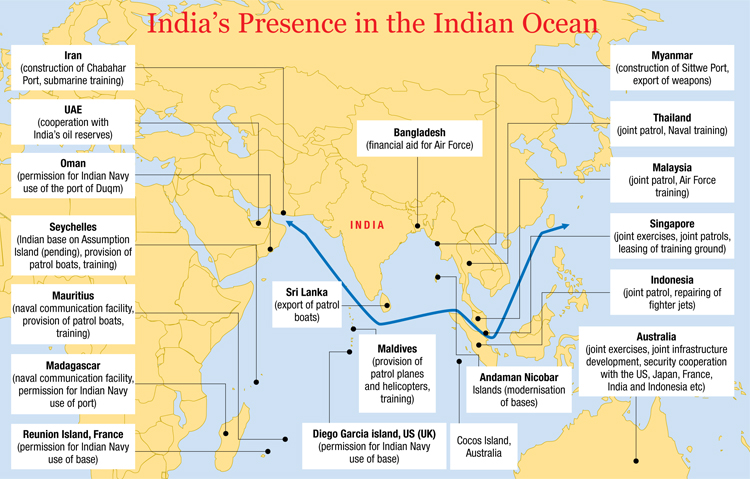
Overview of the Indian Ocean Region (IOR)
- Third-largest ocean, covering 70.56 million sq km, linking Asia, Africa, and Australia.
- A historic trade route, shaped by Indian maritime networks and cultural influence.
Countries Engaged with IOR
- 26 coastal nations, including India, Sri Lanka, Maldives, Oman, Indonesia, Australia, South Africa, and Somalia.
- Landlocked nations like Nepal and Bhutan rely on IOR trade networks.
Significance of the Indian Ocean
1. Trade and Economic Lifeline
- Facilitates 70% of global container shipments.
- Handles 90% of India’s energy imports, making it a crucial economic hub.
2. Strategic Maritime Routes
- Hosts vital sea lanes like the Strait of Malacca, Hormuz, and Bab el Mandeb, ensuring global trade continuity.
3. Resource Abundance
- Rich in fisheries, hydrocarbons, and minerals, supporting regional economies.
4. Global Security Nexus
- Home to naval bases of major powers (US, UK, China, France), influencing global defense policies.
India’s Role in the Indian Ocean
1. SAGAR Vision (2015)
- India’s Security and Growth for All in the Region initiative aims for regional stability and prosperity.
2. Strengthening Maritime Defense
- The Indian Navy engages in joint exercises like MILAN, Malabar, and Varuna for regional security.
3. Economic & Infrastructure Development
- Enhancing ports through Sagarmala and promoting the Blue Economy for sustainable resource use.
4. Humanitarian & Disaster Response
- India leads in disaster relief operations, assisting nations in crisis situations.
5. Diplomatic & Multilateral Engagements
- Actively collaborates through IORA, BIMSTEC, and QUAD for maritime governance.
Key Challenges in the IOR
1. Expanding Chinese Influence
- The String of Pearls strategy and rising Chinese naval activity challenge regional stability.
2. Threats of Piracy & Illegal Activities
- Somali piracy, illegal fishing, and arms smuggling disrupt trade and security.
3. Climate-Induced Risks
- Rising sea levels and coastal erosion threaten small island nations.
4. Cyber & Underwater Security Risks
- Chinese control over subsea cables raises concerns over data security.
5. Maritime Crimes & Terrorism
- Drug trafficking, human smuggling, and terrorism pose security risks.
Strategic Measures for the Future
1. Strengthening Maritime Infrastructure
- Investments in modernizing ports, expanding naval capabilities, and enhancing surveillance.
2. Deepening Regional Cooperation
- Strengthening partnerships with IORA, QUAD, and key bilateral agreements.
3. Advancing Blue Economy & Sustainability
- Promoting marine industries, clean energy, and sustainable fisheries.
4. Safeguarding Regional Sovereignty
- Enhancing cybersecurity and countering foreign dominance in key maritime sectors.
5. Climate Resilience & Disaster Preparedness
- Developing early warning systems, resilience strategies, and emergency response frameworks.
Conclusion
The Indian Ocean Region is central to global trade, security, and economic stability. India’s leadership through SAGAR and IORA is crucial in ensuring maritime security and regional cooperation. Strengthening infrastructure, strategic partnerships, and sustainability efforts will bolster India’s position in the global maritime order.
Can India Replicate the Amul Success Story for the Fruits & Vegetables (F&V) Sector?
Introduction
- India’s fruits and vegetables (F&V) sector contributes about 30% to crop agriculture and is growing faster than cereals.
- Despite its significance, F&V lacks policy support, organized value chains, and adequate processing infrastructure.
- Farmers receive only 30% of consumer price due to fragmented value chains, post-harvest losses, and seasonal price fluctuations.
- The success of Amul in dairy raises the question: Can India replicate this model for F&V?

The Amul Model & Dairy Revolution
- Amul’s cooperative model helped India become the world’s largest producer of milk (239 million tonnes in 2023-24).
- Milk cooperatives, pioneered by Verghese Kurien, ensured 75-80% of consumer price reached farmers.
- Unlike dairy, the F&V sector is diverse, with multiple commodities requiring specialized infrastructure, storage, and processing.
The Role of Farmer Producer Organizations (FPOs)
- FPOs can be game-changers by integrating farmers into structured value chains.
- Sahyadri Farmer Producer Company Ltd (SFPCL) in Nashik serves as a successful blueprint:
- Founded in 2004 with 10 farmers, now 26,500+ registered farmers (2023-24).
- Annual turnover grew from ₹13 crore (2011-12) to ₹1,549 crore (2023-24).
- Exports to 41 countries, with grapes, mangoes, and bananas being key contributors.
- Farmers receive ~55% of the export price, higher than market averages.
Challenges in Scaling the Amul Model for F&V
- Commodity Diversity: Unlike milk, F&V includes multiple crops requiring specialized handling.
- Price Volatility: Seasonal variations cause extreme price fluctuations.
- Post-Harvest Losses: 8.1% for fruits, 7.3% for vegetables, totaling ₹1.53 trillion in losses annually (NABCONS, 2022).
- Lack of Processing Infrastructure: Only a small fraction of F&V is processed, leading to distress sales.
Key Interventions Needed
A. Strengthening FPOs
- Provide working capital, infrastructure support, and digital integration.
- Link FPOs with Open Network for Digital Commerce (ONDC) for market access.
- Use blockchain technology to enhance transparency and traceability.
B. Expanding Government Initiatives
- Revive & expand Operation Greens (launched in 2018) to stabilize perishable prices.
- Increase funding (beyond ₹500 crore under Ministry of Food Processing).
- Ensure strong leadership like Kurien in Operation Flood.
C. Building a National Value Chain Strategy
- Develop commodity-specific processing facilities to stabilize prices.
- Ensure at least 10-20% of F&V is processed to prevent distress sales.
- Establish a National Fruit and Vegetable Board similar to NDDB.
- Promote retail linkages (e.g., SAFAL) for better price realization for farmers.
Conclusion
- Scaling up 10,000 high-impact FPOs like Sahyadri Farms can redefine India’s F&V sector.
- Requires policy support, financial backing, and leadership akin to Verghese Kurien.