

World Health Organization (WHO)
Why in News: The head of the World Health Organization recently urged global leaders to pressure Washington to reconsider President Donald Trump’s decision to withdraw from the U.N. health agency.

Overview
- WHO is the specialized health agency of the United Nations.
- Established in 1948, it aims for the highest possible level of health for all people.
- Health, as per the WHO Constitution, is defined as a state of complete physical, mental, and social well-being, not just the absence of disease.
Functions
- Provides leadership on global health issues.
- Shapes the health research agenda.
- Sets norms and standards in healthcare.
- Develops evidence-based policy recommendations.
- Offers technical support to countries.
- Monitors and assesses global health trends.
Membership and Headquarters
- Comprises 193 member countries and two associate members.
- The headquarters is in Geneva, Switzerland.
Structure
- Governance: WHO is managed through the World Health Assembly, which meets annually as the main policymaking body.
- Executive Board: Composed of health specialists elected for three-year terms.
- Leadership: The agency is headed by a Director-General, nominated by the Executive Board and appointed by the World Health Assembly.
Funding
- Around 16% of the budget comes from mandatory contributions by member states.
- The remaining funds come from voluntary donations from governments and private entities.
- Major voluntary contributors include the United States, Germany, the United Kingdom, and the Bill & Melinda Gates Foundation.
World Health Day
- WHO celebrates April 7, 1948, its founding date, as World Health Day every year.
MAKHANA
Why in News: While presenting the Union Budget, the Union Finance Minister announced the establishment of a “Makhana Board” in Bihar to enhance the cultivation and marketing of fox nuts.

Background
- Bihar contributes approximately 90% of India’s makhana production.
- The cultivation is primarily concentrated in northern and eastern Bihar.
Key Takeaways
- Makhana (Fox Nut) is the dried edible seed of the prickly water lily or gorgon plant (Euryale ferox).
- It grows in freshwater ponds across South and East Asia.
- The plant is characterized by violet and white flowers and large, round, prickly leaves that can exceed one meter in diameter.
- The edible seeds have a black to brown outer layer, earning them the nickname “Black Diamond.”
- After processing, the seeds are consumed as popped snacks called ‘lava’.
- Nutritional Value: Rich in carbohydrates, protein, and minerals, making it valuable for medicine, healthcare, and nutrition.
- In 2022, ‘Mithila Makhana’ received a Geographical Indication (GI) tag.
- Besides Bihar, small-scale cultivation occurs in Assam, Manipur, West Bengal, Tripura, Odisha, and neighboring countries like Nepal, Bangladesh, China, Japan, and Korea.
Climatic Conditions for Cultivation
- Makhana is an aquatic crop grown in tropical and subtropical regions.
- Traditionally cultivated in stagnant water bodies such as ponds, lakes, ditches, wetlands, and land depressions with a water depth of 4-6 feet.
- Ideal growing conditions include:
- Temperature: 20-35°C
- Relative Humidity: 50-90%
- Annual Rainfall: 100-250 cm
Falling Indian Rupees
Why in News: The Indian rupee is consistently depreciating against the US dollar, reaching a record low due to the new tariffs imposed by the US President on imports from China, Mexico, and Canada.
Understanding Exchange Rate
- The exchange rate defines the value of one currency relative to another, indicating how much domestic currency is needed to buy foreign currency.
- It fluctuates based on market demand and supply, influenced by trade, investments, and monetary policies.
Mechanism of Exchange Rate Movements
- Impact of Demand and Supply
- If the demand for US dollars surpasses the rupee, the dollar strengthens, leading to rupee depreciation.
- Role of Trade and Investments
- Increased US imports, foreign investments, and capital outflows reduce the demand for the rupee, weakening its value.
- Effect of Inflation and Interest Rates
- High inflation or low interest rates in India reduce investor confidence, contributing to rupee depreciation.
Key Reasons Behind Rupee Depreciation
- Trade Deficits and Global Tariffs
- US-imposed tariffs on China, Mexico, and Canada have strengthened the US dollar, affecting emerging market currencies like the rupee.
- India’s import dependency increases the demand for US dollars, leading to rupee depreciation.
- Stronger US Dollar and Federal Reserve Policies
- The US Federal Reserve’s stringent monetary policies have increased bond yields, attracting global investors to US assets.
- The dollar index climbed to 109.8, making the US dollar stronger against other currencies.
- Capital Outflows from Indian Markets
- Foreign investors are pulling out funds from Indian equity markets, increasing the demand for the dollar.
- Concerns over a trade war and global economic slowdown have accelerated capital flight from India.
- Inflationary Pressures and Interest Rate Gaps
- Higher inflation in India compared to the US weakens purchasing power, making the rupee less appealing.
- Lower interest rates in India discourage foreign investments, further reducing rupee stability.
Gig Workers
Why in News: The Union Finance Minister has declared that gig workers will now be covered under the Ayushman Bharat-Pradhan Mantri Jan Arogya Yojana (PMJAY), making them eligible for healthcare benefits.
Increased Healthcare Budget
- The total health budget allocation has risen by over ₹9,000 crore.
- Key programs include Ayushman Bharat, infrastructure expansion, and funding for AIIMS-Delhi.
- The Jan Arogya Yojana (PMJAY) offers ₹5 lakh per family annually for hospitalization in both public and private hospitals.
- Details on whether gig workers’ families will be covered under PMJAY are yet to be clarified.
Health Insurance Coverage in India (NITI Aayog Report)
- Only 10% of India’s population has private health insurance.
- Nearly 60% are covered by government-funded schemes like Ayushman Bharat.
- 30% (over 400 million people) still lack any form of health insurance.
Who are Gig Workers?
- Gig workers engage in temporary, flexible, or freelance work instead of traditional long-term employment.
- They often work as independent contractors or freelancers rather than permanent employees.
- The term “gig” originates from the music industry, where artists take up short-term performances.
- Digital platforms connect gig workers to clients for short-term services such as:
- Ride-hailing (e.g., Uber, Ola)
- Food delivery (e.g., Swiggy, Zomato)
- Holiday rentals (e.g., Airbnb)
Gig Economy in India
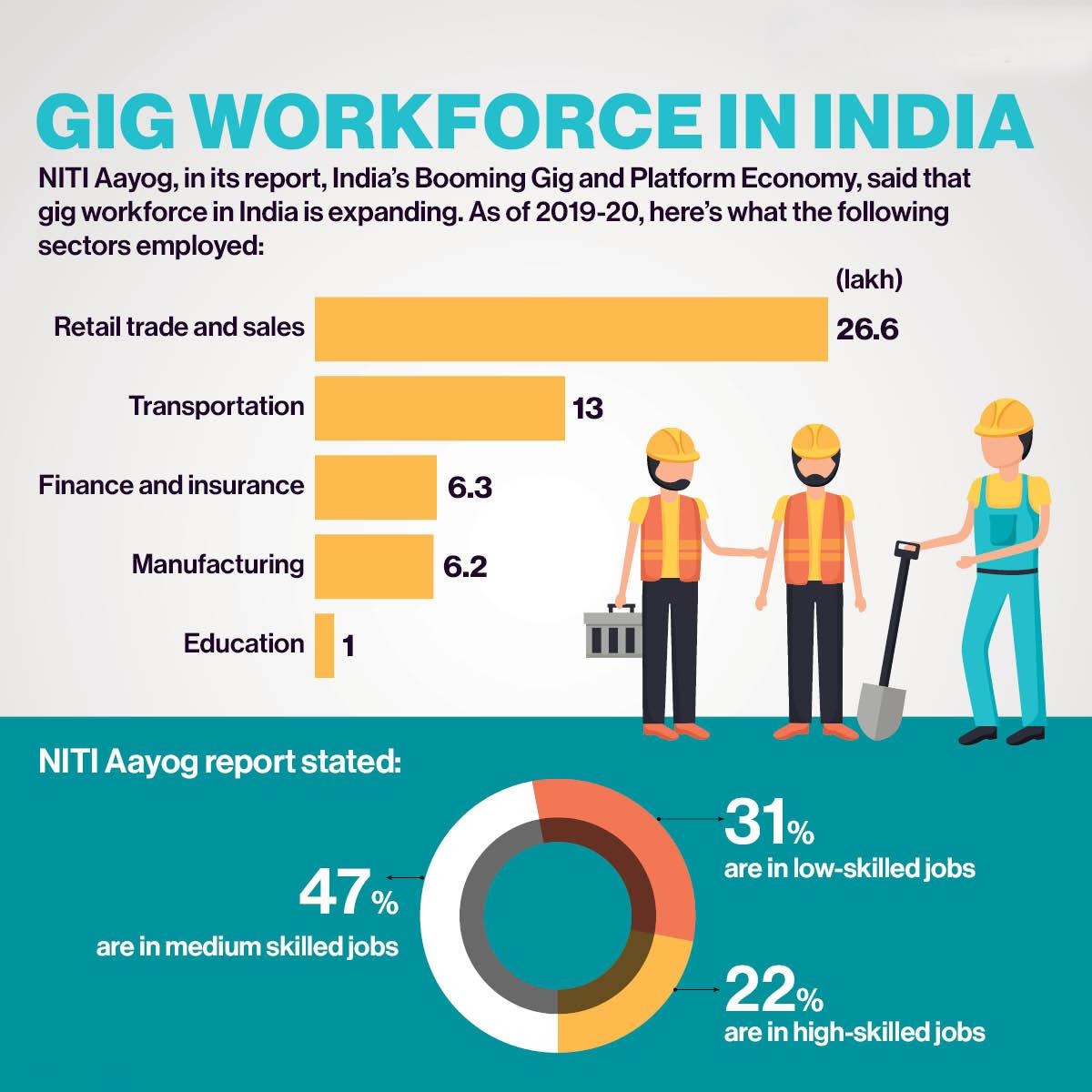
- 7.7 million workers were engaged in gig jobs in 2020.
- By 2029-30, the gig workforce is expected to reach 23.5 million (4.1% of the total workforce).
- Distribution of gig jobs:
- 47% in medium-skilled work
- 22% in high-skilled jobs
- 31% in low-skilled jobs
- The gig economy is projected to contribute 1.25% to GDP by 2030 and generate 90 million jobs in the long term.