

Relevance: GS III Sci & Tech
Why in News: By 2030, the 100 MW project with a desired Q factor higher than 30 might be completed. The ratio of energy generated to energy used to heat the plasma inside the fusion reactor is known as the Q factor.
About the Hybrid Fusion-Fission Reactor
The idea is to breed fissile fuel from fertile materials by using a high intensity neutron flux generated by a fusion reactor to promote a nuclear fission process.
- Consists of a nuclear fusion reactor core encircled by a blanket of fertile material (such as uranium-238 or thorium-232) where deuterium and tritium nuclei fuse to generate helium and a fast neutron.
- Important characteristics of the hybrid reactor capitalizes on the differences between the benefits of fission and fusion: fission reactors are “power rich” and “neutron poor,” whereas fusion reactors are “neutron rich” and “power poor.”
- Because the primary function of hybrid reactors is the creation of neutrons rather than energy, they require less fusion power than pure reactors.
- The blanket’s neutron flow may convert long-lived radioactive waste into shorter-lived, less hazardous trash that is simpler to dispose of.
- By breeding, a hybrid reactor would generate enough fissile fuel. Fertile materials can be transformed into fissile materials (such as uranium-233 or plutonium-239) by fusion neutrons, expanding the availability of fuel.
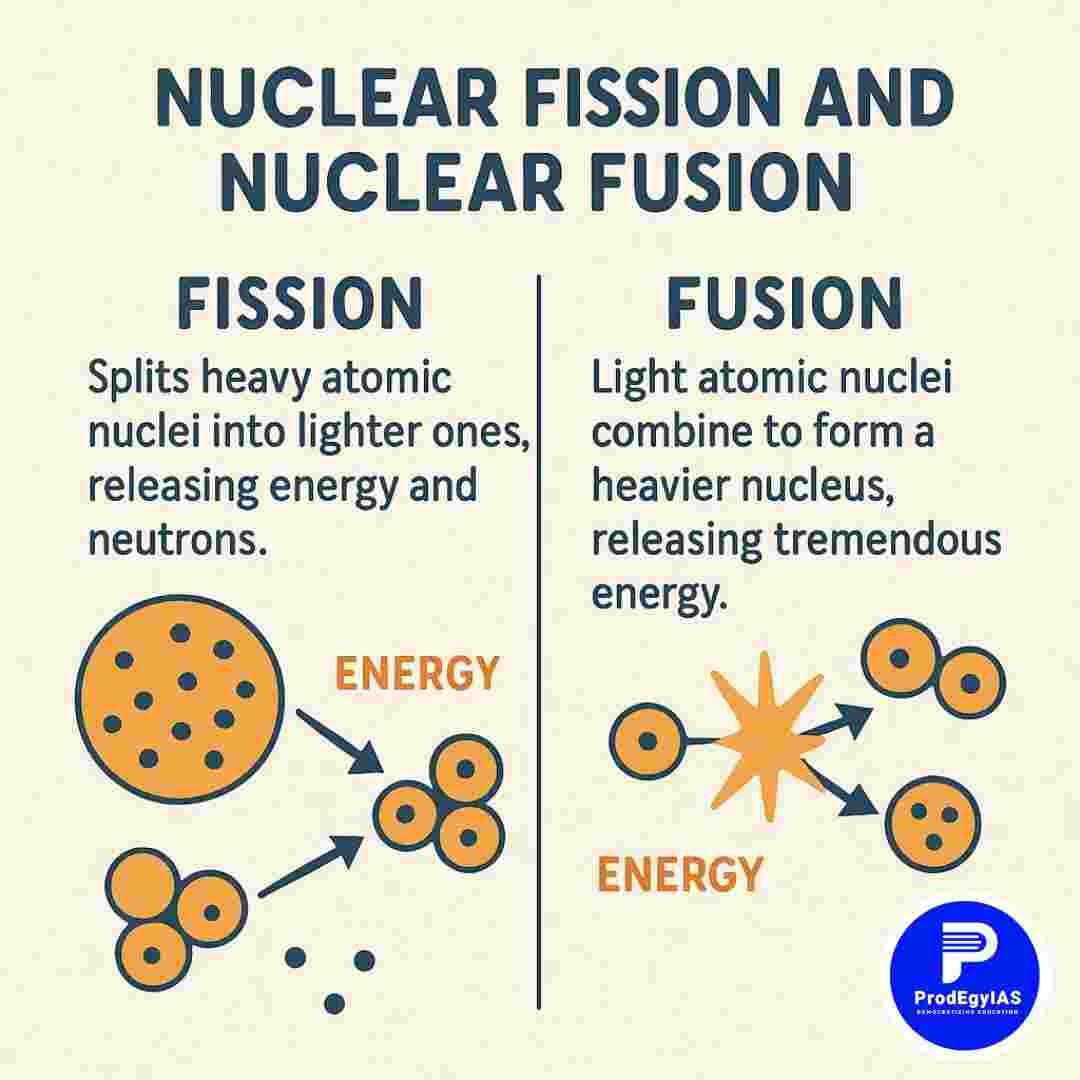
- The concepts of nuclear fusion and fission Fission: Releases energy and neutrons when heavier atomic nuclei split into lighter ones.
- A large amount of energy is released when light atomic nuclei unite to form a heavier nucleus.
| MCQs Q. Consider the following statements about the Hybrid Fusion-Fission Reactor:
How many of the above statements are correct? a) Only one b) Only two c) All three d) None Answer: b) Only two |
UPSC General Studies Paper Preparation
| Topic | |
| UPSC Syllabus | GS Genius-50 Program |
| Public administration crash course | UPSC GS Mains 2025 Study Material |
| About the Author: Nitin Kumar Singh |