
Answer:
Approach to the answer:
Answer:
Approach to the answer:
Comprehending and organizing the response: Write about Shankaracharya’s teachings and beliefs, then emphasize how his work and teachings led to the synthesis of these concepts and ideologies.
Overview:
Provide a synopsis of Adi Shankaracharya’s work and Provide a synopsis of the circumstances that prevailed at the time, including
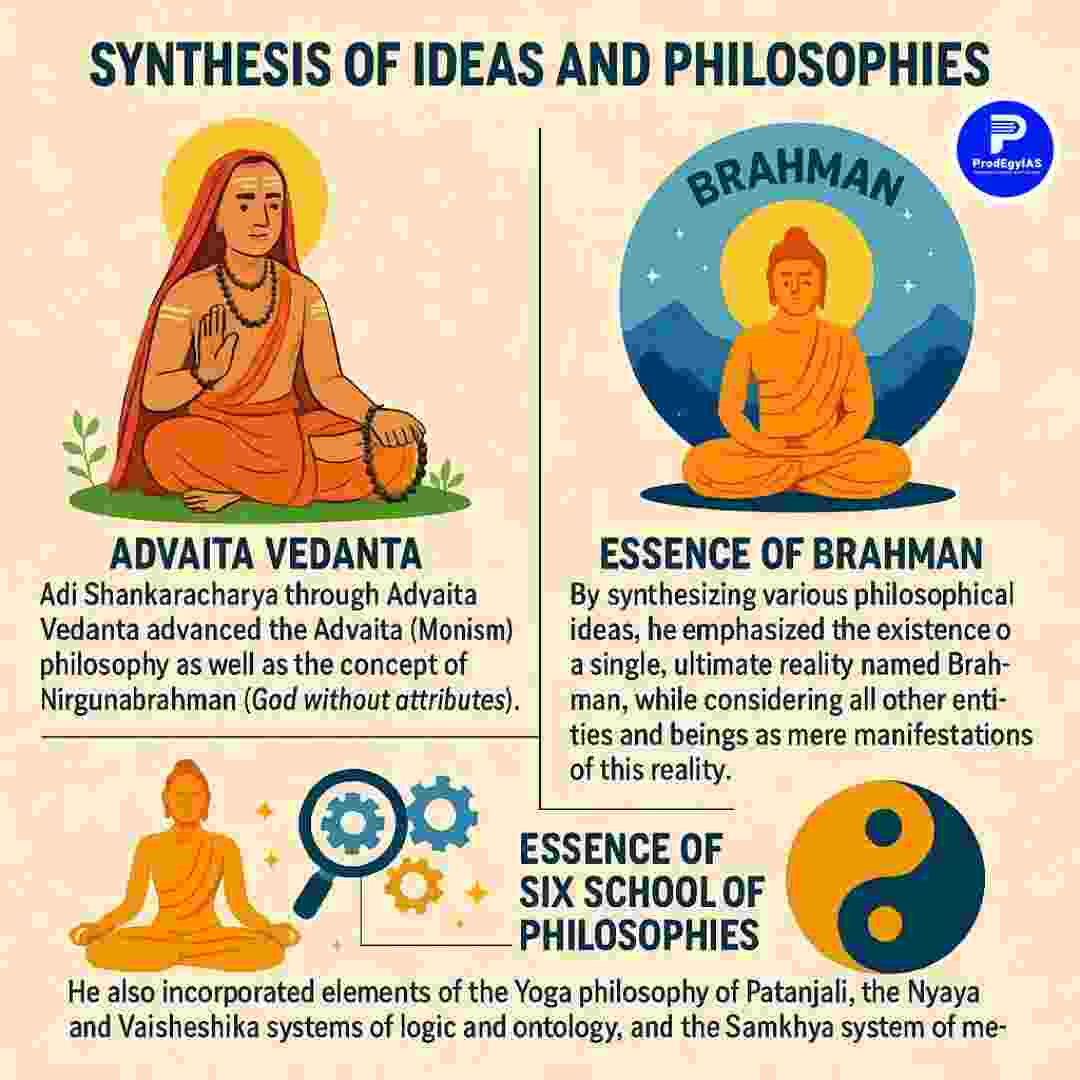
- For Example: Many people consider the great Indian philosopher and theologian Adi Shankaracharya (788–820 CE) to be one of the key players in the formation of Hinduism. He is especially renowned for his attempts to integrate and harmonize various philosophical theories and schools of thinking that were common in ancient India.
Body:
Discuss the request in two sections. 1) Conceptual and philosophical synthesis; 2) Adi Shankaracharya’s contribution.
In summary:
Provides an overview of Adi Shankaracharya’s role in the evolution of Hindu philosophy and Provides an overview of the significance of Adi Shankaracharya’s teachings and philosophies.
- For Example: Adi Shankaracharya made important and long-lasting contributions to Hindu philosophy. For millennia, India’s intellectual and spiritual heritage has been influenced by his emphasis on non-dualism and the ultimate truth of Brahman, as well as his commentary on Hindu texts. His writings and teachings have had a long-lasting influence on India’s spiritual and intellectual heritage.
Practice Question: The establishment of the four mathas by Adi Shankaracharya was more than just a religious move — it was an institutional strategy. Discuss how the monastic orders established by Adi Shankaracharya contributed to cultural consolidation and knowledge dissemination in India.
MCQs
- With reference to Adi Shankaracharya, consider the following statements:
- He was born in Kaladi, Kerala in the 8th century CE.
- He was a devotee of Lord Vishnu and composed the Vishnu Sahasranama.
- He took Samadhi at Kedar Tirth at the age of 33.
- He established mathas in four corners of India to promote Advaita Vedanta.
Which of the statements given above are correct?
- 1, 3 and 4 only
- 1 and 2 only
- 2, 3 and 4 only
- 1, 2, 3 and 4
Answer: A
UPSC General Studies Paper Preparation
| Topic | |
| UPSC Syllabus | GS Genius-50 Program |
| Public administration crash course | UPSC GS Mains 2025 Study Material |
| About the Author: Nitin Kumar Singh |