

Overview
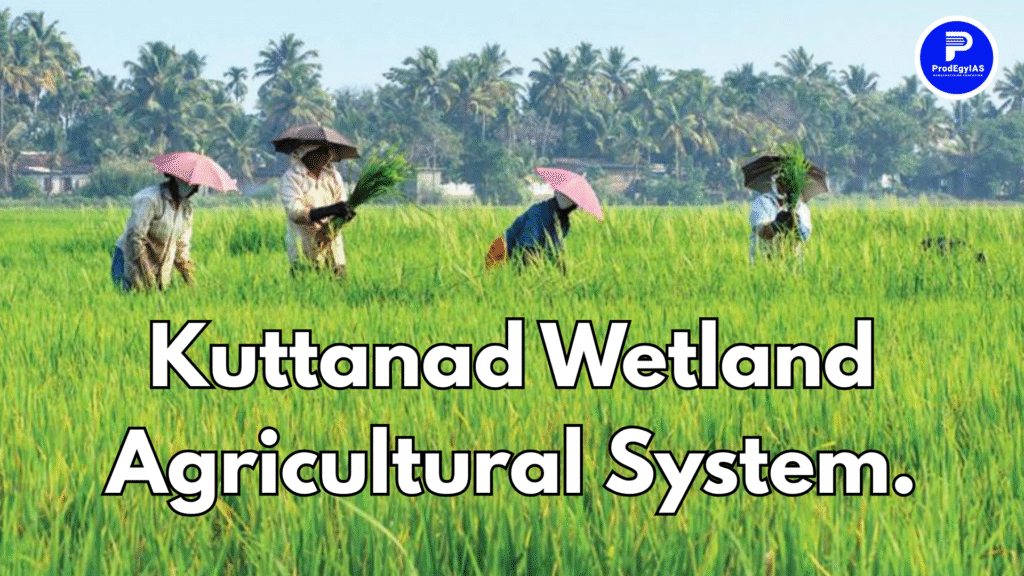
Kerala’s Kuttanad Wetland Agricultural System (KWAS) is a singular illustration of sustainable farming and traditional ecological expertise. An indigenous reaction to difficult ecological conditions, Kuttanad has been designated as a Globally Important Agricultural Heritage System (GIAHS) by the FAO. Kuttanad is essential to India in terms of sustainable development, food security, and climate change.
The Unique Features of the Kuttanad System
Paddy is grown in Kuttanad, widely known as the “Rice Bowl of Kerala,” on reclaimed marshes that are one to two meters below mean sea level. In the past, farmers have built padasekharams, or earthen bunds, to shield farms from salty backwaters. A thorough awareness of ecology is demonstrated by the management of water through sluices, canals, and manual dewatering. The system appropriately balances biodiversity, fisheries, and agriculture.
Environmental and Socioeconomic Significance
The Kuttanad system is really good at keeping the wetlands of different kinds of plants and animals. It helps thousands of farmers who do not have a lot of land. The Kuttanad system acts like a wall that stops the salt water from coming in and prevents flooding. The Kuttanad system is an example of how people can work together to take care of the land. It also shows how we can deal with changes in the weather and grow food without using a lot of chemicals. The Kuttanad system and other similar ideas are becoming more important as India tries to find ways to stop the earth from getting damaged and to help farmers who are struggling. The Kuttanad system is a solution for Indias problems, with the environment and farming.
Issues with the System
Kuttanad has some problems even though it has some things. These days Kuttanad gets flooded a lot. The floods are really bad. This is because of climate change. The soil and water in Kuttanad are not as good as they used to be because people are using many chemical fertilisers. They have built walls and drainage systems that have changed the way water naturally moves in Kuttanad. Kuttanad is also, in trouble because many people are moving to cities and not many young people are involved in Kuttanad anymore.
In the future we need to take care of Kuttanad in a way. Kuttanad needs a plan that uses ideas and new research together. We have to fix the wetlands get the people who live there involved use bad chemicals and farm in a way that is good for the earth. If we get help from the government we can save Kuttanad and its old way of farming by protecting the wetlands and making sure the farming is strong, against weather.
In conclusion, the Kuttanad Wetland Agricultural System is both a regional and a worldwide illustration of sustainable agriculture. Its preservation is essential to India’s aspirations for climate adaptation, cultural heritage, and ecological security.
FAQs on Kuttanad Wetland Agricultural System
1. What makes Kuttanad unique in Indian agriculture?
It is one of the few regions in the world where farming is practiced below sea level.
2. Why is Kuttanad recognised by FAO?
Due to its sustainable wetland farming practices and rich agricultural heritage.
3. Which crops are mainly grown in Kuttanad?
Paddy is the dominant crop, along with inland fisheries.
4. What are the major threats to the Kuttanad system?
Climate change, flooding, chemical pollution, and hydrological disturbances.
5. How is Kuttanad relevant for UPSC?
It links GS-I (culture, heritage), GS-III (agriculture, environment), and climate resilience.
UPSC General Studies Paper Preparation
| Topic | |
| UPSC Syllabus | UPSC Free Notes |
| UPSC Optional Subjects | Khushhali Solanki (AIR 61, UPSC CSE 2023) |
Public Administration Optional Exam Preparation
Topic | |
About the Author: Jyoti Verma