

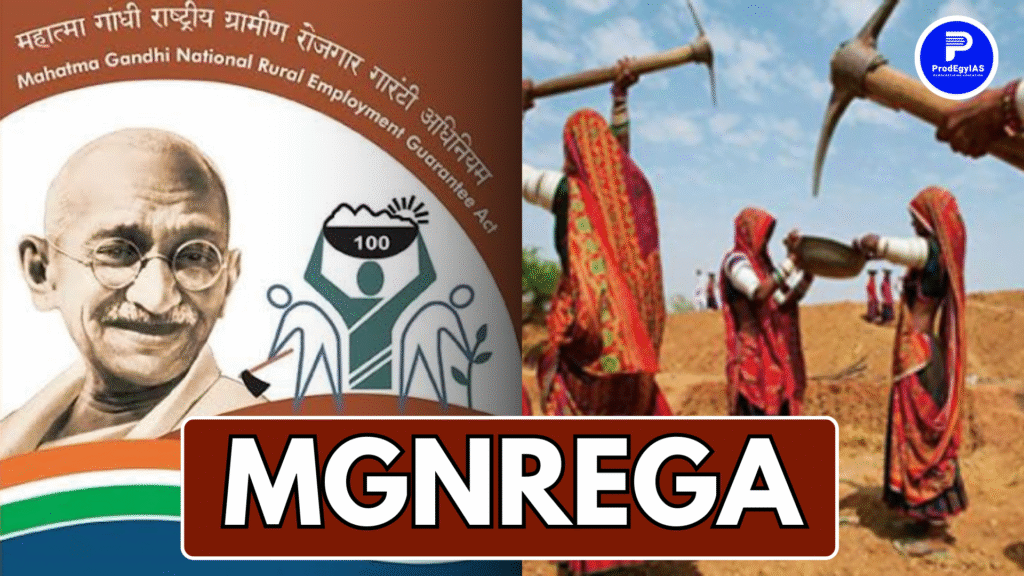
The Mahatma Gandhi National Rural Employment Guarantee Act (MGNREGA) of 2005 is one of India’s most important rights-based welfare laws, aiming at providing livelihood stability to rural households. Unlike typical poverty-relief programs, MGNREGA establishes a legal rights to employment, changing welfare from a charity to a justiciable right.
Objectives and Key Features
MGNREGA provides 100 days of pay employment every fiscal year to every rural household whose adult members volunteer for unskilled manual work. Employment must be offered within 15 days of demand; otherwise, an unemployment benefit is payable. The Act promotes decentralised planning, with Gramme Sabhas playing an important role in identifying projects and monitoring their progress.
MGNREGA work focusses on asset building, such as water conservation, drought mitigation, rural connection, and the construction of Anganwadi centres. The 60:40 wage-to-material ratio is a fundamental design factor that ensures the scheme’s labour-intensive nature. At least one-third of the beneficiaries are female, encouraging gender equality.
Administrative and Financial Architecture
MGNREGA is implemented by the Ministry of Rural Development, with financing split between the Centre and the States. Wages are adjusted to the Consumer Price Index for Agricultural Labourers (CPI-AL) and paid via Direct Benefit Transfer (DBT) to maintain transparency. Aadhaar-based payments, asset geotagging, and social audits have all helped to improve accountability.
Achievements and Significance
MGNREGA is implemented by the Ministry of Rural Development, with financing split between the Centre and the States. Wages are adjusted to the Consumer Price Index for Agricultural Labourers (CPI-AL) and paid via Direct Benefit Transfer (DBT) to maintain transparency. Aadhaar-based payments, asset geotagging, and social audits have all helped to improve accountability.
UPSC General Studies Paper Preparation
| Topic | |
| UPSC Syllabus | UPSC Free Notes |
| UPSC Optional Subjects | Khushhali Solanki (AIR 61, UPSC CSE 2023) |
Public Administration Optional Exam Preparation
Topic | |
About the Author: Jyoti Verma