

Satkosia Wildlife Sanctuary |
Why in News: Concerns have arisen regarding the migration patterns of long-ranging animals due to the sparse population of elephants in the Satkosia Wildlife Sanctuary.
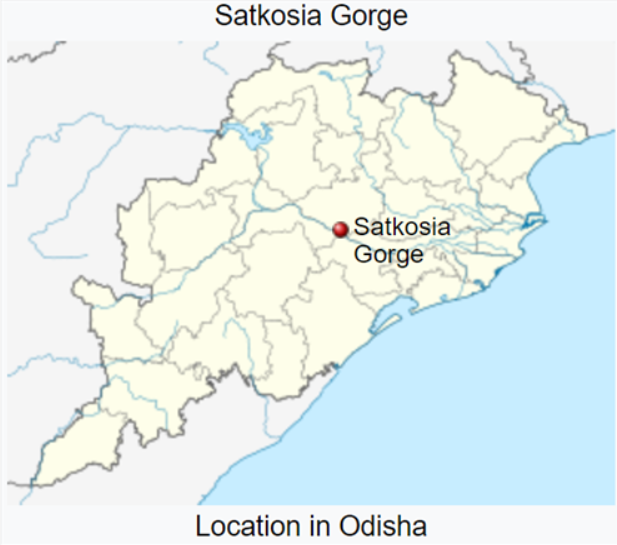
About Satkosia Wildlife Sanctuary:
- Origin of the Name: The sanctuary derives its name from the narrow segment of the Mahanadi River called “Sat-kosh,” highlighting its significance in Odisha’s tiger habitat.
- Consolidation as Tiger Reserve:Initially established as separate entities, the Satkosia Gorge Sanctuary and Baisipali Sanctuary were amalgamated and designated as the Satkosia Tiger Reserve in 2007.
- Diverse Wildlife:The sanctuary is home to a variety of fauna, including Sloth bears, Gaurs, sambar deer, spotted deer, and other species.
Kalasa Banduri Project |
Why in News: The Karnataka government recently presented an updated proposal to the National Wildlife Board (NWB) and the Ministry of Environment, Forest and Climate Change (MoEFCC) regarding the Kalasa-Banduri project.
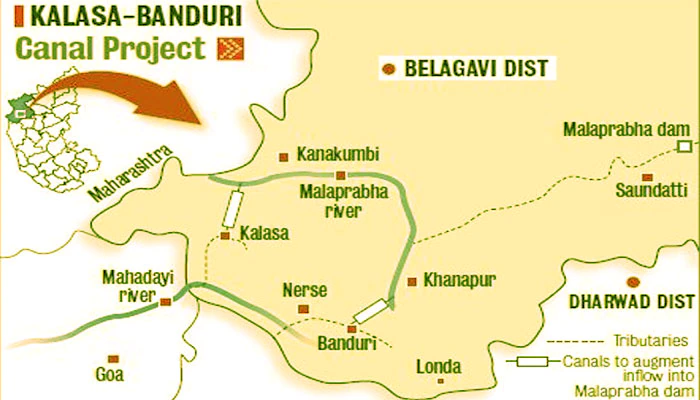
About Kalasa-Banduri project:
- Objective of the Project:The project is designed to redirect water from the Mahadayi River to address the drinking water requirements of Belagavi, Dharwad, Bagalkot, and Gadag districts in Karnataka.
- Infrastructure Plan:It involves the construction of barrages on the Kalasa and Banduri streams, which are tributaries of the Mahadayi River.
- River Source and Route:The Mahadayi River originates in the Bhimgad Wildlife Sanctuary located in the Belagavi district of Karnataka. It traverses through the state and eventually empties into the Arabian Sea in Goa.
Nagarjunasagar-Srisailam Tiger Reserve |
Why in News: The Nagarjunasagar-Srisailam Tiger Reserve received a “Very Good” rating in the 5th Cycle of Management Effectiveness Evaluation (MEE).

About Nagarjunasagar-Srisailam Tiger Reserve (NSTR):
- Geographical Coverage:Spanning across five districts in Andhra Pradesh and Telangana, the reserve is predominantly situated within the Nallamala Hills region.
- Ecological Characteristics:The reserve features typical tropical dry and moist deciduous vegetation, characterized by hilly terrain adorned with bamboo and grass undergrowth.
- River Basin Presence:The basin of the Krishna River traverses through the territory of this reserve, contributing to its ecological diversity.
- Eco-Tourism Initiatives:Eco-tourism activities within the Nagarjunasagar-Srisailam Tiger Reserve (NSTR) involve active engagement with local communities, particularly the ‘Chenchus’ (PVTG), to garner public support for wildlife conservation. These initiatives also aim to provide alternative livelihood options to the indigenous communities.
Gandhi Sagar Wildlife Sanctuary |
Why in News: Madhya Pradesh recently declared its intention to develop Gandhisagar Sanctuary as a secondary habitat for cheetahs.

About Gandhisagar Wildlife Sanctuary:
- Geographical Location:Situated in Madhya Pradesh, the sanctuary shares its boundary with the Rajasthan border.
- Habitat Characteristics:The sanctuary boasts open landscapes with sparse vegetation, rocky terrain, and small patches of dense forests, creating an ideal environment for cheetahs. It is intersected by the River Chambal.
- Vegetation Diversity: Tree species within the sanctuary include Khair, Salai, Dhawda, Tendu, and Palash, contributing to its ecological richness.
- Rich Fauna:The sanctuary is inhabited by a variety of wildlife, including herbivores such as Chinkara, Nilgai, and Spotted Deer, along with carnivores like the Indian Leopard, Striped Hyena, and Jackal.
Netravali Wildlife Sanctuary |
Why in News: A rescued Black Panther was slated for release into the Netravali Wildlife Sanctuary.
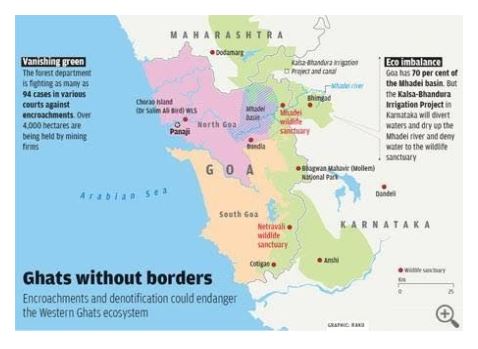
About Netravali Wildlife Sanctuary:
- Geographical Position: Positioned in the Sanguem Taluka in Southeastern Goa, the sanctuary is nestled within this region.
- River System: The sanctuary is the birthplace of the River Netravali, which holds significance as a major tributary of the Zuari River.
- Vegetation Composition:Dominated by moist deciduous forest, with pockets of semi-evergreen forest nestled in valleys, the sanctuary’s flora exhibits diverse characteristics.
- Wildlife Diversity:Among its fauna are species like the Indian gaur, spotted deer, sambar deer, barking deer, and others, contributing to its ecological richness.
- Neighboring Reserves:Adjacent to the sanctuary are the Bhagwan Mahavir Wildlife Sanctuary and the Cotigao Wildlife Sanctuary, forming part of its neighboring protected areas.