

Did Corporate Tax Cuts Increase Wages?
Context
Corporate tax cuts were implemented in major economies like the U.S. and India to stimulate economic growth, investment, and employment. These cuts aimed to enhance corporate profitability, which was expected to trickle down to increased wages and job creation. However, the actual impact on wages has been a subject of debate.
Findings from the U.S.
Tax Cuts and Jobs Act (2017):
- The U.S. reduced the corporate tax rate from 35% to 21%.
- Impact on Investment: Studies indicate an 8-14% increase in investment post-tax cuts. However, this resulted in only a modest long-term GDP increase of 0.9% and an annual wage increase of less than $1,000 per worker.
- Revenue and Fiscal Health: The tax cuts led to a significant reduction in tax revenue, impairing the U.S. economy’s fiscal health, with minimal benefits for wage earners.
Findings from India
Corporate Tax Reduction (2019):
- India lowered corporate tax rates from 30% to 22% for existing companies and from 25% to 15% for new companies.
- Impact on Wages and Employment: The tax cuts had negligible effects on employment and wages. Regular wage employment declined from 22.8% (2017-18) to 20.9% (2022-23), with rural wages decreasing in real terms and urban wages stagnating.
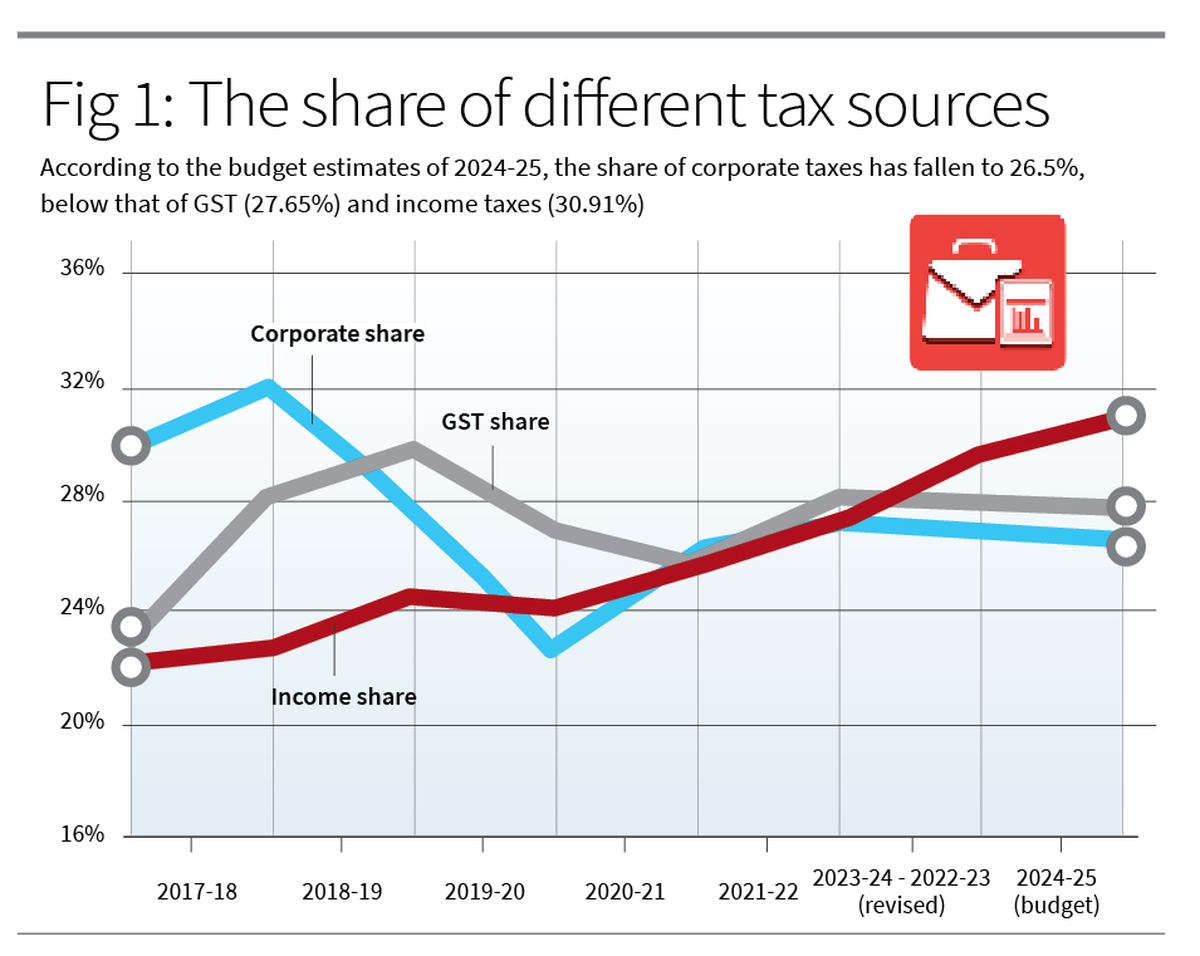
- Shift in Tax Burden: The tax cuts led to a shift in the tax burden from corporates to individuals, with the share of corporate taxes in gross tax revenue falling from 32% (2017-18) to 26.5% (2024-25).
Conclusion
Corporate tax cuts primarily benefited private capital without significantly boosting wages or employment. The reduction in tax rates increased profits on existing investments but did not substantially drive new investments that could have raised wages and employment. The overall impact on income distribution was skewed in favor of capital owners, with wage earners seeing little to no benefit. This suggests that while corporate tax cuts may increase profitability, their effectiveness in stimulating broader economic benefits, such as higher wages, is limited.
Why is Google Accused of Being an Illegal Monopoly?
Context
Google, the dominant player in the search engine market, was accused by the U.S. Department of Justice (DOJ) in 2020 of being an illegal monopoly. The accusation stems from Google’s business practices that allegedly stifled competition and maintained its dominant position at the expense of rivals and consumers.

Accusations Against Google
- Default Search Engine Practices: Google is often pre-installed as the default search engine on most new devices, including phones and laptops. The company pays substantial sums—billions of dollars annually—to manufacturers like Apple and Samsung to ensure that Google remains the default option on their devices. For instance, Google paid Apple around $20 billion in 2022 to be the default search engine on Safari, Apple’s browser. This arrangement makes it difficult for competitors to gain market share, as many users tend to stick with the default search engine on their devices.
- Market Dominance: With over 90% of the global search engine market share, Google’s size and influence raise concerns about its ability to dictate terms to other businesses and its overwhelming impact on the market. Critics argue that this level of dominance limits consumer choice and stifles innovation, as competitors struggle to break through the entrenched user base of Google.
Monopoly Debate
- Pro-Monopoly Concerns: The argument that Google is a monopoly stems from its overwhelming market share and the advantages it gains from being the default search engine. This position, some argue, allows Google to exert undue influence over the market and suppress competition.
- Counterarguments: However, others, including the judge in the recent case, argue that having a large market share does not inherently make a company a harmful or illegal monopoly. The presence of potential competition and the absence of legal barriers to market entry suggest that Google’s dominance could be challenged if a competitor offers a superior product. Additionally, supporters claim that Google’s success is due to the quality of its service, not just its business practices, and that paying for default status is akin to purchasing prime real estate for better visibility.
Potential Consequences
- Court Proceedings: The court proceedings against Google are set to continue, and several outcomes are possible. The court might order Google to cease sharing ad revenues with companies like Apple to maintain its default search engine status. It could also mandate that users be given a clear choice of search engines when setting up their devices.
- Sharing Data: Another possible outcome is that Google could be forced to share search data with competitors, which could level the playing field by allowing rivals to improve their services.
- Breaking Up Google: In a more extreme scenario, the court could consider breaking Google into smaller companies to reduce its dominance, although this outcome is less likely.
- Appeal: Google may choose to appeal the court’s decision, prolonging the legal battle and its potential implications for the company and the broader tech industry.
Conclusion
The case against Google highlights the complexities of regulating powerful tech companies in a rapidly evolving digital landscape. The outcome of this legal battle could have significant implications for the future of competition in the tech industry and the way dominant companies operate in global markets.
The Harm Principle: John Stuart Mill’s Theory on Liberty and Its Limits
Context
John Stuart Mill, a 19th-century philosopher, is renowned for his work On Liberty, where he explores the extent to which individual freedoms should be exercised in a society. Mill’s harm principle is a foundational concept in this work, arguing that individual liberties should only be restricted to prevent harm to others.

Mill’s Harm Principle
- Core Idea: Mill’s harm principle posits that the only justification for society or the state to restrict an individual’s liberty is to prevent harm to others. According to Mill, actions that solely affect the individual (self-regarding actions) should not be subject to societal or governmental interference. However, actions that affect others (other-regarding actions) may warrant intervention.
- Application: For instance, Mill would argue that while an individual has the liberty to drink excessively (a self-regarding action), the state or society might intervene if that behavior leads to harm, such as violence against others (an other-regarding action).
Defining Harm
- Physical vs. Psychological Harm: Mill primarily focused on physical harm, such as violence. However, contemporary debates have expanded the definition of harm to include psychological and emotional damage, such as that caused by hate speech or misinformation. The complexity of defining harm becomes evident in cases like hate speech, where the damage may not be immediately apparent but can have severe long-term consequences.
- Case Study: The example of hate speech in Assam, where derogatory terms like “Miya Muslims” are used, illustrates the challenge of applying Mill’s harm principle. While some might argue that such speech falls under free expression, it can also incite violence and perpetuate deep-seated biases, leading to significant harm to targeted communities.
Freedom of Speech and Expression
- Mill’s Stance: Mill strongly advocated for freedom of speech, believing that the clash of opinions is essential for discovering truth and maintaining the vitality of beliefs. He argued that even false opinions contribute to the strength of true beliefs by challenging them.
- Limits on Free Speech: Despite his advocacy for free speech, Mill acknowledged that this freedom is not absolute. He provided the example of inflammatory speech that incites a mob, arguing that such speech could justifiably be restricted because it poses an immediate risk of harm.
- Modern Implications: In today’s context, the balance between free speech and preventing harm is increasingly relevant. For instance, when leaders or influential figures make inflammatory remarks, the potential for inciting violence or perpetuating harmful stereotypes is significant, raising questions about the limits of free speech.
Conclusion
John Stuart Mill’s harm principle remains a critical framework for understanding the limits of liberty. While Mill emphasized the importance of individual freedom, he recognized the need for restrictions when actions harm others. In modern society, where the definition of harm has broadened to include psychological and social dimensions, Mill’s theory continues to influence debates on free speech, societal responsibility, and the role of the state in regulating behavior. The ongoing relevance of Mill’s ideas highlights the enduring challenge of balancing individual liberties with the collective well-being of society.
Can Earthquakes Explain Why Gold Nuggets Are Found in Quartz Veins?
Context
Gold nuggets found in quartz veins have long puzzled scientists, with various theories attempting to explain how they form. A recent study published in Nature Geoscience offers a novel explanation that ties the formation of these nuggets to seismic activity, specifically the piezoelectric properties of quartz.

The Mystery of Gold Nuggets in Quartz Veins
- Current Theories: Scientists have struggled to fully explain how large gold nuggets accumulate in quartz veins, especially considering gold’s low solubility in fluids. Some hypotheses include nanoparticle transportation in water or deposition from hot, mineral-rich fluids. However, these ideas have limitations, particularly in explaining the localization and concentration of gold in specific areas.
Quartz’s Piezoelectric Properties
- Piezoelectricity: Quartz is a piezoelectric crystal, meaning it generates an electric charge when subjected to mechanical stress. This property allows quartz to influence the movement of charged particles, such as electrons, between the crystal and nearby fluids.
- Piezocatalysis: When quartz is repeatedly stressed, such as during an earthquake, it can drive electrochemical reactions at its surface through a process called piezocatalysis. This mechanism can cause gold from nearby solutions to deposit onto the quartz.
Experimental Evidence
- The Study: Researchers tested this theory by placing quartz slabs in a gold-bearing solution and subjecting them to mechanical strain similar to what they would experience during seismic activity. After just one hour, they observed gold deposits forming on the strained quartz, but not on the control slabs.
- Chemical Reactions: The key reactions involved the reduction of gold ions (AuCl4–) to elemental gold (Au), facilitated by the piezocatalytic activity of the quartz. These findings suggest that seismic waves can indeed promote the accumulation of gold in quartz veins over time.
Implications
- Localized Gold Deposits: The study also explains why gold nuggets are highly localized in quartz veins. Once some gold is deposited, the area becomes more conductive, attracting even more gold through subsequent piezocatalytic reactions.
- Fracture Networks: Repeated seismic activity reactivates fractures in quartz veins, allowing fluids to flow through and continually deposit gold, creating interconnected networks of gold deposits that appear to “float” in the quartz.
Conclusion
The study’s findings suggest that earthquakes and the piezoelectric properties of quartz play a crucial role in the formation of gold nuggets in orogenic quartz veins. This explanation, grounded in basic principles of physics and chemistry, provides a compelling answer to a long-standing geological mystery. By understanding the process, we gain insight into the natural mechanisms that have concentrated gold in specific geological settings over millions of years.
Unified Lending Interface (ULI) by RBI
What is the Unified Lending Interface (ULI)?
The Unified Lending Interface (ULI) is a digital platform developed by the Reserve Bank Innovation Hub (RBIH), Bengaluru, under the Reserve Bank of India (RBI). ULI is designed to streamline and simplify the lending process by facilitating the seamless flow of a borrower’s digitized financial and non-financial data from multiple data service providers to lenders. This platform uses a common and standardized set of Application Programming Interfaces (APIs), allowing for a “plug and play” approach that integrates data from diverse sources, including government databases, land records, and satellite imagery.

How Will ULI Enable Frictionless Credit to Farmers?
- Access to Data: ULI will enable lenders to access comprehensive digital data about borrowers, including economic activities and land records, all through a single platform. This reduces the need for borrowers, especially farmers, to provide extensive documentation, making the credit application process faster and more efficient.
- Automated Credit Appraisal: The platform will allow lenders to instantly assess a farmer’s financial condition, land ownership status, and income through integrated data sources. This automation of credit appraisal processes can lead to quicker loan approvals and disbursements.
- Support for Tenant Farmers: ULI will assist tenant farmers who often struggle to access credit due to a lack of land titles. The platform can verify the identity and economic activity of these farmers through alternative data, such as their involvement in agricultural activities, ensuring that they can receive loans even without land ownership.
How Will ULI Make Things Easier for Lenders?
- Simplified Data Integration: Lenders will no longer need to deal with multiple technical integrations or manually gather data from various sources. The standardized APIs in ULI ensure that all necessary information is available in one place, reducing complexity and operational costs.
- Enhanced Decision-Making: With access to comprehensive, real-time data, lenders can make more informed decisions. The visibility into a borrower’s financial condition and economic activities, facilitated by ULI, reduces the risk associated with lending and improves the accuracy of credit assessments.
- Faster Turnaround Times: The platform enables the automation of loan processing, from application to disbursement. This not only speeds up the lending process but also enhances customer satisfaction by providing quick access to credit, particularly in rural and underserved areas.
Origin and Development
The ULI evolved from the RBI’s initiative to create a Public Tech Platform for Frictionless Credit, announced on August 10, 2023. This initiative aimed to digitize the credit delivery process, particularly for small and rural borrowers. A pilot project for the digitalization of Kisan Credit Card (KCC) loans in select districts demonstrated the platform’s potential, leading to its broader implementation as ULI. The pilot showed that loans could be disbursed at the borrower’s doorstep without paperwork, marking a significant step towards financial inclusion.
Conclusion
The Unified Lending Interface (ULI) represents a significant advancement in India’s digital public infrastructure, particularly in the lending sector. By facilitating frictionless credit to farmers and simplifying the process for lenders, ULI promises to enhance financial inclusion, reduce loan processing times, and improve the overall efficiency of the credit ecosystem.